
Brookline’s elected-official stipend debate may sound like inside baseball.
It is not.
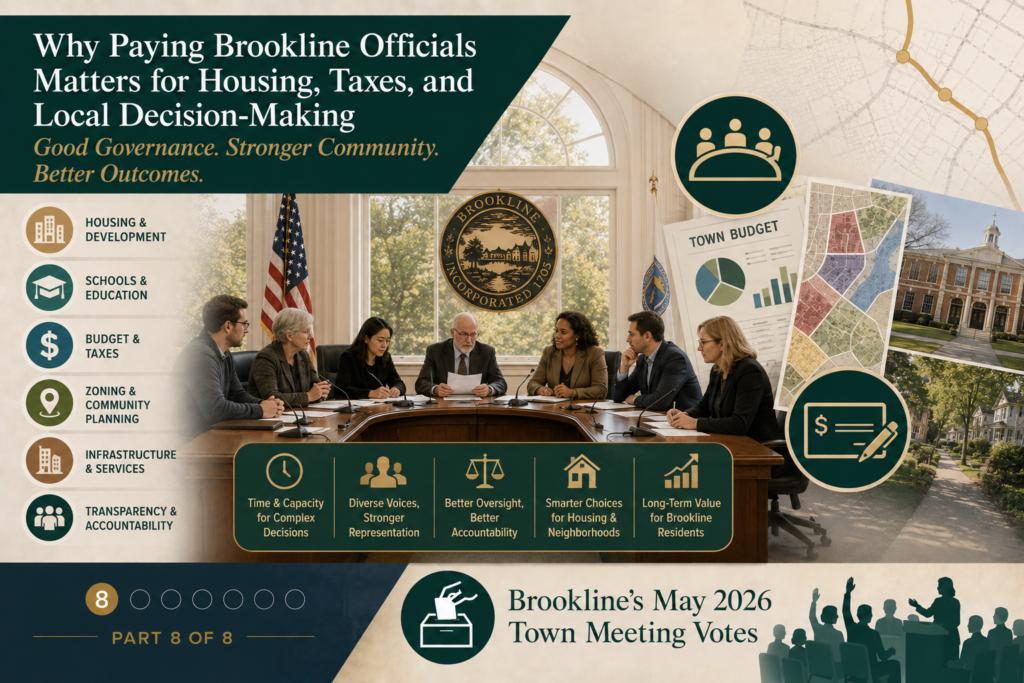
Article 23 is a governance story, but governance is a real estate issue in Brookline. The people who serve on the Select Board and School Committee help shape budgets, taxes, schools, zoning, development, public safety, labor agreements, capital planning, and the civic systems that support property values and quality of life.
If those roles require enormous time commitments but offer little or no compensation, the town has to ask a serious question: who can afford to serve?
That is the core issue behind Article 23.
Related reading: For a broader pricing and inventory backdrop, see our Brookline Real Estate Market Report Q1 2026.
What Article 23 proposed
Brookline’s official materials describe Article 23 as a proposal to introduce stipends for School Committee members and increase stipends for Select Board members.
The original version was much larger. It contemplated eventual stipends of $35,000 for Select Board members and $20,000 for School Committee members, with higher amounts for chairs. During the review process, the petitioners revised the motion to a more modest structure: $4,999 stipends for Select Board members and $4,999 stipends for School Committee members by July 1, 2029.
That $4,999 figure is not random.
The materials explain that stipends of $5,000 or more can trigger eligibility for pension benefits after 10 years of service, creating additional cost uncertainty. The revised proposal was designed to move compensation forward while avoiding new pension obligations.
Brookline’s materials also note that Select Board members currently receive $3,500 per year, with $4,500 for the chair, while School Committee members receive no stipend or compensation for costs such as transportation or caregiving.
Why this is a real estate issue
Local government capacity directly affects real estate.
In Brookline, elected and appointed officials deal with questions such as:
- How much housing should be allowed, and where?
- How should Brookline handle ADUs, inclusionary zoning, and affordable housing?
- How should the town manage property tax overrides and budget pressure?
- What infrastructure should be funded?
- How should schools be staffed and financed?
- What public safety policies should govern town spaces?
- How should the town balance neighborhood character with housing supply?
- What major redevelopment projects should be approved, conditioned, or rejected?
These are not small decisions. They affect home values, rental markets, development feasibility, public services, and long-term confidence in the town. A recent example is Brookline’s Chestnut Hill rezoning approval, where local governance directly shaped future housing supply and tax base.
If the roles are effectively limited to people who can absorb a heavy workload without meaningful compensation, Brookline may narrow the pool of candidates willing and able to serve.
The accessibility argument
The strongest argument for stipends is accessibility.
Serving on the Select Board or School Committee can function like a second job. Members attend meetings, read lengthy packets, respond to residents, handle subcommittee work, engage with staff, review budgets, prepare for hearings, and make decisions under public scrutiny.
People with flexible jobs, retirement income, wealth, family support, or fewer caregiving responsibilities may be more able to serve. People with hourly jobs, demanding careers, young children, elder-care responsibilities, disabilities, or lower incomes may find service impossible.
That matters because housing policy should not be made only by people who can afford to donate large amounts of time.
Tenants, young families, working parents, lower-income residents, and newer residents all have stakes in Brookline’s decisions. A stipend does not guarantee diverse representation, but lack of compensation can be a barrier.
The fiscal caution argument
The counterargument is also real.
Brookline is facing budget pressure. Voters just approved a major operating override. Departments and schools are managing difficult financial constraints. Some residents are worried about property taxes and affordability.
In that context, increasing compensation for elected officials can feel poorly timed.
The Advisory Committee’s discussion reflected this tension. The materials describe the proposal as well-intentioned but also note concerns about budgetary pressure, pension liability, political optics, and whether higher stipends would actually change who runs for office.
This is why the revised proposal matters. It is a smaller step, designed to acknowledge the compensation issue without jumping immediately to large stipends.
Why buyers should care
Buyers often focus on schools, commute, neighborhood, and home condition. But they are also buying into a governing system.
Brookline’s government decides property tax rates, zoning rules, school budgets, capital projects, parking policy, public works, housing regulations, and development review. If the town’s decision-making system is under-resourced or inaccessible, that can affect long-term confidence.
A buyer may not care about stipends directly. But they should care whether Brookline has a government structure capable of making thoughtful decisions about housing, taxes, and services.
Why sellers should care
Sellers benefit when a town is seen as well governed.
Predictability, service quality, strong schools, responsive town departments, and clear land-use decisions all support buyer confidence. When local government struggles, that confidence can erode.
The stipend debate is not a listing talking point, but it is part of the town’s long-term value story. Brookline’s desirability depends not only on location and housing stock, but also on civic capacity.
Why tenants should care
Tenants are often underrepresented in local government, even though town decisions affect them directly.
Zoning, affordability, inspections, schools, public transportation advocacy, public safety, and budget priorities all affect renters. If unpaid or underpaid roles discourage tenants and working residents from running, tenant perspectives may be less visible.
Paying elected officials does not solve representation by itself. But it can lower one barrier.
Why landlords and developers should care
Landlords and developers need predictable, informed, and timely decision-making.
Permitting delays, unclear policy, inconsistent zoning interpretation, and overburdened elected officials create uncertainty. A better-resourced civic structure can improve the quality of debate and the reliability of decision-making.
That does not mean landlords and developers will always get what they want. It means the process may be more professional, accessible, and sustainable.
The Brookline real estate takeaway
Article 23 is not about whether elected officials “deserve a raise” in the abstract.
It is about whether Brookline’s civic model matches the complexity of the decisions the town is asking people to make.
Brookline has expensive housing, a constrained tax base, school pressures, major zoning debates, affordability challenges, infrastructure needs, and major redevelopment decisions. Those issues require time, expertise, preparation, and representative participation.
For Brookline real estate, the message is simple: governance capacity is market infrastructure.
The people making decisions about housing, taxes, schools, and development affect every buyer, seller, tenant, and landlord in Brookline. Paying those people modestly may not solve every problem, but the debate is worth taking seriously.
FAQ
What did Brookline Article 23 propose?
Article 23 proposed introducing stipends for School Committee members and increasing stipends for Select Board members, with the revised motion seeking $4,999 stipends by July 1, 2029.
Why was the revised stipend amount $4,999?
The revised amount was designed to avoid crossing the $5,000 threshold that could trigger pension eligibility and additional cost uncertainty.
How much are Brookline Select Board members currently paid?
Brookline’s Article 23 materials state that Select Board members receive $3,500 per year, with $4,500 for the chair.
Are Brookline School Committee members currently paid?
Brookline’s Article 23 materials state that School Committee members currently receive no stipend.
Why do elected official stipends matter for real estate?
The Select Board and School Committee influence budgets, taxes, schools, services, zoning, and town policy. Those decisions affect property values, rental markets, buyer confidence, and housing affordability.
Related reading: For a closer look at how Brookline policy choices shape the market, read Public Records, Email Archives, and Real Estate Transparency in Brookline and Brookline’s Inclusionary Zoning Change: Why 11 to 19 Unit Projects Matter.