
Brookline’s inclusionary zoning change is easy to misunderstand.
At first glance, Article 15 sounds technical: it changes the unit-count threshold at which a development must provide affordable units on-site rather than making a cash payment to the Affordable Housing Trust.
But this is not just a technical zoning edit.
It is a real estate feasibility story, an affordable housing strategy story, and a neighborhood planning story all at once.
The basic issue: what should Brookline require from smaller multifamily projects?
Brookline’s inclusionary zoning rules require certain developments to contribute to affordable housing. For a related look at how Brookline is handling affordability pressure more broadly, see our analysis of the town’s latest 40B wave. The contribution can happen in different ways. A project can include affordable units on-site, or in some circumstances, the developer can make a cash-in-lieu payment to the Affordable Housing Trust.
Article 15 changes the threshold.
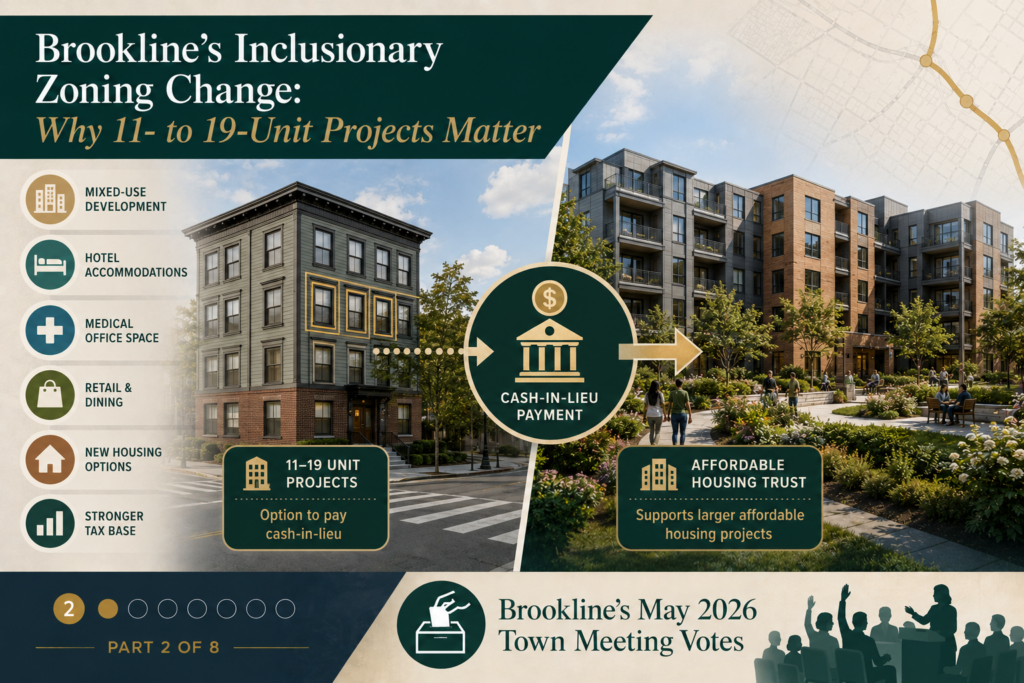
Under the article materials, developments with fewer than 20 units would be allowed to choose between providing affordable units on-site or making a cash payment to the Housing Trust. Before this proposed change, that cash option was generally available only for 4 to 10 unit projects, while 11-unit and larger projects were pushed toward on-site affordable units.
The proposed structure restores an earlier approach: cash payment permitted for 4 to 19 unit projects, with on-site units required at 20 units or more.
In plain English: a new 12-unit, 15-unit, or 19-unit building could choose to be entirely market-rate and make a payment to the Affordable Housing Trust instead of including one or more affordable units inside the building.
Why supporters wanted this change
Supporters framed Article 15 around leverage.
The argument is that small numbers of on-site affordable units can be difficult and inefficient for the town to monitor, especially when they are scattered across smaller buildings. A single affordable unit here and two affordable units there may help, but each one creates administrative work and may not serve households with the deepest affordability needs.
Cash-in-lieu payments, by contrast, can be pooled in the Affordable Housing Trust and used to support larger affordable housing projects. Those projects may be built by the Brookline Housing Authority or other mission-driven affordable housing developers. Local dollars can also help unlock state funding, federal funding, and tax-credit financing.
That is the core pro-Article 15 argument: one dollar in the Affordable Housing Trust may help leverage many more dollars in a dedicated affordable housing project.
The town materials specifically note that trust-fund dollars have been used to help affordable housing developers replace older buildings, create additional affordable units, and access outside funding sources.
Why critics may worry
The tradeoff is equally real.
If a smaller building can choose cash instead of on-site affordable units, the likely result is fewer mixed-income units inside 11 to 19 unit market-rate buildings. Brookline’s own materials acknowledge that where the cash option exists, developers tend to choose it because it is simpler.
That means smaller new buildings may be 100 percent market-rate, even while contributing financially to affordable housing elsewhere.
This is not automatically good or bad. It is a strategic choice.
On-site units integrate affordable housing within market-rate buildings and across neighborhoods. Cash-in-lieu payments can support larger, deeper, and possibly more efficient affordable housing projects. The question is which tool produces more housing benefit in practice.
Why this matters for sellers
For sellers of potential development sites, Article 15 changes the pro forma.
If a site can support between 11 and 19 units, the affordable housing obligation becomes easier to model. Developers may prefer the cash payment because it can reduce design, financing, marketing, monitoring, and compliance complexity.
That can affect land value. Not necessarily dramatically, and not in every case, but a cleaner development pathway can make certain sites more attractive.
This is particularly relevant for owners of underused parcels, older multifamily buildings, small commercial properties with redevelopment potential, and lots where zoning allows a mid-sized project but not a large one.
A seller should not assume that the change automatically increases value. Construction cost, interest rates, zoning, parking, design review, neighborhood opposition, and permitting still matter. But if the inclusionary obligation becomes more predictable, a developer can price risk differently.
Why this matters for buyers
For buyers, the impact depends on what they are buying.
A buyer purchasing a unit in a new 11 to 19 unit building may find that the building has no on-site affordable units because the developer made a cash payment instead. That can affect building composition, association structure, resale narratives, and the broader neighborhood affordability conversation.
A buyer purchasing a development site should pay close attention to whether the project falls below or above the 20-unit threshold. In Brookline, one unit can change the economics.
This also matters for buyers who care about community impact. Some buyers strongly value mixed-income housing. Others may focus more on townwide affordable housing production. Article 15 puts that debate directly into the real estate conversation.
Why this matters for tenants
For tenants, Article 15 is complicated.
On one hand, smaller market-rate buildings may include fewer affordable units on-site. That could reduce the chance that an income-qualified tenant finds an affordable unit in a new smaller building.
On the other hand, if the Affordable Housing Trust uses cash payments effectively, tenants may benefit from larger affordable housing projects, deeper affordability, and more stable long-term units.
The tenant impact will depend on implementation. The key question is not simply whether cash payments are collected. It is whether those funds actually help produce or preserve affordable housing at scale.
Why this matters for landlords and developers
For landlords and developers, Article 15 may reduce friction.
Small numbers of affordable units can be difficult to administer. Income certification, resale or rental restrictions, monitoring requirements, and compliance obligations are more manageable in larger affordable or mixed-income projects than in scattered small buildings.
A cash-in-lieu option does not eliminate the affordable housing contribution. It changes the form of that contribution.
This may make some projects easier to finance and build, especially in a high-cost environment where small multifamily projects already face tight margins.
The Harvard Street / Main Street exception matters
One detail should not be missed: Brookline’s materials indicate that the change does not apply to the Harvard Street / Main Street corridor districts, where on-site affordable units remain required.
That means Article 15 is not a townwide abandonment of on-site affordability. It is a targeted adjustment to the threshold for many smaller projects, while certain planning areas continue to follow separate rules.
The Brookline real estate takeaway
Article 15 is best understood as a shift in affordable housing strategy.
The old question was: should smaller multifamily projects include affordable units on-site?
The new question is: can Brookline get more affordable housing by letting 11 to 19 unit projects pay into the Affordable Housing Trust instead?
For sellers and developers, the change may improve feasibility for certain mid-sized projects. For tenants and affordability advocates, the key issue is accountability: will cash-in-lieu dollars turn into meaningful affordable housing? For buyers, the article adds a new layer to understanding new construction and neighborhood development.
This is exactly the kind of Town Meeting vote that deserves its own real estate article. It is not flashy, but it changes the math behind what gets built.
FAQ
What did Brookline’s Article 15 change?
Article 15 changes Brookline’s inclusionary zoning threshold so that developments with fewer than 20 units may choose between on-site affordable units and a cash-in-lieu payment to the Affordable Housing Trust.
What is a cash-in-lieu payment?
A cash-in-lieu payment is money paid by a developer to support affordable housing instead of providing affordable units inside the project itself.
Does Article 15 eliminate affordable housing requirements?
No. It changes how certain smaller projects may satisfy the requirement. Projects of 20 or more units still face on-site affordable housing requirements, and certain corridor districts have their own rules.
Who benefits from Brookline’s inclusionary zoning change?
Potential beneficiaries include developers of 11- to 19-unit projects, sellers of development sites, and affordable housing developers that may receive more trust-fund support. The tradeoff is fewer on-site affordable units in some smaller market-rate buildings.
How could this affect Brookline real estate values?
It may improve feasibility for some redevelopment sites, but value impact depends on zoning, construction costs, financing, permitting risk, and market demand.