
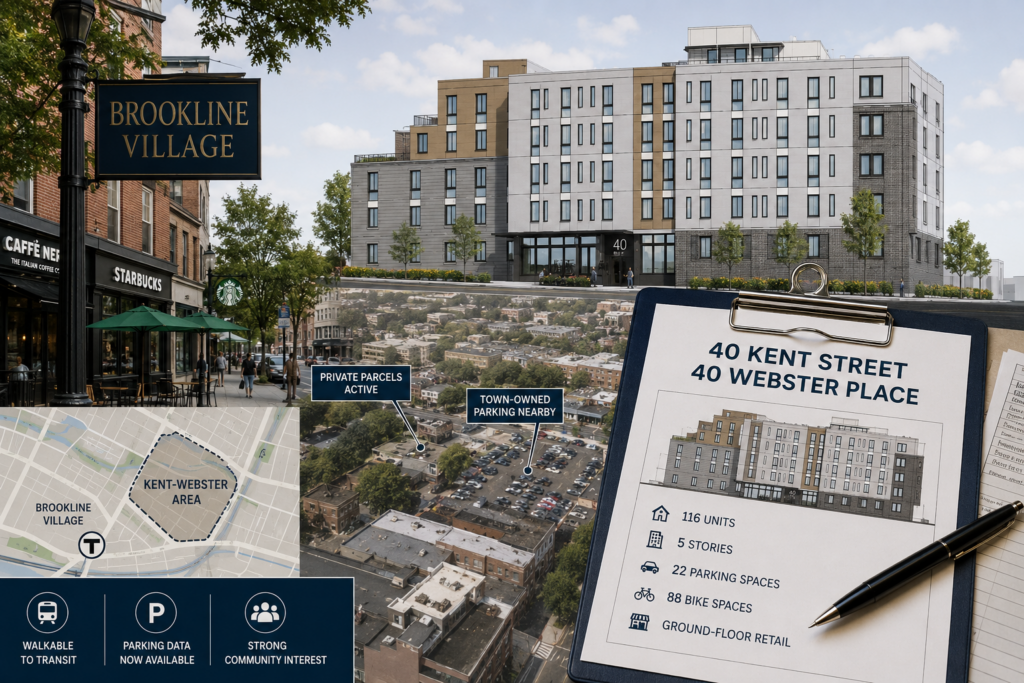
Brookline Village may be the next place where Brookline’s housing debate becomes very real.
The Kent-Webster area, tucked behind the Caffe Nero and Starbucks side of Brookline Village, is emerging as a potential development zone because several forces are converging at once: private parcels are already active, town-owned parking is nearby, the area is close to transit, and the town now has better parking data than it had during earlier development fights.
That combination makes Kent-Webster one of the most important Brookline Village sites to watch.
For the public-site side of the same Brookline Village story, see our Kent-Station senior housing analysis.
What is happening at 40 Kent Street and 40 Webster Place?
The clearest active proposal in this area is the private development at 40 Kent Street and 40 Webster Place.
According to the town’s 40 Kent Street / 40 Webster Place project page, the applicant, DND Homes LLC, is seeking zoning relief for a major impact project and design review in the G-2.0 General Business district.
The proposal has evolved over time. The initial concept contemplated 50 to 69 units in a six-story building with 24 parking spaces and ground-floor retail. A June 2025 revision changed the proposal to 79 units in a five-story structure with 22 parking spaces and 88 bike spaces. A 2026 revision increased the proposed unit count from 79 to 116 by reducing unit sizes.
That makes this more than a theoretical planning conversation. There is already an actual development proposal in the area.
Why Kent-Webster matters
The Kent-Webster area matters because it sits in the heart of Brookline Village, one of the town’s most walkable and transit-served neighborhoods. It is close to the Brookline Village Green Line stop, restaurants, shops, medical uses, civic buildings, and established residential streets.
In a town like Brookline, that kind of location is rare.
It is also politically sensitive. Brookline Village is already dense by Brookline standards. It has narrow streets, historic buildings, curbside loading needs, employee parking demand, resident parking concerns, and a strong neighborhood identity. Any development proposal has to be understood within that physical and political context.
That is why parking is central to the Kent-Webster conversation.
For a deeper look at that constraint, see our Brookline Village parking analysis.
The parking story is more complicated than people think
The most useful insight from the Brookline Village parking study is that the district has both a real parking crunch and hidden parking capacity.
In the Stantec presentation for the Brookline Village Parking and Curb Use Study, the project team said it counted more than 3,000 total parking spaces in Brookline Village, including public and private spaces. Depending on time of day, roughly 700 to 800 spaces are open to the public.
At peak, the broader Brookline Village study area had about 1,200 empty spaces. At the same time, the core — the area where visitors most want to park — was described as functionally full.
That distinction is crucial.
The issue is not simply “Brookline Village has no parking.” The issue is that the most convenient spaces fill up, while other spaces nearby are underused, restricted, confusing, poorly signed, or not integrated into a customer-friendly system.
That matters for Kent-Webster because it gives the town a more sophisticated way to evaluate new development. Instead of asking only whether a project adds or removes a certain number of spaces, Brookline can ask whether the entire district’s parking system is being used intelligently.
Shared parking could change the development math
One of the most important recommendations in the Stantec presentation was to increase parking available to the public by using existing parking differently.
The presentation specifically identified places such as the Brookline Place garage, the lots adjoining Kent Street, and the lot near Goldfish Swim School as potential shared-parking opportunities. The idea is that the town could work with landowners to make private or restricted spaces available to certain users, such as permit holders, rather than building new parking from scratch.
That has direct implications for Kent-Webster.
If Brookline can move long-term parkers out of the most valuable front-door spaces and into shared parking arrangements nearby, the village core becomes more flexible. That could make it easier to support new housing, small businesses, loading zones, short-term customer parking, and pedestrian improvements.
It also reframes parking as a management problem, not only a supply problem.
Why this site is important for housing
The proposed 40 Kent / 40 Webster project is notable because it includes a large number of relatively small units in a highly walkable location. That is exactly the kind of housing Brookline often says it wants more of: smaller homes near transit, shops, restaurants, and services.
Micro-units and smaller apartments can serve several market segments: young professionals, downsizers, graduate students, medical-area workers, people who do not want or need a car, and residents priced out of larger Brookline units.
That does not mean the project should be approved exactly as proposed. Design, preservation, affordability, parking, loading, trash, trees, and neighborhood fit all matter. But the location is fundamentally logical for housing.
What buyers and sellers should watch
For buyers, Kent-Webster is a reminder to study the blocks behind the storefronts. Brookline Village is not static. A condo or home near this area may benefit from future improvements, but buyers should also expect years of planning, hearings, possible construction, and debate.
For sellers, the area’s long-term story may become more attractive if Brookline Village gains new housing, better parking management, improved wayfinding, and stronger commercial vitality. But sellers should be prepared for buyer questions about construction timing, traffic, density, and parking access.
For investors and developers, the Kent-Webster area shows where Brookline may be headed: smaller units, transit-served locations, design review, historic preservation tradeoffs, and parking-management strategies rather than simply adding large amounts of on-site parking.
The bottom line
Kent-Webster is not just a private development site. It is a test of whether Brookline Village can absorb new housing while modernizing how it handles parking.
The old debate was simple: more development means worse parking.
The new data suggests a more complicated reality. Brookline Village’s core is tight, but the broader district has underused capacity. With shared parking, better signage, demand-based pricing, loading zones, employee permit reform, and better wayfinding, Brookline may be able to support more housing without making the village function worse.
That is why Kent-Webster deserves ongoing coverage.
FAQ
What is the Kent-Webster development in Brookline Village?
Kent-Webster refers to the area around Kent Street and Webster Place in Brookline Village, including the active 40 Kent Street / 40 Webster Place proposal for a residential building.
How many units are proposed at 40 Kent Street and 40 Webster Place?
The town’s project page says the proposal was revised in 2026 to increase the number of units from 79 to 116.
Why is parking central to the Kent-Webster debate?
Brookline Village’s core parking spaces are heavily used, but the broader area has underused parking capacity. That makes parking management, shared parking, wayfinding, and pricing central to whether new housing can work.
Why does Kent-Webster matter for Brookline real estate?
It is a transit-served, walkable village-center location where new housing, parking reform, and private development pressure are all converging.
Sources and further reading