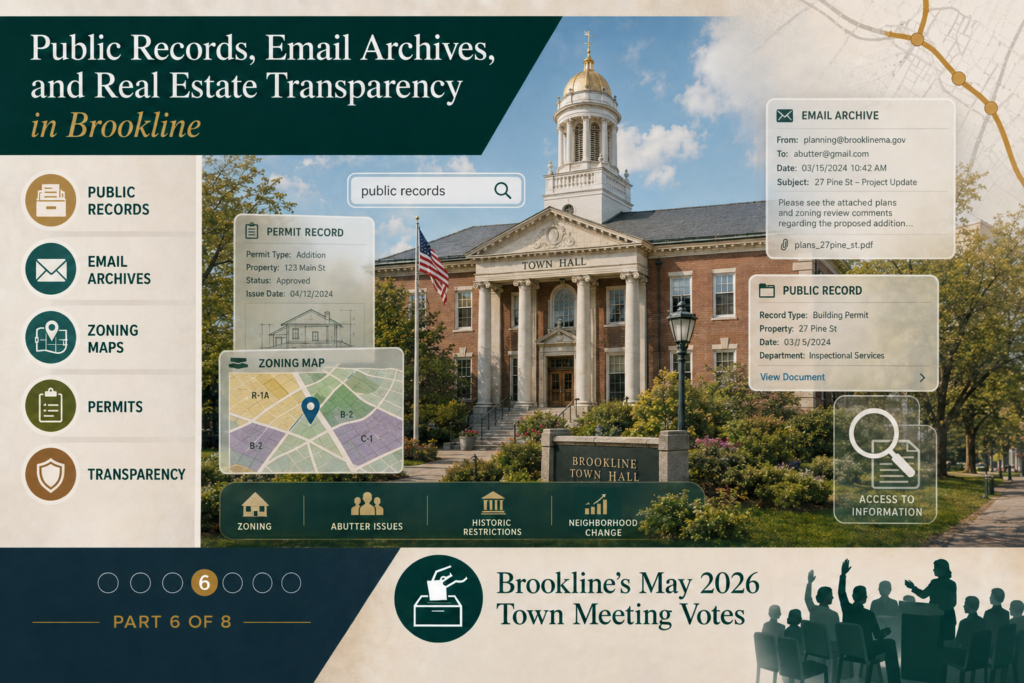
Transparency is not just a good-government issue. Part 6 of our eight-part series on Brookline's May 2026 Town Meeting votes looks at how public records access can shape real estate decisions involving zoning, permits, development, abutter issues, public works, historic restrictions, and neighborhood change.
Transparency is a real estate issue.
That may sound unusual at first. Public records, email archives, and municipal request logs are usually treated as good-government topics. But in Brookline, they also affect buyers, sellers, landlords, tenants, abutters, developers, and anyone trying to understand what is happening around a property.
That is why Articles 12 and 24 belong together in one real estate-focused article.
Related reading: For a companion look at how land-use rules shape permitting and redevelopment, read How Zoning Shapes Brookline Real Estate Development. For a second lens on how town governance affects housing, taxes, and civic confidence, see Why Paying Brookline Officials Matters for Housing, Taxes, and Local Decision-Making.
Article 12: public posting of records requests
At the 2026 Annual Town Meeting, Brookline Town Meeting approved Article 12, 234–0–5. The approved motion would add a general bylaw requiring the town to publish public-records requests and response summaries. Readers should verify the town’s implementation status because post-vote review or administrative work may still be required.
The amended version is important. The original version sought more extensive posting of response materials. The revised version focuses on request information and response summaries instead of requiring the town to post all underlying documents.
Brookline’s official materials explain that the revised approach was intended to satisfy transparency goals while avoiding complications related to redaction, document accessibility, ADA compliance, and staff burden. The materials also describe a 30-day timeline for making requests and responses publicly available on the town website.
The approved motion describes minimum information including the requester name, request date, department, text of the request, response date, responding department, and a brief description of the response, including a list of public records provided.
That is a practical change. It gives the public a window into what information people are asking for and how the town is responding.
Why public records matter in real estate
Public records are one of the most important tools in real estate due diligence.
A buyer may want to know whether a renovation was permitted. A seller may need to resolve whether a finished basement, deck, parking space, or rental unit has proper approvals. A developer may need to understand prior zoning decisions. A neighbor may want to see correspondence related to a proposed project. A tenant may need inspection records, complaints, or enforcement history.
Public records can answer questions such as:
- Was work on the property permitted?
- Did the Zoning Board of Appeals grant a variance or special permit?
- Are there open building, health, or fire issues?
- Has the town received complaints about a property?
- Are there public works projects planned nearby?
- What did town boards consider before approving or denying a project?
- Are there historic preservation restrictions or prior review decisions?
In a town like Brookline, where zoning is complex and neighborhood context matters, access to records can materially affect decision-making.
How Article 12 could affect buyer research
For buyers, a public request log can make research easier.
Instead of filing a new request for every issue, a buyer or buyer’s agent may be able to see whether someone else already requested related records. Even if the full documents are not posted, the request summary can point a buyer toward the right department, topic, or follow-up request.
This is especially useful for properties with complicated histories: older homes, multifamily buildings, condo conversions, former rental properties, homes near major development sites, or buildings with extensive renovations.
A public log does not replace professional due diligence. Buyers still need attorneys, inspectors, lenders, and sometimes zoning professionals. But it can make the process more transparent.
How Article 12 could affect seller preparation
For sellers, transparency can be a double-edged sword.
On the positive side, clearer records can help sellers resolve issues before going to market. If a seller knows there is a permit question, prior enforcement matter, or missing document, they can address it earlier.
Addressing documented issues before marketing can reduce avoidable transaction surprises.
On the other hand, public request logs can make it easier for buyers, journalists, neighbors, or competitors to see what has been requested about a property or issue. Sellers should assume that records questions may become more visible.
The practical response is preparation. Before listing, sellers and their agent should review permits, use history, condo documents, parking rights, zoning status, and known public-record issues.
How transparency affects landlords and tenants
For landlords, public records transparency means property history may be easier to review. That includes inspection records, enforcement matters, permits, and department correspondence.
That can be uncomfortable, but complete and well-documented property records can make due diligence clearer.
For tenants, records access can be especially valuable. Tenants may use public records to understand code enforcement, health inspections, building history, complaints, or town responses to habitability issues. Clear information can help tenants understand property history and enforcement.
Article 24: email archiving for boards and committees
Article 24 addressed a different but related issue: electronic communications by public officials and appointed bodies.
The article asked the Select Board to strengthen existing voluntary guidance that board and commission members copy a town archive email address when conducting official town business. The idea was to improve preservation and accessibility of public records generated through email, including emails sent from personal accounts while conducting town business.
Brookline’s final 2026 Annual Town Meeting record states that no motion was offered under Article 24.
Even though Article 24 did not move forward in the same way as Article 12, the issue remains important.
Why email records matter in real estate
Much of local government happens through meetings, memos, staff reports, agendas, and official decisions. But real estate decisions often also involve email.
Board members may email about zoning proposals. Appointed committee members may exchange information about development studies. Residents may contact officials about traffic, public works, trees, historic concerns, or land-use changes.
Massachusetts electronic-records guidance explains that government email is subject to public-record disclosure, retention, and maintenance requirements unless an exemption applies. The practical problem is retrieval: records scattered across different accounts can be harder to locate and review.
For real estate, that affects trust.
When buyers, sellers, neighbors, or developers ask, “How did the town reach this decision?” the answer should not depend on whether someone remembered to search an old email account.
The Brookline real estate takeaway
The debates around Articles 12 and 24 show that transparency is not just about government process. It is about market confidence.
Real estate works better when information is accessible. Buyers make better decisions. Sellers can prepare more effectively. Landlords and tenants can understand rights and responsibilities. Developers and abutters can evaluate public decisions. Journalists and residents can hold government accountable.
In Brookline, where land-use decisions can materially affect a property, accessible records have practical due-diligence value.
The main takeaway is simple: public records are part of the real estate infrastructure.
FAQ
What did Brookline approve under Article 12?
Town Meeting approved Article 12, 234–0–5. The approved motion would require Brookline to publish public-records requests and response summaries; readers should verify implementation status with the town.
Why do public records matter in Brookline real estate?
Public records can reveal permits, zoning decisions, inspection history, enforcement issues, development correspondence, and public works information that affects property decisions.
Does Article 12 require Brookline to post every document it provides?
The amended version focuses on posting requests and response summaries, not necessarily all underlying response documents.
What was Article 24 about?
Article 24 addressed email archiving for appointed boards and committees. Brookline’s final results state that no motion was offered.
How can buyers use Brookline public records?
Buyers can use public records to research permits, zoning approvals, prior complaints, inspection issues, historic decisions, and nearby public projects.
Related reading: See why Brookline official stipends matter for housing and taxes.



 Sold
Sold