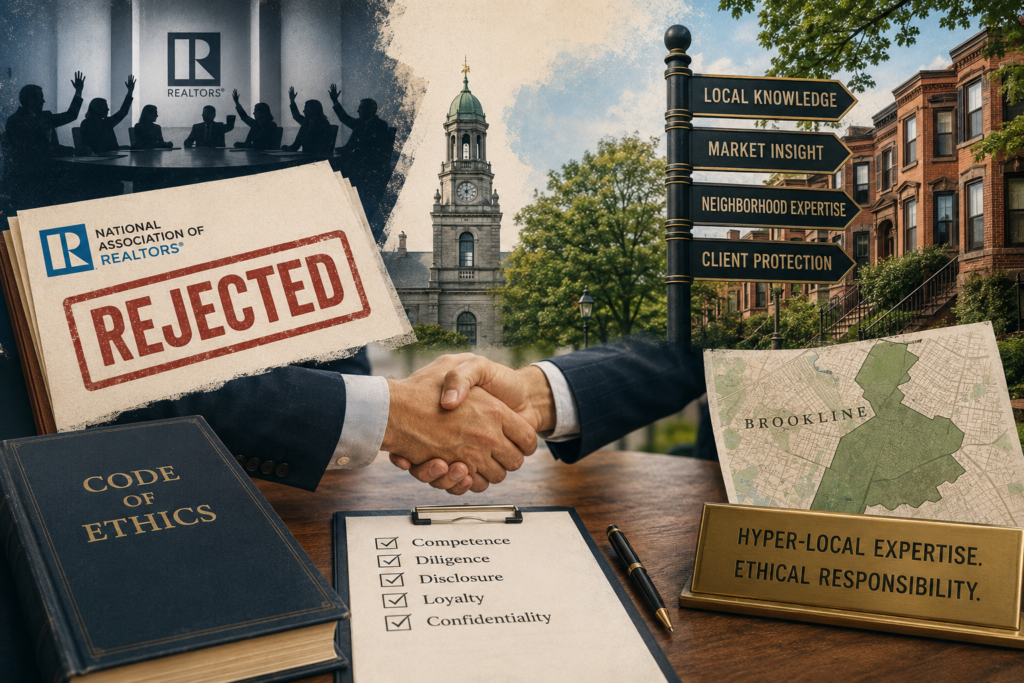
The National Association of REALTORS® recently rejected a proposal that would have required agents to disclose when they lacked experience in a particular market or property type. As someone who has spent nearly two decades serving on the GBAR Professional Standards Committee - I believe the debate missed a more important point.
When the National Association of REALTORS® debated a proposal that would have required agents to disclose when they lacked experience in a particular property type or geographic area, much of the conversation centered on whether another disclosure requirement was really necessary.
The proposal ultimately failed.
Many people viewed that as the end of the discussion.
I don’t.
As someone who has served on the Professional Standards Committee of the Greater Boston Association of REALTORS® for nearly twenty years—including serving as Chair and presiding over ethics hearings—I believe the proposal raised an important question that extends far beyond another piece of paperwork.
The question is simple:
What does it actually mean to be competent enough to represent a client?
The Code of Ethics Already Answers That Question
One misconception surrounding this proposal is that NAR was attempting to create an entirely new ethical obligation.
It wasn’t.
Article 11 of the Code of Ethics has long required REALTORS® to provide services only within their field of competence or to obtain competent assistance and disclose the circumstances to their client.
In other words, the ethical obligation already exists.
The proposed amendment wasn’t creating competence.
It was attempting to make that obligation more explicit when it comes to geographic expertise and specialized property types.
Whether or not that specific language becomes part of the Code someday is almost secondary.
The underlying responsibility has always been there.
Disclosure Doesn’t Create the Duty
Personally, I would welcome a straightforward written disclosure.
Not because I believe a form solves the problem.
It doesn’t.
The obligation exists whether there’s a disclosure form or not.
If an agent accepts an assignment outside their expertise, they still have a professional responsibility to become competent, associate with someone who is, or clearly communicate the limitations of their experience to the client.
A signed document doesn’t create that obligation.
It simply makes the conversation transparent.
And transparency builds trust.
Most Real Estate Mistakes Are Surprisingly Ordinary
When people think about costly real estate mistakes, they often imagine environmental contamination, hidden structural failures, or multimillion-dollar lawsuits.
Those situations certainly exist.
But they are not what most often creates liability.
In my experience, the most common problems arise from something much simpler:
Someone didn’t know what they didn’t know.
A listing agent forgets to schedule the smoke and carbon monoxide inspection before closing.
The closing is delayed.
The buyer’s interest-rate lock expires.
Moving trucks have already been booked.
The seller may now be responsible for hotel costs, storage fees, extension charges, or other damages that could have been avoided with proper planning.
That isn’t dishonesty.
It’s a failure of competence.
The same principle applies throughout a transaction.
Missing a condominium document.
Failing to identify a pending special assessment.
Not understanding Brookline’s local permitting process.
In older housing stock, competence also means recognizing where deeper due diligence matters most. Our guides to hidden structural risk in Brookline’s oldest buildings and Brookline lead-paint compliance show how small oversights can become expensive problems.
Overlooking municipal requirements.
Missing contractual deadlines.
Every item on a transaction checklist exists because, at some point, someone was harmed when it wasn’t handled correctly.
Hyper-Local Knowledge Is Part of Competence
This is especially true in Brookline.
Every community has its own customs and procedures.
Brookline simply has more of them than most.
Our market includes historic districts, unique zoning rules, older condominium associations, complex municipal processes, neighborhood-specific issues, and building histories that rarely appear in MLS remarks.
Some examples have become well known locally.
Questions surrounding the Brook House potential environmental remediation issues.
Structural discussions involving 1080 Beacon Street, and the impact on similar buildings.
School assignment nuances.
Large capital assessments.
These aren’t merely interesting stories.
They’re examples of information that can materially affect a client’s decision-making.
A hyper-local broker doesn’t know these issues because they have a better memory.
They know them because they have spent years working in the same community, attending local meetings, speaking with attorneys, inspectors, lenders, property managers, and fellow agents, and continuously learning from previous transactions.
That knowledge protects clients.
This Isn’t About New Agents
It is important to make one point absolutely clear.
This is not an argument against newer REALTORS®.
Every experienced broker was once new.
The best new agents ask questions, seek mentorship, and surround themselves with experienced professionals.
Likewise, even a twenty-year veteran can find themselves outside their area of expertise if they venture into a different market or property type.
Competence isn’t measured by the number of years you’ve held a license.
It’s measured by whether you’re prepared to protect your client’s interests in the specific transaction you’ve agreed to handle.
The Proposal May Have Failed. The Principle Shouldn’t.
Whether NAR eventually adopts another version of this proposal is ultimately less important than the conversation it started.
Consumers deserve competent representation.
They deserve honest communication.
They deserve an agent who recognizes the limits of their own experience and isn’t afraid to bring in additional expertise when necessary.
That’s not a sign of weakness.
It’s the hallmark of professionalism.
The paperwork may have been rejected.
The ethical obligation was never on the ballot.



 Sold
Sold