
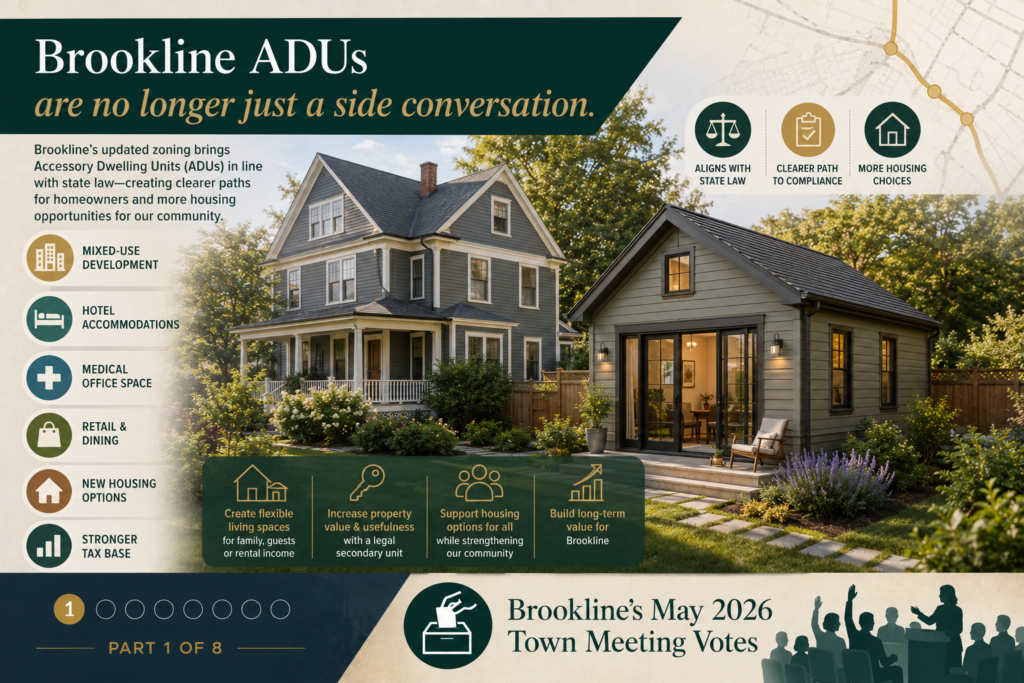
Brookline ADUs are no longer just a side conversation.
For years, accessory dwelling units – usually shortened to ADUs – were treated as a niche possibility in Brookline real estate. A homeowner might ask whether a basement apartment, in-law suite, garage conversion, or small detached unit could be legal. A buyer might wonder whether a property could support a second living space. A landlord might look at a large lot and see untapped potential.
But the answer was often complicated. Zoning, parking, dimensional rules, owner-occupancy expectations, and state law all made the conversation harder than it needed to be.
That is why Brookline’s Article 14 deserves its own real estate article.
The short version: Brookline moved to update its zoning so that qualifying “Protected Use ADUs” are treated consistently with the Massachusetts Affordable Homes Act and state ADU regulations. In plain English, this gives many homeowners a clearer path to adding a small, legal secondary housing unit on a property where single-family use is allowed.
For Brookline real estate, that is a meaningful shift.
What is an ADU?
An accessory dwelling unit is a smaller, independent residential unit located on the same lot as a principal dwelling. It must function as housing, not simply as a guest room or finished basement. That means it has independent sleeping, cooking, and sanitary facilities.
Depending on the property, an ADU might look like a basement apartment, an above-garage unit, an addition, an internal conversion, or a small detached structure. In Brookline, the practical details will still depend on the property, the existing structure, the lot, building code, life-safety requirements, utility capacity, historic considerations, and permitting.
The important real estate point is this: ADU potential is now part of the value conversation.
What Brookline changed
Brookline’s official materials explain that the Massachusetts Attorney General had disapproved substantial portions of the town’s earlier ADU bylaw because of inconsistencies with state law. That left Brookline without a fully settled local framework for regulating Protected Use ADUs and created uncertainty for homeowners who might otherwise begin design or permitting work.
Article 14 was designed to fix that.
The town materials describe several core changes. Qualifying Protected Use ADUs are allowed by right in districts that allow single-family residential use. The local rules remove certain restrictive dimensional, parking, and permitting barriers. Brookline’s materials also note that state law does not allow the town to require owner occupancy or restrict ADUs only to family members.
Several details matter for real estate conversations:
- A Protected Use ADU is limited to the lesser of 900 square feet or 50 percent of the gross floor area of the principal dwelling.
- Brookline cannot require additional off-street parking for a Protected Use ADU.
- An ADU must include independent sleeping, cooking, and sanitary facilities.
- Only one ADU is allowed per lot under the protected-use framework.
- Rentals of fewer than 27 consecutive days are prohibited, which means this is not a short-term rental loophole.
That last point is important. This is a housing policy, not an Airbnb policy.
Why this matters for Brookline sellers
For sellers, ADU potential can become part of a property’s marketing story – but only if it is handled carefully.
A seller should not simply advertise “ADU-ready” because the answer will depend on the specific property. A buyer will still need to verify zoning, layout, egress, ceiling height, fire separation, utilities, structural feasibility, parking logistics, condo or trust restrictions, historic rules, and permitting requirements.
But a property that has a logical ADU pathway can be positioned differently. A large single-family home with a walk-out lower level, a detached garage, or a generous lot may appeal to buyers who want rental income, space for relatives, a caregiver suite, or future flexibility.
The strongest listing language will be measured: “Potential for ADU exploration under Brookline’s updated zoning; buyer to perform due diligence.” That keeps the seller honest while still pointing to a real possibility.
Why this matters for buyers
For buyers, ADU potential should become a due diligence question.
This does not mean every Brookline buyer should buy a home because of ADU potential. Construction costs in Brookline can be high. Permitting and design work can take time. Older homes may need substantial upgrades to support a separate dwelling unit. Some layouts are simply not practical.
But buyers should start asking better questions:
Could the lower level become a legal unit?
Does the lot have room for a detached structure?
Would utilities, egress, and life safety make sense?
Are there historic-district or design-review issues?
Could a future ADU help offset monthly carrying costs?
Would an ADU support aging parents, adult children, a caregiver, or long-term rental income?
The answer will often be “maybe.” In Brookline, even “maybe” can matter, because flexibility is valuable.
Why this matters for landlords and rental housing
For landlords and owner-occupants, ADUs can create long-term rental opportunities at a smaller scale than conventional multifamily development. That matters in a town where housing supply, affordability, and neighborhood character are often in tension.
An ADU will not solve Brookline’s housing shortage. It will not suddenly make Brookline inexpensive. But it can add gentle density without requiring every new home to be a large multifamily project.
For tenants, the effect may be modest but real. More legal small units can create additional rental options for singles, couples, older residents, graduate students, caregivers, and people who want to live in Brookline but do not need a large apartment.
The impact will depend on whether owners actually build. Zoning permission is only one piece. Financing, construction cost, insurance, taxes, building code, and landlord obligations all affect whether an ADU becomes reality.
What this does not mean
The ADU update does not mean every Brookline property can suddenly become a two-unit investment property.
It also does not mean the town has eliminated building permits, safety rules, design standards, or practical constraints. Owners still need to comply with building code and local permitting requirements. The physical reality of the property still matters.
It also does not guarantee a specific increase in property value. Some buyers will pay more for a home with credible ADU potential. Others will not. Appraisers may treat ADU potential differently depending on whether a unit already exists, whether permits are in place, and whether comparable sales support a premium.
The safest statement is this: ADU potential gives a property more optionality. Optionality is valuable, but it is not the same as guaranteed value.
The Brookline real estate takeaway
Brookline’s ADU update is one of the most directly real-estate-relevant Town Meeting stories this year.
For homeowners, it opens a path to more flexible use of existing property. For buyers, it adds a new due diligence category. For sellers, it creates a more nuanced marketing opportunity. For landlords, it may create a legal path to small-scale rental housing. For tenants, it may gradually add more small-unit options.
The best way to think about it is not “ADUs will transform Brookline overnight.” They will not.
The better framing is: Brookline just made housing flexibility easier to understand and easier to plan around. In a high-cost, built-out town, that is a big deal.
FAQ
What is an ADU in Brookline?
An ADU, or accessory dwelling unit, is a smaller independent housing unit on the same lot as a principal dwelling. It has its own sleeping, cooking, and bathroom facilities.
Can Brookline require an ADU owner to live on the property?
For Protected Use ADUs, state law limits Brookline’s ability to require owner occupancy or restrict occupancy to family members.
Can Brookline require extra parking for a Protected Use ADU?
Brookline’s Article 14 materials state that no additional off-street parking can be required for Protected Use ADUs.
Does an ADU automatically increase a Brookline home’s value?
Not automatically. A legal, permitted ADU or credible ADU potential may help value, but the impact depends on the property’s layout, permitting, construction feasibility, rental demand, and comparable sales.
Are Brookline ADUs allowed as short-term rentals?
The Article 14 materials prohibit rentals of fewer than 27 consecutive days for Protected Use ADUs.