
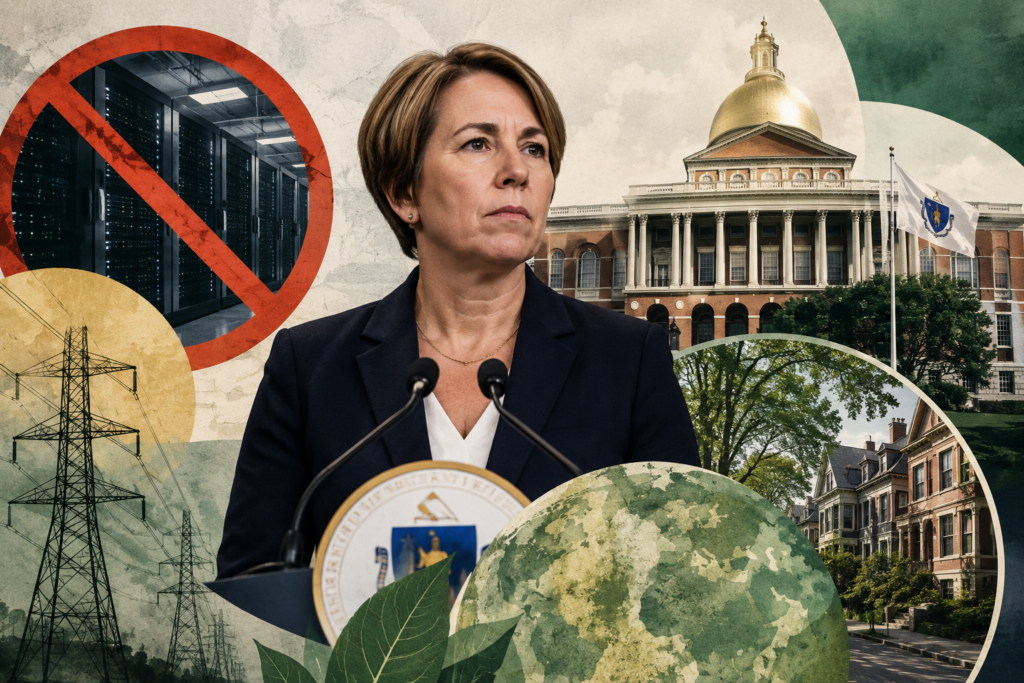
When Massachusetts pauses a 20-year tax incentive program, Brookline real estate stakeholders should pay attention—not because data centers are likely to appear on Harvard Street, but because the state’s new posture on energy-intensive development may shape how other high-load uses, from lab space to digital infrastructure, are evaluated across the metro area. Governor Healey’s decision in June 2026 to halt applications for the qualified data center sales and use tax exemption underscores a shift toward ratepayer protection and decarbonization that resonates with Brookline’s own Climate Action & Resiliency Plan.
What the Pause Covers—and Why It Happened
The exemption, enacted in a 2024 economic development law, was designed to exempt qualifying data centers from the 6.25 percent state sales tax on equipment, software, electricity, and construction costs for 20 years. To qualify, a facility must occupy at least 100,000 square feet, incur at least $50 million in construction and equipment costs, and maintain at least 100 jobs in Massachusetts. Healey’s administration stopped accepting new applications “until stronger protections are in place” for ratepayers, the environment, and public health, citing concerns that large data centers could drive up regional energy demand and costs.
Brookline’s dense, built-out character and high land values make it an unlikely host for campus-scale data centers. But the state’s new expectations framework—requiring future projects to secure 100 percent clean energy supply, pay for grid and water infrastructure impacts, and protect environmental justice communities—may preview how Massachusetts evaluates other energy-heavy proposals, including life sciences facilities or digital infrastructure that could touch Brookline neighborhoods indirectly through utility upgrades or transmission lines.
What Brookline Buyers and Homeowners Should Watch
Buyers near major utility corridors: If data centers or other high-load facilities locate in adjacent municipalities, watch for regional grid reinforcement projects that may affect streetscapes, easements, or utility costs in Brookline homes near transmission routes.
Climate-conscious homeowners: Healey’s emphasis on ratepayer protection and decarbonization aligns with Brookline’s local climate goals, but large energy users elsewhere in the region may still influence your utility bills and the pace of renewable energy deployment statewide.
Investors in mixed-use or commercial properties: The pause signals that Massachusetts is tightening scrutiny of energy-intensive uses, which may slow or reshape proposals for lab conversions, tech campuses, or other high-load tenants in Greater Boston, potentially affecting lease demand and tenant mix in adjacent markets.
Residents engaged in local planning: Brookline’s Climate Action & Resiliency Plan emphasizes regional collaboration; the state’s data center framework offers a case study in how discretionary permitting and infrastructure cost-sharing can be used to manage energy and environmental impacts, lessons that may inform future local debates over zoning, utility planning, or large-scale development proposals.
Regional Grid and Climate Implications
Even though Brookline is unlikely to host a qualifying data center, the town may face indirect effects if large facilities locate nearby. The exemption’s broad scope—covering electricity, equipment, and construction—was designed to attract capital-intensive projects, but Healey’s new requirements that developers fund their own clean energy and infrastructure mitigate some cross-community equity concerns. Still, regional transmission upgrades, substation expansions, or changes in utility rate structures could ripple into Brookline, particularly if multiple data centers cluster in the metro area.
For now, no applications have been certified under the program, giving the administration a relatively clean slate to overlay new guardrails. Brookline stakeholders—especially those active in climate policy and inter-municipal forums—may want to monitor how the state refines its expectations and whether similar frameworks are applied to other high-load uses in the future.
Source: WBUR