
Not every Town Meeting vote should be turned into a property-value headline.
Brookline’s recent debate over civil immigration enforcement, town facilities, police information-sharing, BRIC, fingerprinting, and UASI grants is one of those topics.
The real estate angle is not “will this raise or lower home prices?” That would be the wrong frame.
The better question is: how does community trust affect housing stability?
That is the lens for Articles 17 and 25. For broader context on how Brookline policy shifts affect affordability and day-to-day housing stability, read our analysis of Brookline’s new ADU rules.
What Article 17 was about
Article 17 focused on civil immigration enforcement activities on town property.
Brookline’s official materials describe the proposal as a bylaw that would prohibit federal immigration authorities from using town-owned property as a base for immigration enforcement activities unless they have a judge-signed warrant or court order. The materials specifically refer to town parking lots, parks, schools, police stations, and other public facilities.
The article also addressed nonpublic spaces in public buildings, stating that those spaces would be off-limits to civil immigration enforcement activity without a valid judicial warrant or court order.
This is fundamentally a public-space and public-trust issue.
The town’s materials also show that the debate was not simply pro-immigrant versus anti-immigrant. Several town bodies and officials expressed support for protecting immigrant residents, while also raising questions about legal drafting, enforceability, police procedures, federal preemption, and whether a proclamation or bylaw was the better mechanism.
The Advisory Committee supported referring the subject matter to a Select Board study committee while keeping in place and reaffirming the Select Board’s February 2026 proclamation on civil immigration enforcement.
What Article 25 was about
Article 25 addressed broader collaboration and information-sharing issues involving federal immigration enforcement.
The official materials describe the article as a resolution opposing voluntary cooperation with federal ICE agents and encouraging the town to take several affirmative steps involving public safety programs and procedures with a potential nexus to ICE.
The article discussed the Boston Regional Intelligence Center, known as BRIC, fingerprint-sharing practices, federal civil immigration enforcement, 287(g) cooperation agreements, and Urban Areas Security Initiative, or UASI, grants.
The Advisory Committee materials also show the complexity of the issue. There was strong support for the article’s sentiment and concern for Brookline’s immigrant population. The materials note that nearly one in three Brookline residents is foreign-born. At the same time, Brookline public safety officials raised concerns that withdrawing from BRIC, changing fingerprinting procedures, or leaving UASI grant programs could compromise law enforcement and emergency readiness.
The Advisory Committee supported referral of the subject matter to a Select Board committee to study the issues with participation from relevant town bodies, police, town counsel, and community stakeholders, while reaffirming existing civil immigration enforcement policies.
Why this belongs in a real estate series
Housing is not just buildings. Housing is stability.
People need to feel safe reporting a broken lock, calling the fire department, contacting police, talking to school staff, visiting Town Hall, attending public meetings, and using parks and libraries.
If immigrant residents fear that local public systems are entangled with civil immigration enforcement, they may avoid the very institutions that help keep housing and neighborhoods safe.
That can affect everyone.
A tenant who does not report a housing condition can end up living in unsafe conditions. A neighbor who does not call about a fire hazard may put a building at risk. A parent who avoids school or town services may lose access to support. A resident who does not attend public meetings may be excluded from land-use decisions that affect their home.
That is why community trust is a housing stability issue.
Why tenants are most directly affected
Tenants, especially immigrant tenants and mixed-status households, are often more vulnerable than homeowners.
They may have less control over their housing. They may be more dependent on landlords, public services, school systems, health systems, and local enforcement. They may also be more hesitant to complain about repairs, unsafe conditions, harassment, discrimination, or code violations if they fear exposure to immigration consequences.
A town policy environment that builds trust can make it easier for tenants to report problems early.
That is good for tenants, but it is also good for buildings and neighborhoods.
Why landlords and property managers should care
Landlords should not treat this as someone else’s issue.
Good property management depends on communication. Tenants need to report leaks, pests, heat issues, lock problems, safety concerns, and neighbor conflicts. If tenants are afraid to communicate, small problems become large problems.
Landlords and property managers should also understand that fair housing obligations apply regardless of immigration-related debates. Housing providers should avoid discriminatory screening, harassment, retaliation, or differential treatment based on protected characteristics.
From a practical standpoint, landlords should make it clear that repair requests, safety concerns, and lease communications are handled professionally and without intimidation.
Why buyers and sellers should handle this carefully
Buyers may care about Brookline’s civic values. They may ask whether the town is welcoming, safe, well-governed, and transparent. Sellers may be tempted to turn every local vote into a market talking point.
This topic needs more care.
The right message is not “this will affect home prices.” The right message is that Brookline is actively debating how to balance immigrant protection, public safety, legal authority, emergency readiness, and local governance.
For buyers who value community trust and civic engagement, that may be relevant. For sellers, it is part of the town’s broader identity. But it should not be reduced to a sales pitch.
Why public safety concerns are part of the story
The official materials make clear that public safety officials raised substantive concerns about some proposed actions.
Brookline police leadership argued that BRIC provides criminal intelligence information and shared regional resources. Fire and emergency management leadership raised concerns about losing UASI-funded training, equipment, emergency preparedness programs, and Alert Brookline support.

Those concerns do not erase the immigrant-protection concerns. They explain why the debate moved toward study rather than a simplistic yes-or-no framing.
For real estate, that balance matters. Residents want to feel protected from federal overreach and safe from crime, fire, and emergencies. Both types of safety matter to housing stability.
The Brookline real estate takeaway
Articles 17 and 25 belong in the real estate series, but not because they are classic market stories.
They belong because homes are embedded in communities. A stable housing market depends on trust in public institutions, safe public spaces, responsive landlords, accessible town services, and residents who feel secure enough to participate in civic life.
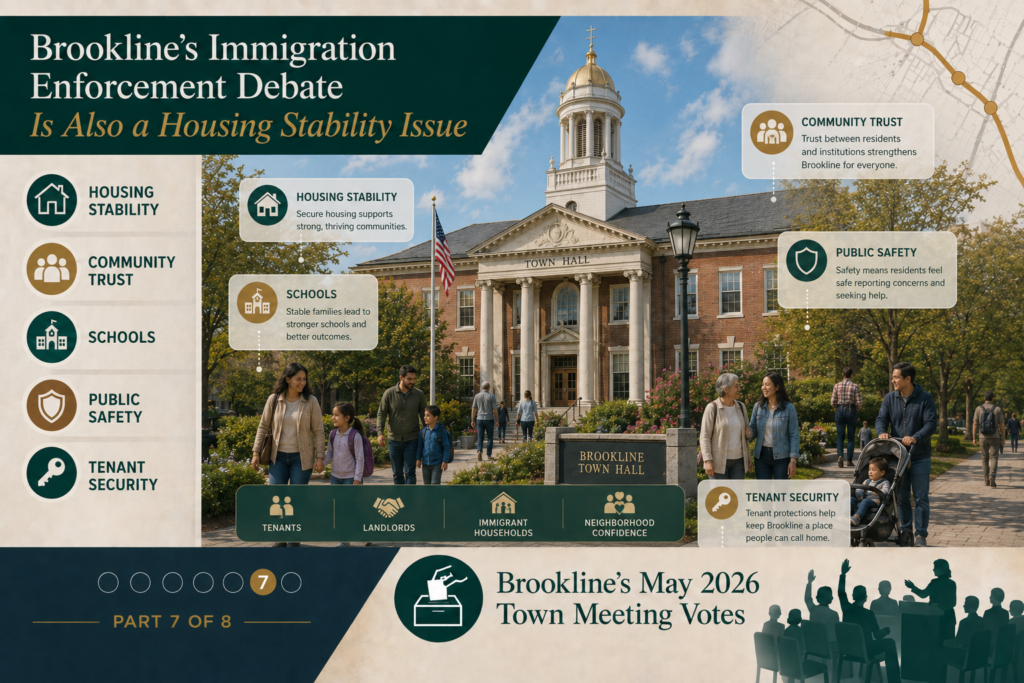
The most responsible framing is this: Brookline’s immigration enforcement debate is about community trust, and community trust is part of housing stability.
FAQ
What was Brookline Article 17 about?
Article 17 addressed civil immigration enforcement activities on town property, including whether town facilities could be used as staging areas, processing locations, or operations bases without a judicial warrant or court order.
What was Brookline Article 25 about?
Article 25 addressed voluntary cooperation and information-sharing connections between local or state public safety systems and federal immigration enforcement, including BRIC, fingerprinting, UASI grants, and related policies.
Why does immigration enforcement matter for housing stability?
Residents who fear public institutions may avoid reporting unsafe housing, calling for help, participating in school or town services, or attending public meetings. That can affect tenants, landlords, and neighborhoods.
Does this directly affect Brookline home values?
This should not be framed as a direct home-value issue. The stronger real estate connection is community trust, tenant stability, public safety, and civic confidence.
Who is most affected by these policies?
Immigrant residents, mixed-status households, tenants, landlords, schools, public safety officials, and community organizations are among the most affected.
Another Brookline policy debate with direct housing consequences for owners, renters, and investors is the current rent-control fight. Read Massachusetts Rent Control Is Off the Ballot, but Brookline’s S.960 Is Still Alive.