Part 3 of our eight-part series on Brookline’s May 2026 Town Meeting votes: the Chestnut Hill redevelopment decision could reshape one of Brookline’s most important commercial corridors, with implications for housing supply, tax revenue, affordability, and nearby real estate.
The biggest Brookline real estate story may not be in Coolidge Corner, Brookline Village, or Washington Square.
It may be on Route 9.
Brookline’s Chestnut Hill Commercial Overlay vote deserves a full standalone article because it is exactly the kind of decision that can reshape how a corridor functions. It involves zoning, commercial space, housing, hotel use, medical office, retail, affordable housing payments, infrastructure, public benefits, and long-term tax-base planning.
That is not a normal neighborhood zoning tweak. It is a real estate strategy.
What is the Chestnut Hill Commercial Overlay?
The Chestnut Hill Commercial Overlay, often shortened to the CHC Overlay, is a zoning framework for parts of the Boylston Street / Route 9 commercial area in Chestnut Hill.
The town’s official materials connect the overlay to long-running planning goals: expanding Brookline’s commercial tax base, encouraging planned redevelopment, improving vibrancy, and creating a better mix of uses in an underutilized corridor.
The key idea is straightforward: Brookline has limited commercial tax-base opportunities. Route 9 is one of the few places where the town can realistically support larger-scale commercial redevelopment without trying to force that intensity into established residential village centers.
That makes the Chestnut Hill corridor unusually important.
What the City Realty proposal includes
The most visible project tied to the overlay is City Realty’s proposed redevelopment of the Chestnut Hill Office Park at 1280-1330 Boylston Street.
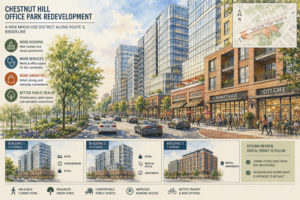
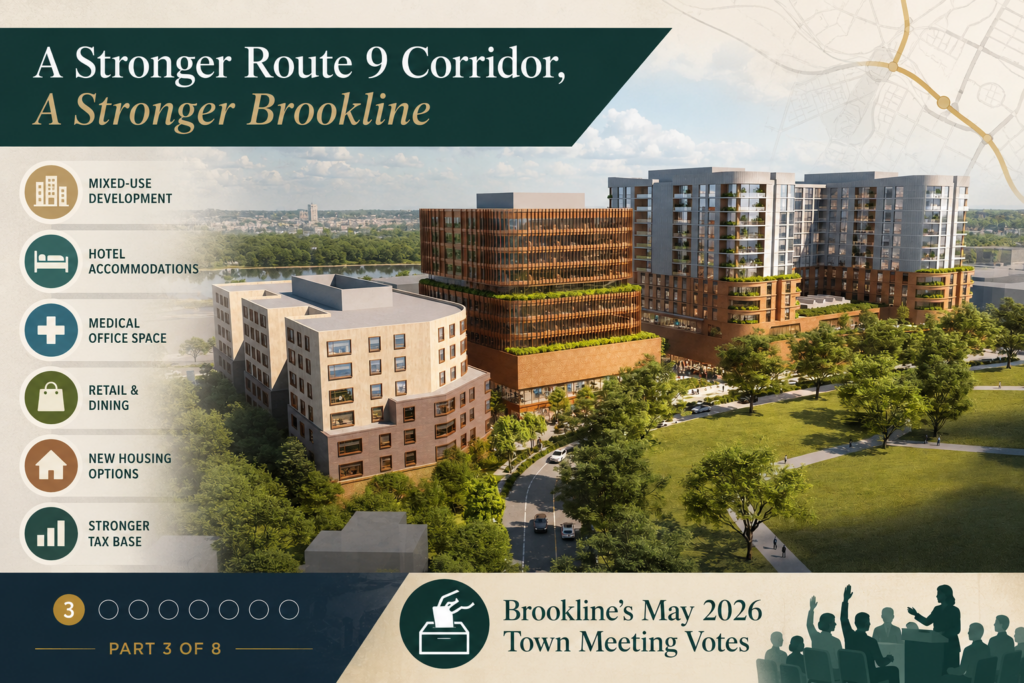
Brookline’s official Special Town Meeting materials describe the site as a 5.3-acre property and the largest redevelopment site along Boylston Street. The proposal includes three buildings: a 14-story building with retail, parking, hotel, and condominiums; a 12-story building with retail, parking, and medical offices; and a 7-story building with rental apartments and parking.
The official materials describe approximately 420,000 square feet of commercial space, including a 200-room hotel, event and conference space, medical office, and retail uses. The proposal also includes 246 residential units, 21 on-site affordable rental units, and a 0.93 million cash-in-lieu payment to Brookline’s Affordable Housing Trust for the luxury condo component.
Those numbers matter because they show what this vote is really about. It is not just “more housing.” It is a mixed-use commercial growth strategy with housing attached.
Why the tax-base story matters
Brookline’s budget pressures are not abstract. The town relies heavily on residential property taxes, and voters recently approved a major operating override. In that context, the Chestnut Hill Commercial Overlay is a direct attempt to grow revenue from commercial uses.
The official materials estimate that the City Realty proposal could generate net new tax growth of roughly .2 million to .3 million per year after accounting for the property’s existing tax contribution. Advisory Committee materials also described an estimated .6 million in net new tax growth and roughly 4 million in mitigation and public benefits, including approximately 1 million for the Affordable Housing Trust, 2 million in infrastructure improvements, and million in other public benefits.
That is why this is a real estate and fiscal-policy story at the same time.
For homeowners, commercial tax-base growth can matter because it may help relieve some pressure on the residential tax base over time. It will not eliminate property tax increases. It will not erase the need for operating overrides. But it can change the long-term revenue mix.
Why the housing story matters
The project also adds housing.
The official materials describe 246 residential units, including condominiums and rental apartments, plus 21 on-site affordable rental units at 50 percent of area median income. In addition, the cash-in-lieu contribution to the Affordable Housing Trust could help fund affordable housing elsewhere in Brookline.
That combination — market-rate housing, on-site affordable units, and trust-fund dollars — gives this project more than one housing impact.
For buyers, new condominium supply in Chestnut Hill could create options in a part of Brookline where large-scale new construction is limited. For renters, new rental apartments may add supply near major retail, medical, and transit-adjacent amenities. For affordable housing advocates, the key question will be how effectively the Affordable Housing Trust uses the contribution.
Why buyers and sellers should watch the corridor
The Route 9 / Chestnut Hill corridor has always been different from Brookline’s more traditional village centers. It is more auto-oriented, more commercial, and more connected to Newton and regional retail patterns.
If the overlay leads to significant redevelopment, nearby properties may be evaluated differently.
Buyers may ask whether the area is becoming more walkable, more amenity-rich, or more urban. Sellers may be able to tell a stronger neighborhood-growth story. Investors may see opportunities around medical office, retail, hospitality, housing, and service businesses.
At the same time, buyers and sellers should be honest about tradeoffs. Larger projects can bring traffic, construction disruption, shadow and scale concerns, and changes to neighborhood feel. The market may reward some of those changes and resist others.
This is why the best real estate advice is not simply “this is good” or “this is bad.” The right framing is: the corridor is becoming more strategic.
Why landlords and commercial owners should care
For landlords and commercial owners, the overlay signals that Brookline wants this corridor to do more economic work.
A hotel, medical office, ground-floor retail, public plaza, and increased residential density can change tenant demand. Nearby retail may benefit from more foot traffic. Medical and service tenants may see a stronger ecosystem. Residential landlords may benefit from improved amenities, though they may also face new competition from modern rental supply.
Commercial property owners should watch how the overlay affects allowed uses, height, density, commercial floor area requirements, and parking assumptions.
What is still uncertain
A zoning vote is not the same as a completed project.
Post-vote coverage from Bisnow reported that the rezoning passed by a 217-20 margin, but the project still faces additional steps, including state environmental review and town special permit review. Timing can change. Design can change. Financing can change. Construction markets can change.
For real estate clients, that means the right approach is to monitor the corridor without assuming every projected benefit happens on schedule.
The Brookline real estate takeaway
The Chestnut Hill Commercial Overlay is the strongest real estate story in the Town Meeting package because it is about Brookline’s future growth model.
Brookline is a built-out town with expensive housing, high service expectations, budget pressure, and limited land. The Chestnut Hill corridor is one of the few places where the town can pursue significant commercial growth, new housing, public benefits, and affordable housing contributions in one package.
For buyers, sellers, landlords, tenants, and investors, the takeaway is simple: Route 9 is no longer just a pass-through corridor. It is becoming a major planning and real estate battleground.
Related reading: For a policy-level companion on affordability and local decision-making, read 32 Marion Street: Brookline’s Affordable Housing Milestone and Why Paying Brookline Officials Matters for Housing, Taxes, and Local Decision-Making.
Update for July 26, 2026: A fresh example of that leasing risk is already visible at 1180 Boylston Street. Read Chestnut Hill Age-Restricted Rental Opens to All Renters for a live look at how premium Route 9 rental assumptions are colliding with actual demand.
FAQ
What is the Chestnut Hill Commercial Overlay in Brookline?
The Chestnut Hill Commercial Overlay is a zoning framework for the Boylston Street / Route 9 commercial area intended to encourage mixed-use redevelopment, commercial tax-base growth, housing, and public benefits.
What is proposed at 1280-1330 Boylston Street?
Brookline’s official materials describe a three-building redevelopment with commercial space, a hotel, medical office, retail, 246 residential units, on-site affordable units, parking, and public benefits.
How many affordable units are included in the Chestnut Hill proposal?
The official materials describe 21 on-site affordable rental units, plus a 0.93 million cash-in-lieu payment to Brookline’s Affordable Housing Trust.
How could the Chestnut Hill project affect Brookline property taxes?
The project could add commercial tax revenue, with official materials estimating millions of dollars in net new annual tax growth. That may help diversify the tax base, but it does not eliminate broader tax and budget pressures.
Is the Chestnut Hill redevelopment already built?
No. Rezoning is a major step, but additional permitting, review, financing, and construction steps remain.



 Sold
Sold