
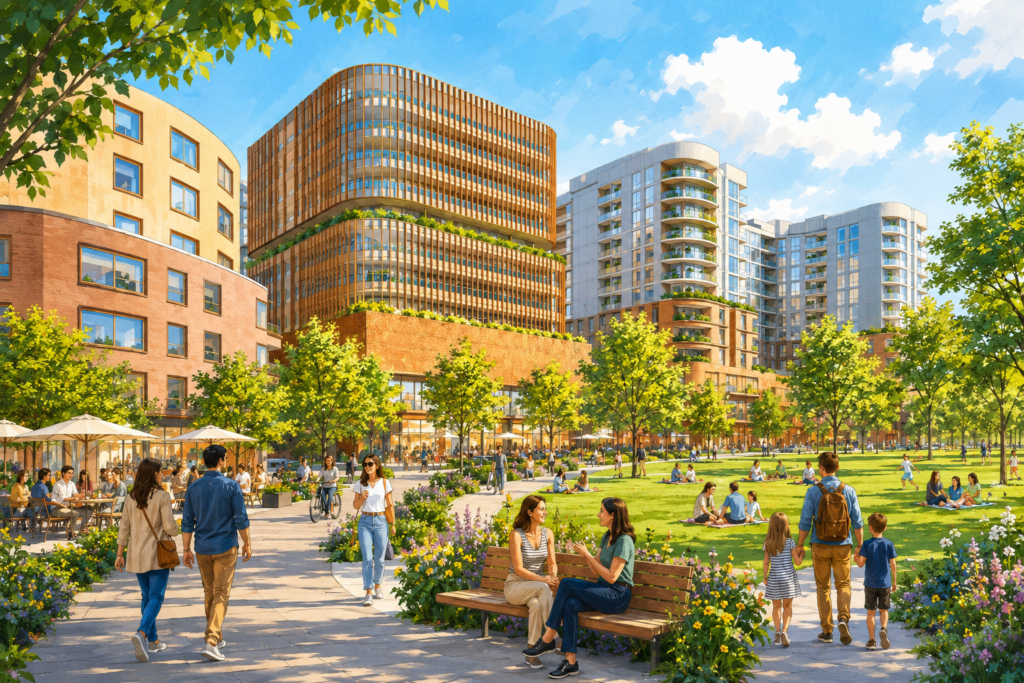
Brookline Town Meeting is expected to vote (today, May 28th) on one of the most consequential redevelopment proposals the town has considered in decades: the rezoning of the Chestnut Hill office park at 1280–1330 Boylston Street.
The site sits along Route 9, near the Newton line, in an area that already functions differently from Brookline’s traditional residential neighborhoods. It is not Coolidge Corner, Washington Square, Fisher Hill, or a side street of single-family homes. It is a commercial corridor with unusually large parcels, direct regional access, and the physical scale to absorb growth that would be far more disruptive elsewhere in town.
That distinction matters.
City Realty’s current proposal calls for three buildings of approximately 14, 12, and seven stories, with a mix of uses that could include a 200-room hotel, 266 apartments and condominiums, medical office space, ground-floor retail, and restaurants. The zoning article requires a two-thirds vote of Town Meeting.
For Brookline homeowners, buyers, sellers, and landlords, the question is not simply whether the buildings are tall. The larger question is whether Brookline is willing to use the few sites where major tax-base expansion is realistic.
Why This Vote Matters After the Override
Brookline recently approved a major property-tax override, making clear that the town’s structural budget issues are no longer theoretical. Brookline residents value excellent schools, public safety, libraries, parks, walkable neighborhoods, and strong municipal services. But those services require revenue.
For decades, Brookline has relied heavily on residential taxpayers. That model becomes more difficult when town costs rise faster than the Proposition 2½ levy limit, especially in a community with limited vacant land and strong resistance to large-scale development.
This is why the Route 9 project matters. Town planners have estimated that the redevelopment could generate roughly $4.2 million to $6.3 million per year in net fiscal impact once built. “Net fiscal impact” means the expected tax revenue minus the anticipated cost of providing town services to the new residents and businesses.
That is not a rounding error. In Brookline fiscal terms, that is meaningful revenue.
No single project will solve Brookline’s long-term budget challenge. But refusing commercial-tax-base growth while continuing to demand high-quality services puts more pressure on homeowners over time.
Route 9 Is Where Brookline Should Be Having This Conversation
Brookline is not a blank slate. Most of the town is already built out, and much of its housing stock sits in established neighborhoods where scale, setbacks, traffic, school capacity, and historic character are legitimate concerns.
But Route 9 is different.
The Chestnut Hill office park is already a commercial site. It is already automobile-oriented. It sits on a major regional roadway, not a narrow residential street. If Brookline is going to allow larger mixed-use development anywhere, this is one of the most logical places to consider it.
That does not mean every detail of the project should be accepted without scrutiny. Height, traffic mitigation, design quality, pedestrian safety, public realm improvements, affordable housing, infrastructure, and construction impacts all matter. Brookline should negotiate hard and demand a high-quality result.
But the threshold question is whether Brookline is willing to let an underutilized commercial site become a more productive part of the town’s tax base.
From a real estate perspective, that question is central.
The Real Estate Impact: Not Just Chestnut Hill
The immediate neighborhood will feel the most direct effects. Buyers near the Route 9 corridor will ask about height, traffic, views, walkability, future retail, and the character of the district. Sellers nearby will need to be prepared to explain the project clearly rather than let uncertainty define the conversation.
But the broader impact reaches across Brookline.
Property taxes affect buyer affordability. Municipal services affect buyer confidence. School quality affects demand. Zoning decisions affect housing supply. Commercial growth affects the long-term tax burden. These are not separate issues. They are all part of the same local real estate ecosystem.
When I analyze Brookline market conditions, including through AI-assisted market research and data review, one pattern is clear: buyers do not evaluate homes in isolation. They evaluate the full package — taxes, schools, neighborhood trajectory, infrastructure, services, walkability, and long-term value.
A major Route 9 redevelopment therefore becomes more than a Chestnut Hill planning issue. It becomes a townwide signal about whether Brookline can adapt its land-use policy to fiscal reality.
The Height Debate Is Real — But It Should Not Be the Only Debate
The most visible objection to the proposal is height. That is understandable. Buildings of 14 and 12 stories would represent a significant change in Brookline’s built environment.
But height should be analyzed in context. A 14-story building on Route 9 is not the same as a 14-story building in the middle of a low-rise residential block. The planning question should be whether the massing, setbacks, transitions, shadows, traffic systems, and public improvements are appropriate for this specific location.
Brookline should not dismiss neighborhood concerns. But it also should not allow height alone to end the conversation before weighing the fiscal, housing, and planning tradeoffs.
Good planning is not simply saying no to scale. Good planning is deciding where scale belongs, what the town receives in return, and how the public interest is protected.
The Risk of Saying No
There is also a strategic risk in rejecting carefully negotiated mixed-use zoning: Brookline may not get a better outcome.
If the town refuses to create a viable path for mixed-use commercial redevelopment, developers may pursue alternatives that are less aligned with Brookline’s goals. A residential-heavy project with less commercial space could create more school and service demand while producing weaker fiscal benefits. A project with less local design control could also leave the town with fewer tools to shape the final result.
That is the land-use tradeoff Brookline has to take seriously.
The choice is not always between development and no development. Often, the real choice is between planned growth, negotiated growth, and reactive growth.
What Buyers, Sellers, and Homeowners Should Watch
For buyers, the vote matters because it may affect the long-term trajectory of Chestnut Hill and the Route 9 corridor. More retail, hotel activity, medical office use, and residential density could change the feel of the area. It could also improve amenities and strengthen the town’s fiscal position.
For sellers, especially in Chestnut Hill and South Brookline, the key is messaging. Some buyers may see redevelopment as a negative. Others may see it as evidence that the area is becoming more dynamic, walkable, and commercially productive. The answer will depend heavily on execution.
For homeowners across Brookline, the fiscal side may be the most important. If the town wants to reduce long-term pressure on residential taxpayers, it needs more revenue from commercial and mixed-use properties. There are only a limited number of locations where that kind of growth is realistic.
For landlords and investors, the project is another reminder that Brookline’s housing and rental market is shaped by more than unit-level supply and demand. Zoning, taxes, municipal finance, and neighborhood perception all influence long-term value.
My Take
Brookline should be careful, demanding, and realistic.
Careful, because a project of this scale must be designed well and managed responsibly.
Demanding, because the town should insist on strong public benefits, attractive architecture, safe circulation, meaningful ground-floor activation, and serious mitigation for neighbors.
Realistic, because Brookline cannot keep approving higher residential taxes while rejecting the kinds of commercial-tax-base opportunities that could help reduce future pressure.
The Route 9 redevelopment vote is not just about one office park. It is about whether Brookline can align its zoning decisions with its fiscal needs, housing needs, and long-term real estate reality.
That is why this vote matters.
Frequently Asked Questions
What is the proposed Route 9 redevelopment project in Brookline?
The proposal would redevelop the office park at 1280–1330 Boylston Street in Chestnut Hill into a mixed-use project with residential units, hotel space, medical offices, retail, restaurants, and public improvements. The project requires zoning approval from Brookline Town Meeting.
Why is the Route 9 redevelopment considered important for Brookline?
The project is significant because it could expand Brookline’s commercial tax base at a time when the town is facing long-term structural budget pressure. Town planners estimate the redevelopment could generate millions of dollars annually in net fiscal impact.
How could the Route 9 project affect Brookline property taxes?
Supporters argue that expanding Brookline’s commercial tax base may help reduce future pressure on residential taxpayers. While one project alone will not solve Brookline’s fiscal challenges, mixed-use commercial redevelopment can diversify town revenue sources.
Will the redevelopment increase housing supply in Brookline?
Yes. Current plans include approximately 266 apartments and condominiums. In a town with limited land and high housing demand, new housing production is a major part of the redevelopment discussion.
Why are some Brookline residents concerned about the project?
Concerns include building height, traffic, neighborhood character, infrastructure strain, construction impacts, and how large-scale development could change the feel of the Chestnut Hill and Route 9 corridor.
Why is Route 9 viewed differently from other Brookline neighborhoods?
Route 9 is already a major commercial corridor with larger parcels, regional traffic access, and existing office development. Many planners and residents view it as one of the few Brookline locations capable of supporting larger mixed-use projects without directly impacting lower-scale residential streets.
How could the project affect Brookline real estate values?
The answer depends on execution. Some buyers may view redevelopment, new retail, and improved amenities positively, while others may focus on traffic or density concerns. In Brookline, property values are often shaped by taxes, schools, walkability, municipal services, and neighborhood trajectory together — not by a single factor alone.
What does “net fiscal impact” mean?
Net fiscal impact refers to the estimated tax revenue generated by a project minus the expected public costs associated with it, including municipal services, infrastructure, and schools.
Could Brookline reject the project entirely?
Yes. The zoning proposal requires approval from two-thirds of Brookline Town Meeting members. Without approval, the current redevelopment plan cannot move forward as proposed.
Why are Brookline zoning decisions important for buyers and sellers?
Brookline zoning decisions influence housing supply, density, commercial activity, tax pressure, neighborhood growth patterns, and long-term investment confidence. Buyers increasingly evaluate not only individual homes, but also the long-term trajectory of the town itself.
Related: Brookline Real Estate Market Update: 5/20/2026-5/27/2026