
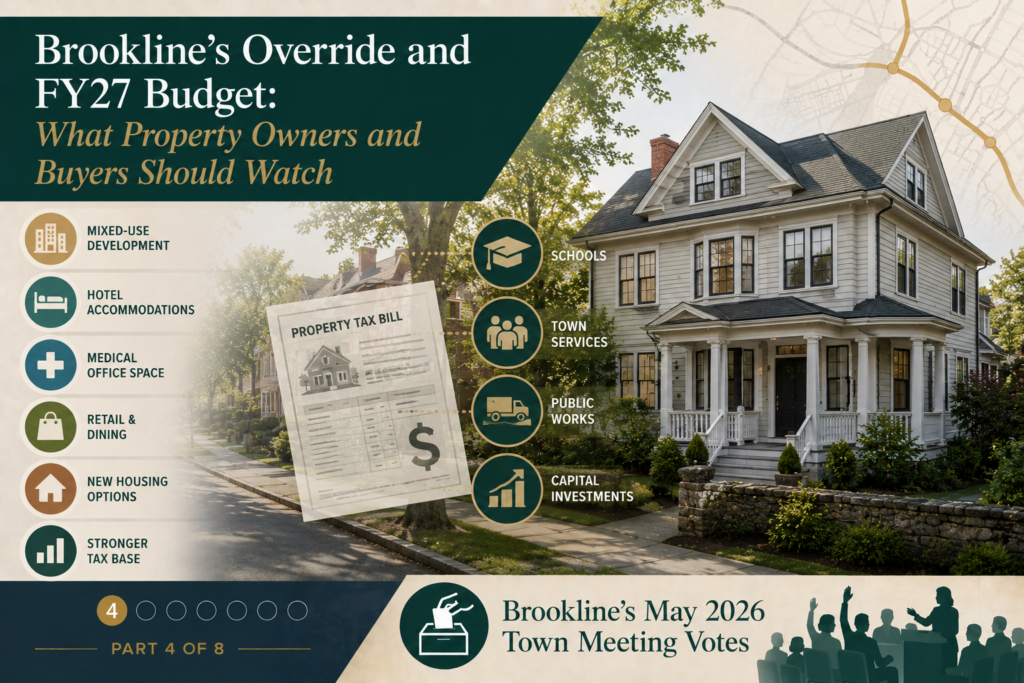
Brookline’s real estate market does not exist apart from Brookline’s budget.
That is the main point buyers, sellers, landlords, and tenants should take from the town’s recent override and FY27 budget votes.
Property taxes are not just a line item. They are part of the cost of ownership. They influence buyer affordability. They affect landlord expenses. They shape how sellers position a home. They also help pay for schools, parks, roads, public safety, libraries, senior services, planning work, and public infrastructure.
That is why the override and budget deserve a standalone real estate article.
Source and analysis note: Vote counts and budget facts below come from official Brookline records. Discussion of buyer, seller, landlord, or tenant behavior is The Bushari Team’s analysis, not a forecast or a property-value conclusion.
What voters approved
On May 5, 2026, Brookline voters approved a major operating override. The official election results show 8,859 yes votes and 5,826 no votes, with 317 blank votes and 35 percent turnout.
Brookline’s Annual Town Meeting materials describe the override as a voluntary increase of roughly $23.25 million to the town’s property-tax levy limit. The materials explain that the amount was expected to be added gradually over three years, with part of the municipal share proposed for an Operating Override Stabilization Fund.
Article 7 addressed that fund.
In plain English: Brookline voters approved a larger property-tax levy to support town and school operations, and Town Meeting approved the mechanism for managing part of the new revenue over the override cycle.
What Article 7 does
According to Brookline’s final results, Town Meeting approved Article 7, 218–24–5. The approved motion creates an Operating Override Stabilization Fund.
The town’s materials explain that this separate fund allows Town Meeting to maintain control over override dollars that are raised before they are spent. The town also identified a bond-rating concern: if money simply sat unappropriated and later became Free Cash, it could create the appearance that Brookline was using Free Cash to cover operating costs.
For most homeowners, that detail may sound procedural. But it matters because it shows how Brookline is trying to manage the optics and mechanics of a large override.
The important takeaway is not just “taxes are going up.” The more accurate takeaway is that Brookline is managing a multi-year operating plan funded by an approved levy-limit increase.
Why Article 8 matters
Article 8 is the annual budget appropriation article. It funds operating expenses, debt, departments, schools, capital needs, and enterprise-fund activity. Brookline’s final results report that Town Meeting approved Article 8, 237–1–3.
For Brookline real estate, the budget is where abstract tax dollars become visible public services.
Street rehabilitation, sidewalk work, building maintenance, energy improvements, school funding, parks, recreation facilities, public safety staffing, and town operations all affect how it feels to live in Brookline. They also affect how buyers compare Brookline with Newton, Boston, Cambridge, Somerville, Needham, Wellesley, and other nearby communities.
Town budgets fund public services, and budget changes can alter service levels and carrying costs. This article does not measure a resulting effect on real estate demand or value.
Why buyers should care
For buyers, the key concept is monthly carrying cost.
A Brookline home is not affordable or unaffordable based only on the purchase price. Buyers need to evaluate mortgage payment, interest rate, insurance, condo fee, maintenance, utilities, and property taxes. A higher tax bill changes the monthly number.
That can affect purchasing power.
A buyer who can afford a certain price at one tax level may need to adjust expectations if the annual tax bill rises. This is especially important for first-time buyers, move-up buyers, and buyers comparing Brookline to nearby communities.
Buyers may weigh public schools, parks, libraries, public safety, walkability, and municipal services alongside carrying costs. This article does not quantify how the override affects buyer demand or property value.
The buyer question is not simply “Are taxes high?”
The better question is: “What am I getting for the full carrying cost?”
Why sellers should care
For sellers, property taxes can influence buyer budgeting and property comparisons.
A listing with a higher tax bill may prompt questions about carrying costs. Sellers and agents should provide accurate tax information and discuss documented property features, location, updates, walkability, transit access, municipal services, and current market context.
The goal is not to hide the tax bill. The goal is to contextualize it.
Buyers are not only buying square footage. They are buying into a town system. If that system is strong, it should be part of the listing narrative.
Higher carrying costs may matter more to households with tighter monthly budgets. The effect is property-specific and is not quantified here.
Why landlords should care
For landlords, property taxes are part of operating expense.
Higher taxes can reduce net operating income unless rents increase or other costs are controlled. But rent increases depend on market conditions, lease terms, unit condition, operating costs, and legal requirements.
Landlords should model tax increases rather than react to them after the fact. That is especially true for small landlords who own two or three family properties, condos used as rentals, or older buildings with rising maintenance costs.
A strong Brookline rental market may absorb some cost pressure, but not every cost can be passed through immediately or fully.
Why tenants should care
Tenants do not receive the property tax bill directly, but they are not unaffected.
Landlord expenses can influence rent levels over time. Municipal budgets also affect the services tenants use every day: schools, libraries, snow removal, streets, parks, public safety, trash systems, planning, inspections, and tenant-facing local government.
For tenants, the override is part of the broader affordability conversation. A town can be high-service and expensive at the same time. Brookline is trying to sustain service levels, but the cost is part of the local housing burden.
The fixed-income homeowner issue
One of the most important real estate implications is for homeowners on fixed or limited incomes.
A tax increase that seems manageable to one household can be painful to another. Older homeowners, long-time residents, and people with limited income growth may feel the effect most acutely.
This is a key part of Brookline’s housing stability conversation. Affordability is not only about renters or first-time buyers. It also includes residents who already own homes but may struggle with rising carrying costs.
The Brookline real estate takeaway
The override and FY27 budget are not separate from the real estate market. They are part of it.
Higher taxes increase carrying costs. Buyers may also consider public services and infrastructure. The net effect on demand or property value is not measured in this article.
Buyers and owners may consider schools, walkability, amenities, services, and civic infrastructure alongside taxes and other carrying costs. The override makes that tradeoff visible.
The practical advice is simple: buyers should model the full monthly cost, sellers should present accurate tax and property information, landlords should update operating assumptions, and tenants should understand that town finance can affect housing costs indirectly.
FAQ
Did Brookline voters approve the 2026 override?
Yes. Official election results show the override passed with 8,859 yes votes and 5,826 no votes.
How much was the Brookline override?
Brookline’s official Town Meeting materials describe the override as a voluntary increase of roughly $23.25 million to the town’s property tax levy limit.
What is the Operating Override Stabilization Fund?
It is a fund designed to hold certain override revenues separately so Town Meeting can control future appropriations and avoid having unused funds fall into Free Cash.
How does the override affect Brookline real estate?
It affects property taxes and carrying costs and helps fund schools, services, infrastructure, and other municipal operations described in the budget.
Should buyers be worried about Brookline property taxes?
Buyers should not ignore property taxes. They should model the full monthly carrying cost and compare it to the services, location, schools, and amenities they value.