A $193,500 CPA-funded project at Harvard and Pierce Streets shows how a relatively small public-space investment can improve comfort, climate resilience and the pedestrian experience.
Not every important real estate story is a new building.
Sometimes it is the space between buildings.
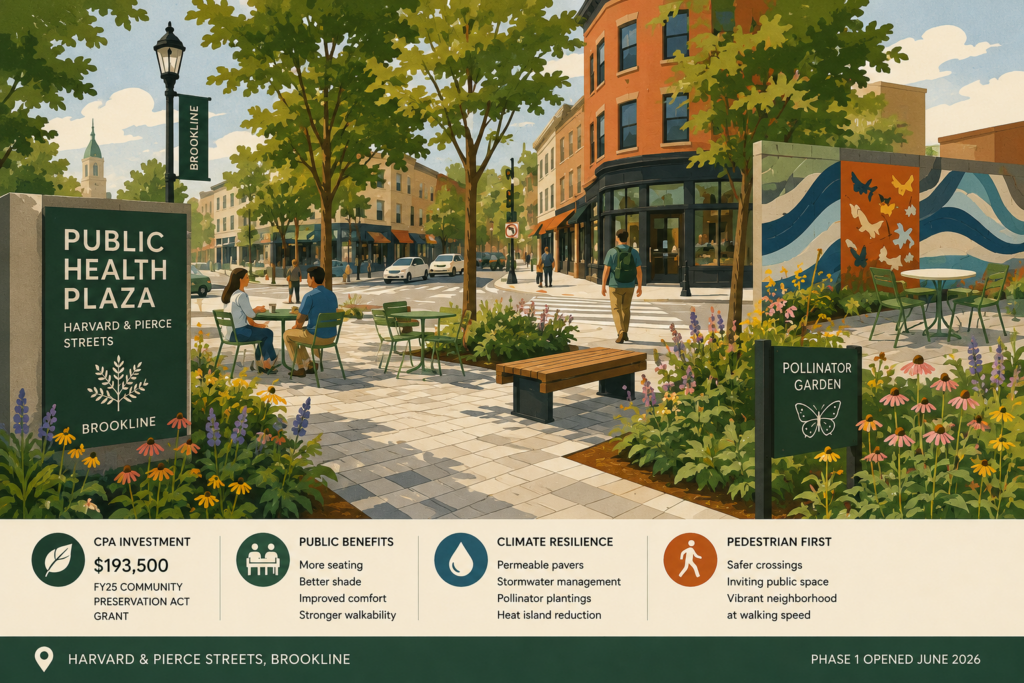
Brookline’s new Public Health Plaza, at the corner of Harvard and Pierce Streets, transformed an underused lawn and heat-island area into a small public space with seating, permeable pavers, new plantings, public art and a pollinator garden.
The first phase opened in June 2026. The project was funded by a $193,500 fiscal year 2025 Community Preservation Act grant.
That is modest compared with the cost of a school, park reconstruction or affordable-housing development. But small public-realm projects can have an outsized effect on how a neighborhood feels at walking speed.
What the project adds
The Town’s project materials describe:
- a new seat wall and updated site furnishings;
- permeable pavers to improve stormwater storage;
- new trees and other plantings;
- a community-planted pollinator garden;
- a wrap for an existing utility box;
- a planned dragonfly sculpture; and
- space that can support Town and community programming.
The plaza sits next to the Garden of Remembrance and is intended to serve as a gateway into the Brookline Village business district.
Each element is small. Together, they turn a pass-through corner into a place where someone can pause.
Why pause space matters
Commercial districts depend on more than storefronts and parking.
They need sidewalks and public spaces that make walking comfortable. Seating can help an older resident rest, give a caregiver room to pause with a child, or allow someone to wait outside a nearby appointment. Shade and plantings can soften a hardscape-heavy block. Public art can make a corner more recognizable.
None of these improvements guarantees stronger retail or higher property values.
But they support the conditions that make a district more usable: foot traffic, comfort, identity and reasons to remain in the area rather than move through it as quickly as possible.
The climate-resilience value is practical
The Town described the former site as both underused and a heat island. The redesign introduces vegetation and permeable surfaces, with future enhancements potentially adding more shade, native plantings, accessibility and ecological benefits.
For Brookline property owners, the stormwater component is especially relevant.
Permeable surfaces can help slow and store runoff where rain falls. One small plaza will not solve a neighborhood’s flooding risk, but it demonstrates how public-space design can combine everyday use with environmental function.
That approach is increasingly important in an older, densely developed community where large new open spaces are difficult to create.
The Community Preservation Act connection
Brookline’s Community Preservation Act program is funded in part through a surcharge on local property taxes. The money supports community housing, historic preservation, open space and recreation.
Because the surcharge appears on tax bills, owners may understandably ask what it produces.
The Public Health Plaza offers a visible answer. CPA funding did not simply maintain an existing lawn. It changed the function of the site by adding seating, ecological features, stormwater capacity and a clearer connection to the business district.
The right test is not whether every taxpayer uses the plaza every day. It is whether the project creates a durable public benefit aligned with the program’s purpose.
A useful comparison with larger park work
Brookline is also completing major investments at places such as Amory Playground and Hall’s Pond. Those projects involve larger landscapes, heavier infrastructure and a broader recreational role.
The Public Health Plaza is different.
Its value is fine-grained. It improves a particular corner, fills a gap in the pedestrian network and adds a small amount of functional green space in a built-up village center.
Healthy neighborhoods need both scales of investment:
- large parks and sanctuaries that serve as destinations; and
- small plazas, benches, trees and crossings that improve ordinary daily movement.
What buyers and sellers should take from it
The plaza should not be used as a shortcut to claim that every nearby home is now worth more. Real estate pricing depends on the specific property, current market conditions and many other factors.
It does, however, illustrate an important form of micro-location due diligence.
Buyers should look at:
- recent and planned public projects within a short walk;
- whether improvements are funded or merely proposed;
- construction timing;
- accessibility and seating;
- shade and stormwater design;
- how a public space connects to shops, transit and civic buildings; and
- whether programming will make the space active at useful times.
Sellers can explain these improvements accurately without overstating their effect. The strongest neighborhood marketing connects a public project to daily life: where someone can sit, walk, meet, shop or reach services.
What happens next
Phase 1 opened with a community planting and ribbon cutting on June 16, 2026. The Town’s announcement said it was still exploring future enhancements, including additional accessibility, shade, native plantings and ecological benefits. The planned dragonfly sculpture was intended to complete the space alongside the Garden of Remembrance.
As the landscaping matures, the real test will be use.
Does the plaza remain comfortable in summer? Are the plantings maintained? Does it become a natural gateway into Brookline Village? Do people choose to stop there?
Those outcomes matter more than the opening-day photograph.
The bottom line
The Public Health Plaza is a small project with a clear lesson.
Neighborhood quality is built incrementally. A seat wall, permeable paving, native plants, shade and a welcoming corner may not look transformational on a capital plan. In daily life, those details can determine whether a village center feels merely functional or genuinely inviting.
Related reading: Amory Playground’s Renovation Shows How Brookline Protects Property Values Through Public Investment
Primary sources



 Sold
Sold