
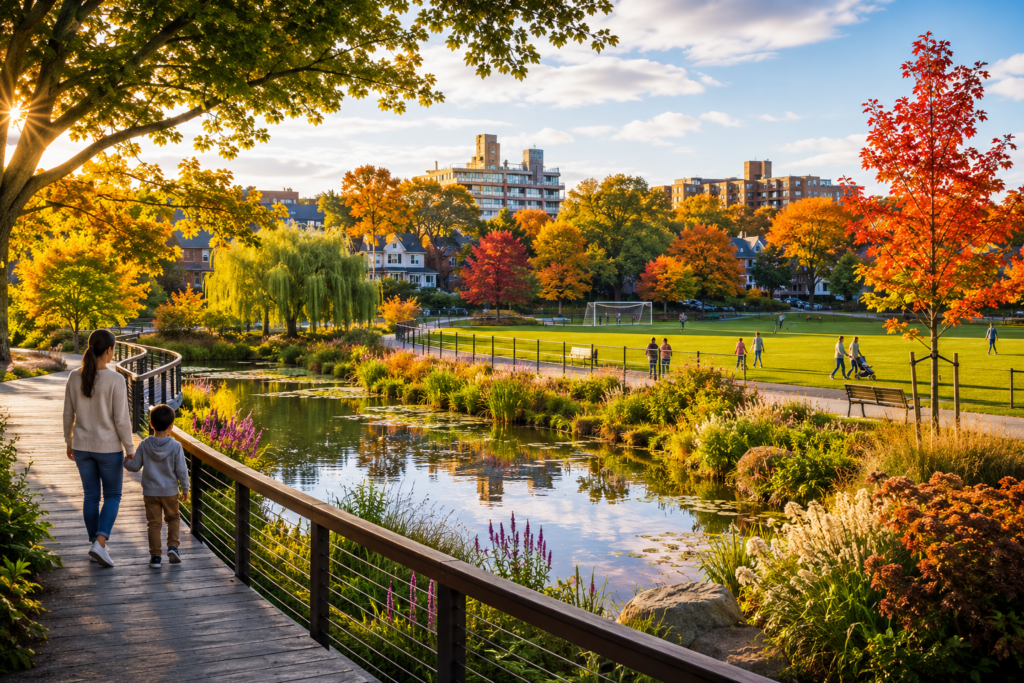
Brookline Is Rebuilding More Than a Playground
For many Brookline residents, Amory Playground is simply a neighborhood park. It’s where children play, tennis players compete, dog owners gather, and residents pass through on their way to Hall’s Pond or Coolidge Corner.
Today, much of that space is hidden behind construction fencing.
The Town of Brookline is in the middle of a substantial renovation project that includes rebuilding tennis courts, redesigning entrances, improving accessibility, replacing aging boardwalks, upgrading drainage systems, renovating facilities, and restoring portions of the surrounding landscape.
At first glance, it may seem like a routine parks project.
In reality, the Amory Playground renovation reveals something important about how Brookline maintains its position as one of Greater Boston’s most desirable housing markets.
The project is not merely about recreation. It is an investment in neighborhood quality, environmental resilience, accessibility, and the public spaces that make Brookline neighborhoods attractive to buyers, renters, and homeowners.
In a community where median home values exceed $1 million and competition for housing remains intense, investments like this help explain why demand remains strong even during slower housing cycles.
Why Amory Playground Matters
Location matters in real estate.
But what makes a location desirable often extends beyond the home itself.
Amory Playground sits in one of Brookline’s most connected and heavily used areas, serving residents from:
- Coolidge Corner
- Cottage Farm
- The Longwood Medical Area
- Hall’s Pond Sanctuary
- Nearby condominium communities
- Residents throughout Brookline
Unlike many neighborhood parks that primarily serve local residents, Amory functions as both a recreational destination and an important connector between residential neighborhoods and natural spaces.
The park’s tennis courts attract players from across the region. Hall’s Pond draws birdwatchers, walkers, photographers, and nature enthusiasts. Nearby pathways provide access to one of Brookline’s most unique environmental resources.
For thousands of residents, the area contributes directly to everyday quality of life.
And quality of life is one of the strongest drivers of housing demand.
The Hidden Infrastructure Buyers Rarely Notice
Most buyers touring Brookline properties focus on schools, square footage, kitchens, and proximity to transit.
Few ask about boardwalk conditions.
Yet many of the improvements happening at Amory address exactly the type of infrastructure that quietly influences neighborhood desirability over decades.
The project includes:
- Reconstruction of tennis courts
- Accessibility improvements throughout the site
- Parking and circulation upgrades
- Comfort station renovations
- Drainage improvements
- Irrigation upgrades
- Landscape restoration
- Hall’s Pond boardwalk rehabilitation
- Complete replacement of the Amory Woods boardwalk
These investments are not flashy.
But they are precisely the kind of maintenance that prevents public spaces from deteriorating over time.
One of the most common characteristics of highly desirable communities is not that they build constantly.
It is that they maintain relentlessly.
Brookline has historically invested heavily in schools, parks, public facilities, transportation infrastructure, and environmental resources. Amory Playground represents another example of that long-term strategy.
Hall’s Pond: One of Brookline’s Hidden Gems
Perhaps the most interesting aspect of the project is its connection to Hall’s Pond Sanctuary.
Many Greater Boston residents have never heard of Hall’s Pond despite its location just minutes from Coolidge Corner.
The sanctuary offers a rare combination of wetlands, wildlife habitat, walking paths, educational opportunities, and natural beauty within a dense urban environment.
For nearby residents, it functions almost like a private retreat hidden inside the town.
These natural assets rarely appear in market statistics.
Yet they often influence purchasing decisions.
When buyers evaluate two similar neighborhoods, access to attractive parks, conservation land, walking trails, and recreational amenities frequently becomes a deciding factor.
Hall’s Pond helps distinguish Brookline from many competing communities by offering immediate access to nature without sacrificing urban convenience.
Protecting that resource helps preserve one of the area’s unique advantages.
Accessibility Is Becoming a Major Real Estate Trend
One overlooked component of the renovation is accessibility.
The replacement and elevation of boardwalk systems, pathway improvements, and infrastructure upgrades are designed to improve access for a broader range of users.
Historically, accessibility improvements were often viewed primarily through a compliance lens.
Today, they increasingly influence how communities are evaluated by residents of all ages.
Young families with strollers, older adults, residents with mobility challenges, and visitors all benefit from improved accessibility.
As Brookline’s population continues to age while attracting new families, investments that improve usability for multiple generations become increasingly valuable.
The strongest communities are often those that work well for residents at every stage of life.
Climate Resilience Is Now Part of Community Planning
The boardwalk replacement and drainage improvements also reflect another important trend.
Climate resilience has become a significant consideration in municipal planning.
More intense rainfall events, changing weather patterns, and environmental stressors have forced communities throughout Massachusetts to rethink infrastructure design.
The elevated boardwalks and drainage improvements at Amory are not simply maintenance projects.
They are examples of how local governments are adapting public infrastructure to future conditions rather than merely replacing what existed before.
For homeowners, this matters.
Communities that proactively address infrastructure challenges often position themselves more favorably than communities that defer maintenance until problems become emergencies.
What This Means for Brookline Real Estate
The Amory Playground renovation will not directly increase home prices.
No single project does.
But projects like this contribute to something more important: the overall desirability of the community.
When buyers choose Brookline, they are not purchasing only a house.
They are purchasing access to:
- High-performing schools
- Walkable neighborhoods
- Public transportation
- Parks and recreation
- Environmental amenities
- Community services
- Civic investment
Every time Brookline reinvests in those assets, it strengthens the foundation supporting long-term housing demand.
This helps explain why Brookline often remains resilient even when national housing trends weaken.
The town’s value proposition extends beyond the housing stock itself.
It includes the public infrastructure surrounding it.
The Bigger Lesson
National housing headlines often focus on mortgage rates, inventory levels, affordability challenges, and sales volume.
Those factors matter.
But local quality of life remains one of the strongest drivers of long-term housing demand.
The Amory Playground project is a reminder that real estate values are influenced not only by private investment but also by public investment.
Well-maintained parks, accessible pathways, environmental stewardship, recreational facilities, and thoughtful infrastructure planning all contribute to the experience of living in a community.
Brookline’s willingness to continually reinvest in those assets is one reason the town remains among the most sought-after places to live in Massachusetts.
When the fences come down and the project is complete, residents will gain more than improved tennis courts and new boardwalks.
They will gain another example of how long-term community investment helps preserve what makes Brookline special.