
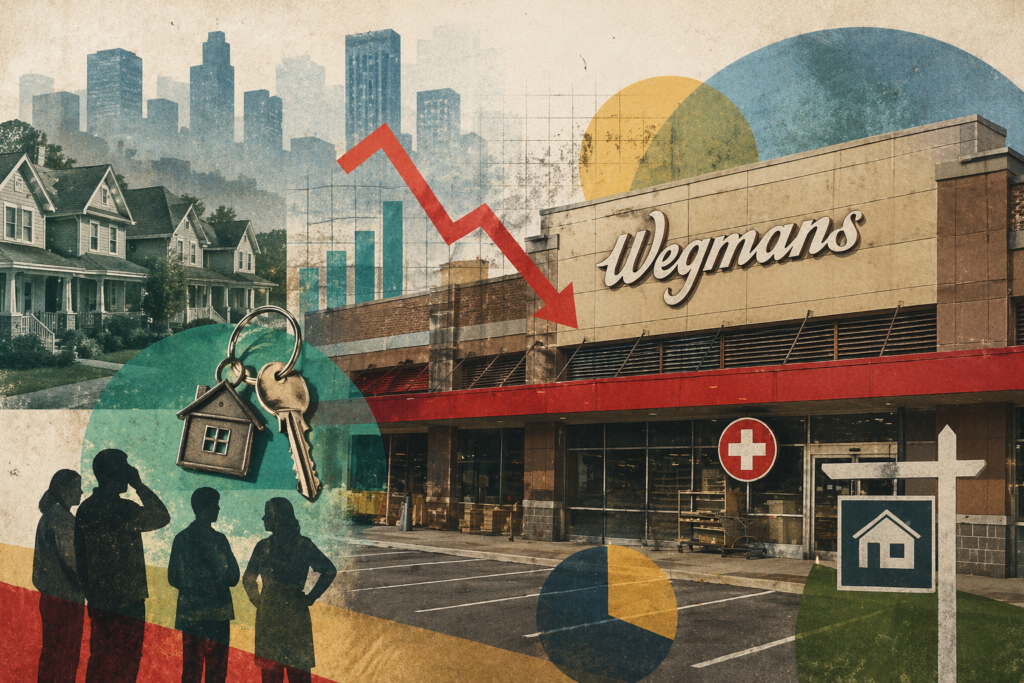
When a supermarket pharmacy closes in an affluent shopping district, the immediate impact feels routine—customers transfer prescriptions, life moves on. But for Brookline real estate professionals and buyers evaluating properties near the Newton border, the Wegmans Chestnut Hill pharmacy closure offers insights into how retail amenity contraction affects neighborhood convenience profiles, particularly for buyers prioritizing walkable errands and service accessibility.
The Wegmans pharmacy at 200 Boylston Street closed in April 2023, prompting the supermarket to introduce a free prescription delivery service after a local resident organized a petition that gathered hundreds of signatures. Wegmans cited space optimization for grocery expansion as the rationale, offering home delivery for maintenance medications and store-based delivery from its Westwood location for temperature-sensitive prescriptions.
Why Pharmacy Access Matters in Brookline Property Evaluation
I’ve had buyers touring condos along Hammond Pond Parkway and Beacon Street near the Chestnut Hill border specifically ask about pharmacy walkability during showings. The ability to access prescription services during routine shopping trips—rather than scheduling separate errands—represents a consolidated convenience factor that some buyers prioritize when assessing neighborhood amenities. The Wegmans closure removed that convenience layer for residents in eastern Chestnut Hill and adjacent Brookline streets, shifting expectations for properties within walking distance of the shopping plaza.
The delivery service Wegmans introduced mitigates some inconvenience, but it doesn’t replicate immediate access. Several buyers I’ve worked with mentioned that mail-order timelines and coordination requirements create friction that in-store pickup avoids. For buyers evaluating Chestnut Hill homes and properties along the Brookline side of Beacon Street, this shift may feel minor now but could compound as retail pharmacy distribution continues evolving nationwide.
Implications for Brookline Property Markets
Walkability scoring becomes more granular. Properties marketed on pedestrian convenience now require more detailed amenity audits, as the presence of a grocery store no longer guarantees pharmaceutical services on-site. I’ve updated my showing notes for buildings near the plaza to reflect current pharmacy locations.
Delivery infrastructure gains relevance. Buildings with secure package rooms or concierge services may see relative advantages as more retail categories shift toward delivery models, making prescription logistics easier to manage without in-person pickup.
Proximity to remaining pharmacy locations matters more. The distribution of CVS, Walgreens, and independent pharmacy locations across Brookline neighborhoods becomes a more explicit factor in convenience assessments, particularly for properties positioned between multiple service points.
Retail corridor stability influences buyer perception. Buyers evaluating long-term property value may weigh the stability of nearby retail anchors differently, recognizing that service contraction can alter neighborhood convenience profiles gradually over time.
Rental market positioning shifts. Investment properties marketed on walkable amenities may need to adjust positioning as pharmacy access becomes less uniform across traditionally full-service retail districts.
Due diligence expands beyond traditional metrics. Property evaluations increasingly require real-time verification of retail services rather than assumptions based on neighborhood reputation or past amenity density.
Aging-in-place logistics enter earlier conversations. Buyers planning extended ownership timelines may evaluate pharmaceutical access as part of long-term livability planning, alongside other service accessibility considerations.
Neighborhood convenience definitions narrow. What constituted a “full-service” retail environment five years ago may require recalibration as certain service categories consolidate or shift to delivery-only models.
What Buyers Should Watch
Retail amenity erosion tends to unfold gradually, making it easy to overlook during property tours. Buyers focused on long-term livability near the Chestnut Hill plaza should verify the current status of pharmacy options within their preferred walk or drive radius. I recommend checking whether remaining pharmacy locations offer extended hours and delivery options during your property search.
The Wegmans closure won’t move markets, but it illustrates a pattern worth monitoring: retail service contraction in affluent suburbs where demographics historically supported robust amenity density. As pharmacy providers optimize footprints and shift toward delivery models, the definition of “full-service neighborhood” may narrow, making granular amenity audits more relevant for buyers prioritizing convenience and accessibility.
Source: Brookline.News
Related reading: Chestnut Hill Avenue Redesign Paused: What It Means for Buyers.