
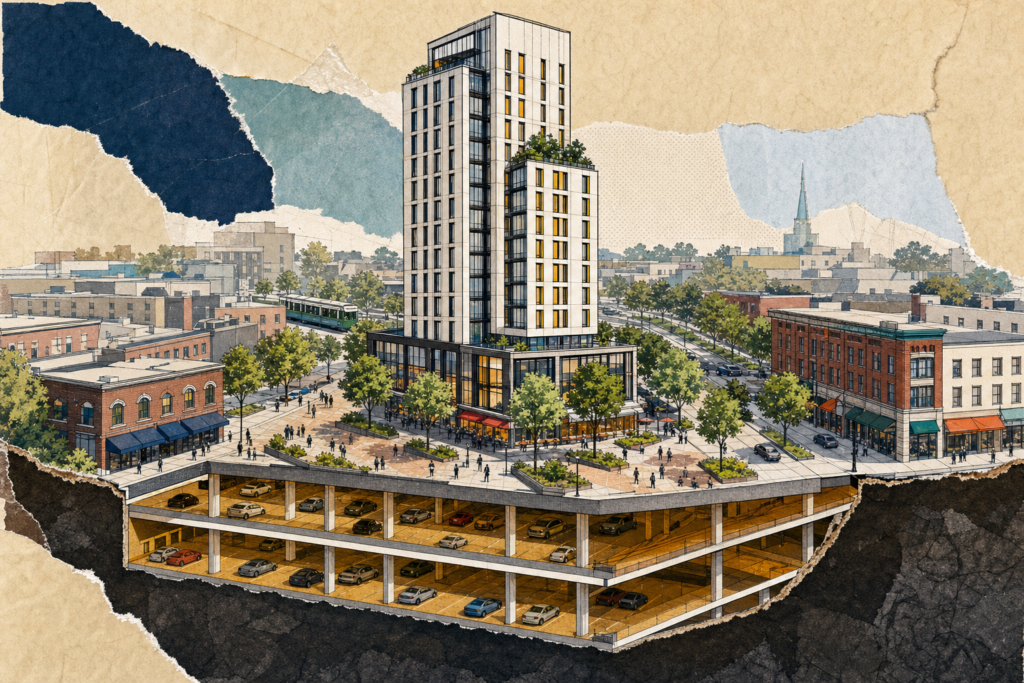
Brookline’s next major development debate may begin in one of the most familiar places in town: the Centre Street parking lots in Coolidge Corner.
For decades, these lots have functioned as practical infrastructure. They support shoppers, restaurant customers, employees, nearby residents, the farmers market, and the everyday rhythm of a major Brookline commercial district. But they are also large, town-owned surface lots in a walkable, transit-served area in town.
That is why Centre Street is now part of a broader question: can Brookline use public land to support parking, local business, housing, open space, climate goals, and town finances at the same time?
Source and analysis note: Project status and survey percentages below come from official Town of Brookline materials. Statements about possible design, market, or property effects are The Bushari Team’s analysis, not adopted Town plans or valuation findings.
Related reading: For the latest pricing and inventory backdrop around Brookline village-center demand, read the Brookline Real Estate Market Update: 7/8/2026-7/15/2026. Buyers focused on this corridor can also review our Coolidge Corner neighborhood guide.
Why the Centre Street lots matter
The Town of Brookline’s Centre Street Lots Exploratory Study is examining the Centre Street East and West parking lots and the role they play in Coolidge Corner. The town retained a consultant team led by Speck Dempsey using $225,000 in ARPA funding, with the stated goal of working with the community toward a future vision for the lots.
That matters because this is not only a parking study. It is a public-land study, a village-center study, and a real estate study.
The town’s own materials describe the Centre Street lots as critical municipal parking resources that could make a greater contribution to the vibrancy of Coolidge Corner. That phrase — greater contribution — is the key.
Surface parking serves current users. In a built-out town with limited land and recurring budget pressure, publicly owned parcels can also be evaluated against different civic uses.
The public is open to change, but not at any cost
The Centre Street survey shows a community that is not broadly opposed to improvement, but is cautious about losing parking.
In the town’s survey analysis, 49% of respondents said they were open to changing the lots, but not at the expense of less parking. Another 33% said they were open to change and would accept some parking going away to accommodate other uses. Only 10% said the lots should not change at all.
Analysis: Based on the survey, a future proposal may need to address both development goals and parking concerns.
When respondents were asked what they would like to see more of if the lots changed, the leading answer was green space, open space, or a public plaza, selected by 66% of respondents. Housing was selected by 34%, and retail by 29%.
Analysis: The survey suggests that visible public-space benefits may be important to community evaluation of a future proposal.
What kind of project could actually work?
The most plausible future for Centre Street is not a single-purpose project.
A parking-focused concept would prioritize vehicle access but could limit other public uses. A housing-focused concept would need to address parking and public-space concerns raised in the survey. A public-space-focused concept would emphasize open space while addressing fewer housing or fiscal objectives.
One possible concept is a hybrid:
- Better pedestrian connections through Coolidge Corner
- More usable green space, seating, lighting, and public gathering areas
- Some structured or better-managed parking
- Housing above or adjacent to civic space
- Possibly ground-floor retail, civic, or community uses
- Improved tree canopy, stormwater infrastructure, and accessibility
This approach also fits the formal charge of the Centre Street Lots Committee, which was asked to evaluate parking utilization, signage, accessibility, commercial-lot access, multimodal connectivity, public gathering space, commercial vibrancy, green space, tree canopy, sustainability, and financial feasibility.
The real estate angle
From a real estate perspective, Centre Street is not just a municipal planning story. It is a neighborhood-value story.
Coolidge Corner offers walkability, Green Line access, retail, restaurants, and varied housing. A future Centre Street plan could change the public realm, access, and construction conditions, but this article does not quantify an effect on property values.
For nearby owners, a future project could change the public realm and access patterns. For buyers and sellers, it is a reminder to review nearby publicly owned parcels and current official plans rather than assume that existing conditions will remain unchanged.
For local businesses, the issue is more delicate. Parking access matters. Construction disruption matters. Customer convenience matters. That is why the town’s guiding principles emphasize continued access for business owners and lot users while also requiring fiscal realism, sustainability, and alignment with town priorities.
Why this debate will be hard
The Centre Street lots are loved because they are useful. People know where they are. People use them. People have routines around them.
That makes change difficult.
Even residents who support more housing may worry about parking. Even business owners who support beautification may worry about customer access. Even people who want more public space may dislike the scale of the building required to finance it.
The next practical step to watch is whether the Select Board moves toward a market-facing process, such as a Request for Information. An RFI would not approve a project. It would test what developers think is financially realistic, what tradeoffs are required, and whether Brookline’s goals can be combined in a viable proposal.
What buyers and sellers should watch
For buyers, the Centre Street conversation is a reminder that Brookline real estate is not static. A property near Coolidge Corner may benefit from future public-space and village-center improvements, but there may also be planning uncertainty, political debate, and eventual construction impacts.
For sellers, the opportunity is narrative, but it must be factual: describe current walkability, transit, and nearby public assets without presenting an unapproved project as certain.
Related reading: For the current pricing and inventory backdrop shaping Brookline’s redevelopment debate, see the latest Brookline market update.
A future proposal would likely need to address multiple stated Town priorities, including parking, housing, fiscal feasibility, design, sustainability, and local business support.
The bottom line
The Centre Street lots are one current test of Brookline’s development process.
If the Town develops a feasible plan that addresses parking, public space, local businesses, housing, and fiscal goals, the process could inform future village-center planning.
If the process cannot reconcile parking and housing concerns, it may stall before a project is selected.
For now, the key takeaway is simple: Coolidge Corner’s most important future development site may be hiding in plain sight.
FAQ
What are the Centre Street lots in Brookline?
The Centre Street lots are town-owned parking lots in Coolidge Corner. They serve local businesses, visitors, residents, and community uses such as the farmers market.
Why is Brookline studying the Centre Street lots?
Brookline is studying whether the lots can better support parking, public space, commercial vitality, housing, sustainability, accessibility, and long-term fiscal goals.
Will the Centre Street lots become housing?
No final decision has been made. Housing is one possible use, but public feedback also shows strong interest in green space, open space, public plaza improvements, and maintaining parking access.
Why are the Centre Street lots important for Coolidge Corner real estate?
No final project has been approved, so any effect on nearby residential or commercial property values is unknown. Readers should follow official updates and evaluate property-specific context.
Sources and further reading