Brookline's proposed Building Emissions Reduction and Disclosure ordinance may reshape renovation costs and property values for existing buildings across town.
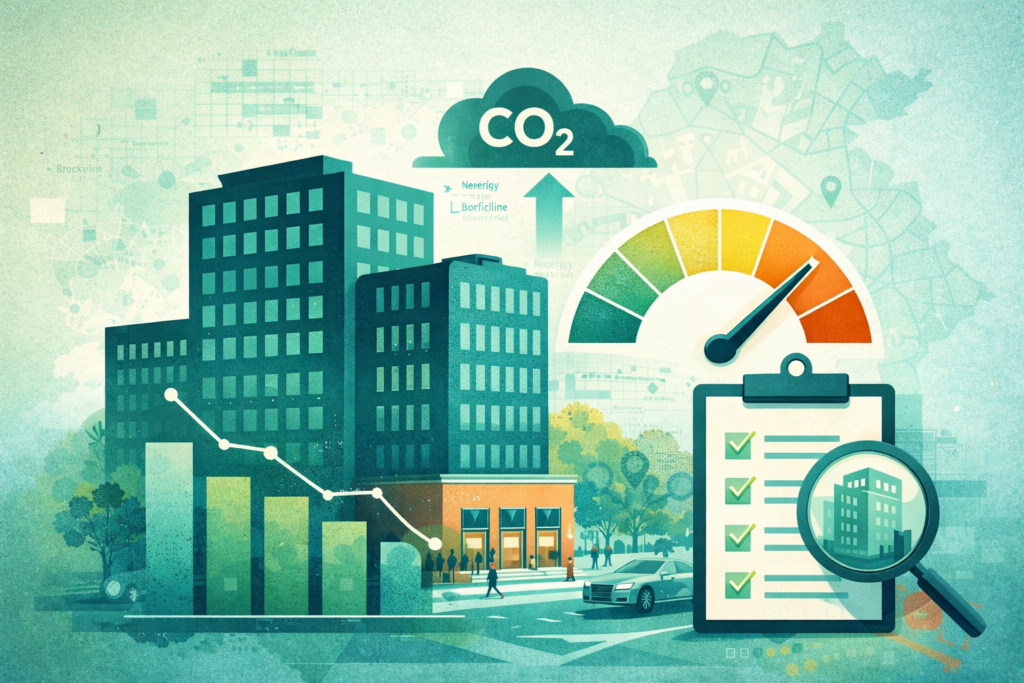
Brookline’s climate policy agenda is shifting from new construction to existing buildings, and that matters for anyone buying, selling, or owning property in town. While the town’s fossil fuel-free building ordinance already governs new projects, a proposed Building Emissions Reduction and Disclosure (BERD) ordinance would impose reporting and emissions reduction requirements on large existing buildings—a policy shift that could affect renovation timelines, operating costs, and long-term property values across Brookline neighborhoods.
Brookline is drafting a Building Emissions Reduction and Disclosure Ordinance aimed at reducing greenhouse gas emissions from buildings, which currently account for 43% of the town’s total emissions. The initiative, led by the town’s Zero Emissions Advisory Board, aligns with Brookline’s goal to achieve net-zero carbon emissions by 2050. Proposed measures include converting heating systems to renewable energy-powered heat pumps and enhancing insulation and air sealing. While Brookline has historically been a leader in climate policy, it is currently behind neighboring municipalities like Newton, Boston, Cambridge, and Lexington in regulating emissions from existing buildings.
How BERD Would Work for Existing Buildings
The proposed BERD article, modeled closely on Boston’s existing ordinance, would require owners of large buildings to annually report energy and water usage and progressively reduce greenhouse gas emissions in compliance with declining CO2-equivalent emissions intensity standards. The ordinance establishes a phased compliance timeline with emissions intensity standards measured as metric tons of CO2e per square foot, declining gradually to reach zero by 2040. Buildings ranging from 20,000 to 35,000 square feet or containing 15 to 35 dwelling units would not face emissions standards until 2031, with reporting beginning for 2030 performance data.
Compliance mechanisms include participation in Brookline’s Green electricity aggregation program, purchase of Renewable Energy Certificates, participation in green power purchase agreements, and payment of alternative compliance payments calculated based on the average cost per metric ton of CO2e to decarbonize large buildings. All alternative compliance payments and penalties would be deposited into a dedicated investment fund administered through the town’s Environmental Department, with expenditures prioritized for local building carbon abatement projects benefiting Environmental Justice populations.
What Buyers and Sellers Should Watch
Buyers considering Brookline homes in larger buildings: Ask whether the property falls within BERD thresholds and review any available energy reporting or capital improvement plans, as buildings facing compliance deadlines may require substantial mechanical system upgrades or alternative compliance payments that could affect condo fees or operating expenses.
Sellers in buildings approaching 20,000 square feet or 15 units: Consider obtaining an energy audit or disclosure of the building’s current emissions profile before listing, as prospective buyers may increasingly factor future compliance costs into purchase decisions, particularly for older buildings with oil or gas heating systems.
Condo associations and investment property owners: Begin evaluating the timeline and cost for converting to heat pumps, improving insulation, and air sealing, as waiting until compliance deadlines approach may result in higher contractor costs and limited availability during peak demand periods.
Landlords with properties near compliance thresholds: Watch for formal adoption timelines and review whether participation in Brookline’s Green electricity aggregation program or renewable energy certificate purchases offers a lower-cost interim compliance pathway compared to immediate mechanical system replacement.
Source: Source
About Elad Bushari
Elad Bushari is an Executive Vice President at Compass and a leading Brookline, Massachusetts real estate agent with over $1 Billion in career sales and 22+ years of experience. He represents buyers, sellers, landlords, tenants and developers across Brookline's most sought-after neighborhoods, including Coolidge Corner, Fisher Hill, Chestnut Hill, Washington Square, and Brookline Village.
A former Inc. 5000 founder and REALTOR® Magazine "30 Under 30" honoree, Elad specializes in luxury single-family homes, condominiums, and multi-family investments throughout Greater Boston. His data-driven approach and deep local knowledge help clients navigate Brookline's competitive market with confidence.
Elad Bushari's Profile
Filed under: Zoning