
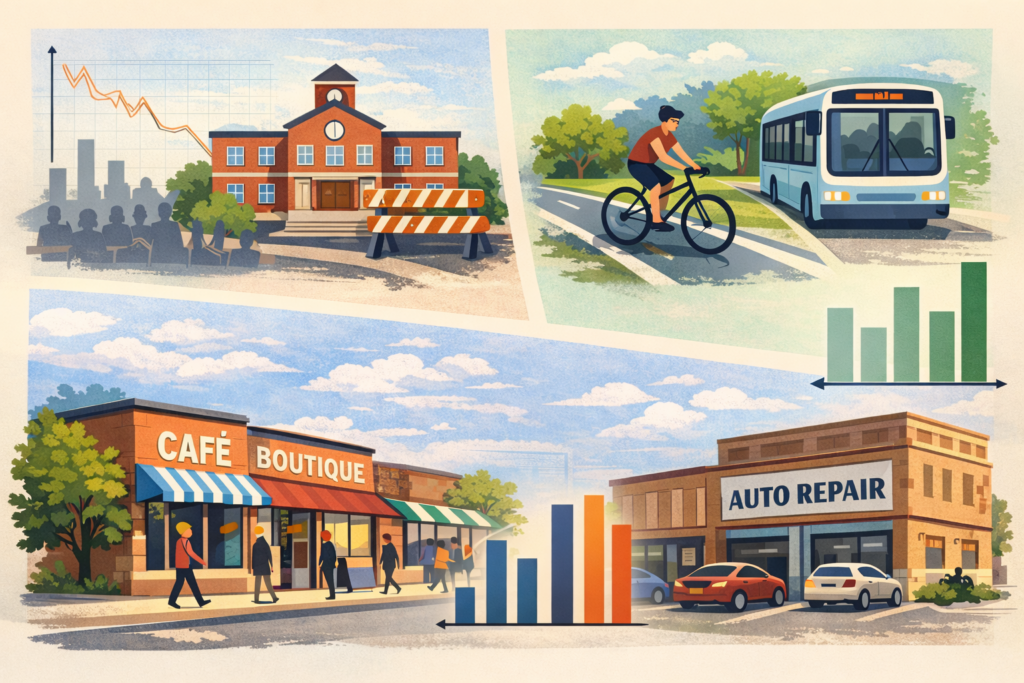
When Town Meeting members start circulating surveys on budget priorities, transit regulations, and e-bike rules, it often signals that zoning or infrastructure votes are coming—and those votes tend to ripple through Brookline homes valuations, especially in transit-adjacent pockets. Recent discussions among Town Meeting members have focused on town finances, T access, and micro-mobility, while commercial development continues along the Harvard Street corridor, adding another amenity layer to Coolidge Corner walkability scores.
Why Budget and Transit Surveys Matter for Property Values
Town-sponsored surveys on budget and transportation may seem procedural, but they often preview warrant articles that affect tax rates, parking policy, or bike infrastructure—all of which influence buyer calculus. If e-bike regulations tighten or expand dedicated lanes, expect incremental demand shifts in Brookline neighborhoods within a half-mile of Green Line stops or the Emerald Necklace. Conversely, budget constraints that defer road or sidewalk maintenance can weigh on older single-family pockets where deferred infrastructure becomes a buyer objection during due diligence.
Condo buyers near transit should watch for any warrant language around T service frequency or parking minimums; reduced parking requirements near stations may accelerate small multifamily conversions, tightening resale inventory in buildings that grandfathered more spaces.
Single-family sellers in South Brookline or Chestnut Hill may find that if the town prioritizes bike lanes over street parking, curb appeal and guest access become talking points; consider staging driveways and off-street options more prominently in listings.
Properties near proposed bike infrastructure could see incremental valuation lifts as car-light households expand their search radius to include areas with protected lanes and secure bike storage options.
Investors tracking warrant articles will notice that budget discussions often precede tax-rate adjustments; properties in precincts with higher commercial tax shares may experience different assessment trajectories than purely residential zones.
Landlords managing older multifamily buildings should monitor any proposed changes to parking minimums or bike-storage mandates, as retrofitting compliance can affect operating budgets and renovation timelines.
Buyers prioritizing school access may find that infrastructure votes affecting sidewalk conditions or crosswalk improvements near Brookline schools influence perceived safety and walkability in family-oriented precincts.
The Harvard Street Food Scene and Micro-Market Walkability
New dining and experiential retail concepts continue to emerge along Harvard Street, adding density to the Coolidge Corner corridor. While one venue won’t move median prices alone, the cumulative effect of dining density—especially delivery-optimized concepts—tends to lift rental comps as walkable errand loops become more robust.
Landlords with Brookline apartments within 0.3 miles of Harvard Street can highlight the expanding food scene in lease marketing; tenants who prioritize walkability often renew at higher rates when amenity clusters deepen, reducing turnover costs.
Investors evaluating small multifamily near Coolidge Corner should note that experiential retail anchors signal corridor evolution; if occupancy stabilizes, adjacent mixed-use parcels may see cap-rate compression as lenders grow more comfortable with pedestrian traffic projections.
Retail tenants and mixed-use owners may find that delivery-optimized food concepts reduce daytime foot traffic volatility, creating more predictable revenue streams that support lease renewals and tenant mix planning.
What to Watch in the Next Warrant Cycle
Civic engagement emails rarely make headlines, but they document the issues Town Meeting members hear from constituents—and those issues become warrant articles within six to twelve months. If budget surveys reveal taxpayer resistance to capital spending, expect deferred school or road projects that may dampen appeal in precincts with aging infrastructure. Conversely, if transit and e-bike discussions coalesce into formal policy, properties near existing bike paths or proposed extensions may see incremental demand from car-light households. Commercial corridor evolution along Harvard Street underscores that Brookline’s retail landscape is shifting faster than its residential zoning, creating pockets where walkability premiums widen while others remain car-dependent.
Source: Source