
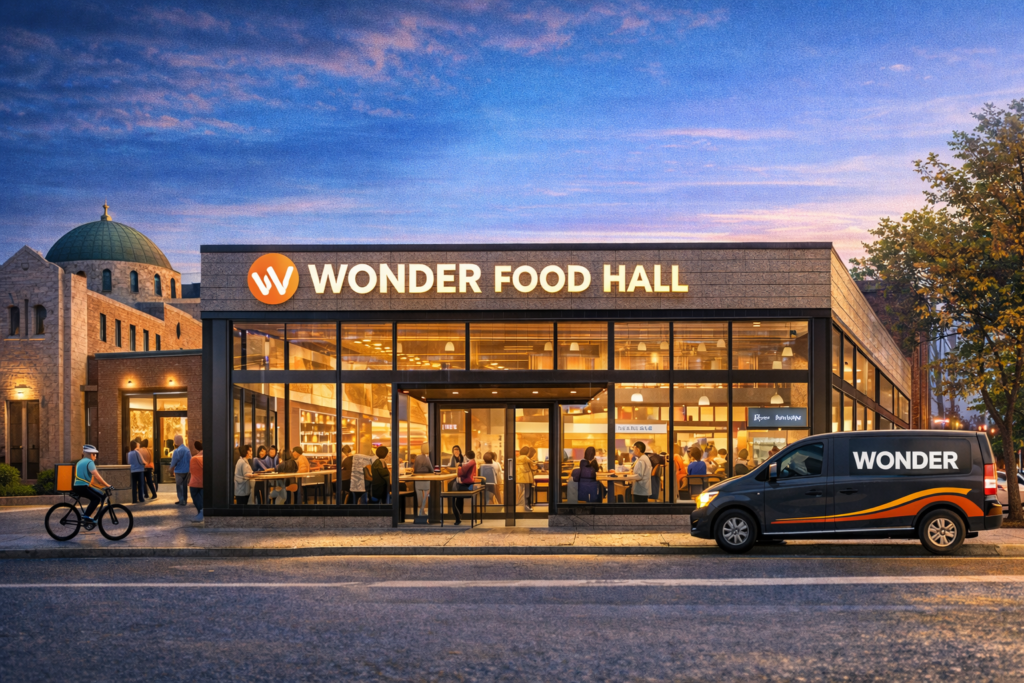
When a technology-driven food concept backed by billions in venture capital chooses $650 million in November 2024. That capital base has enabled rapid expansion—from 46 locations in early 2025 to over 90 by year-end, with announced plans to reach 400 locations by 2027. For Brookline, this means Wonder isn’t testing a concept; it’s deploying a proven playbook in a market it views as strategically important.
What Buyers and Investors Should Watch
Mixed-use investors: Wonder’s arrival may signal that delivery-first tenants are willing to pay competitive rents for Harvard Street frontage, but the model’s reliance on technology and centralized commissaries means it operates with fundamentally different unit economics than traditional restaurants.
Retail landlords near Coolidge Corner: Traditional food halls have struggled nationally, with several closures in Washington, D.C. in 2025 even as Wonder expanded aggressively in the same region, suggesting that independent-vendor models face structural headwinds that vertically integrated platforms may not.
Buyers evaluating Coolidge Corner homes: Wonder’s presence may enhance walkable dining density in the short term, but customer reviews at other locations show mixed satisfaction—Baltimore’s location holds a 3.5 Yelp rating, while D.C.’s 14th Street and College Park locations each have a 2.7 rating.
Condo owners near Harvard Street: Commercial tax growth is a strategic priority for Brookline under Proposition 2½, which caps annual property tax levy growth at 2.5% plus new growth—successful commercial tenants like Wonder may help stabilize residential tax burdens by expanding the commercial base.
Restaurant owners in Brookline neighborhoods: Wonder operates with approximately 30 staff members while offering over 550 menu items, an efficiency ratio that would be impossible in conventional kitchens, potentially creating pricing pressure for independent operators.
Residential developers: Wonder’s model depends on tight delivery radiuses and high order frequency, validating the value of dense, transit-accessible residential catchments near commercial corridors.
Commercial brokers: The company’s ventless technology expands the universe of viable restaurant sites, potentially increasing demand for spaces that would otherwise require expensive kitchen retrofits.
Long-term property holders: If quality doesn’t meet expectations at the Brookline location, the concept could become a low-traffic placeholder rather than a foot-traffic generator, affecting adjacent retail performance.
Source: Brookline.News