
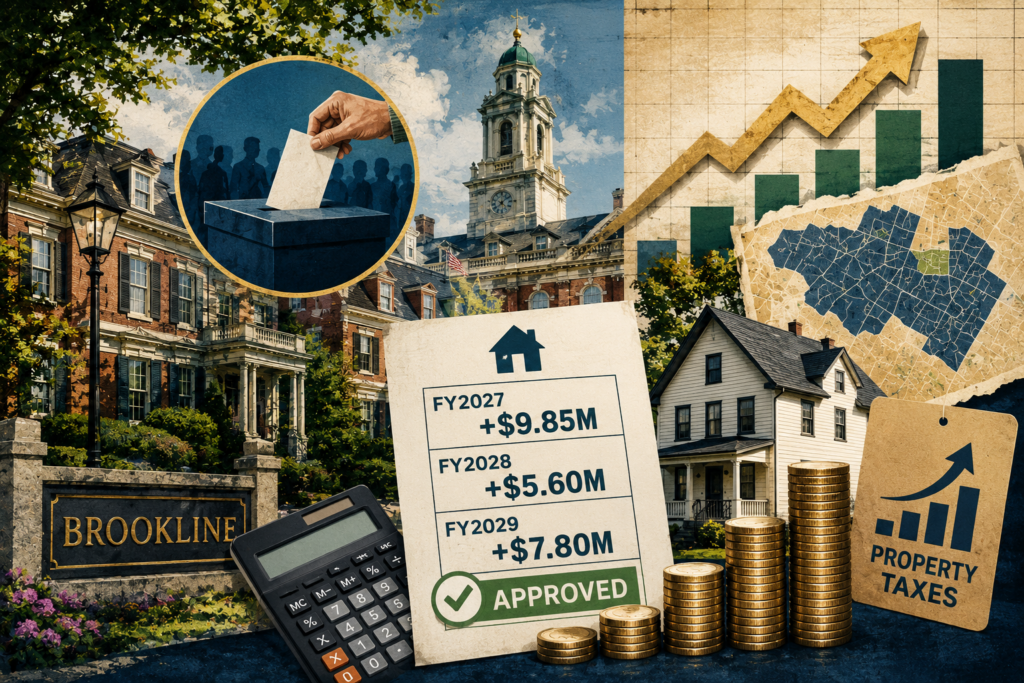
Brookline’s property tax landscape shifted permanently when voters approved a $23.25 million override on May 5, 2026 – the largest such ballot question in Massachusetts history. For anyone evaluating Brookline homes or weighing whether to stay, the three-year phased increase adds a concrete layer of cost that buyers, sellers, and current owners need to factor into their housing decisions.
Understanding the Vote and What It Funds
Town Administrator Chas Carey characterized the override approval as a starting point for long-term fiscal planning, emphasizing that Brookline now faces implementation of changes the override enables. Voters approved the measure by a margin of 8,675 to 5,732, with turnout reaching 35 percent – the highest ever recorded in a Brookline local election. The override prevents elimination of approximately 240 positions, including school staff and firefighters, while addressing a structural deficit driven by health insurance, utilities, and special education costs rising at 4 to 7 percent annually against Proposition 2½’s 2.5 percent revenue cap.
The override adds $9.85 million in FY2027, $5.60 million in FY2028, and $7.80 million in FY2029. For a property assessed at the median value of $484,626, the first-year increase is approximately $145, with cumulative increases reaching roughly 18 percent by FY2029. A $700,000 property faces about $210 more annually in year one, scaling proportionally across all price points.
What Buyers and Sellers Should Watch
First-time buyers near the median: The override adds meaningful carrying cost to properties in Brookline neighborhoods that were already among the state’s most expensive, with the median single-family tax bill at $20,492 before the override – second only to Weston statewide.
Sellers pricing homes above $1 million: Buyers will now calculate annual property taxes of approximately $7,860 on a $1 million assessed home by FY2029, which may shift negotiating dynamics or compress buyer pools sensitive to total monthly costs.
Families prioritizing schools: The override preserves 210 school positions and educational programs that faced elimination, which may sustain demand for homes near Brookline schools, though the tax premium compounds an already-high entry price.
Fixed-income homeowners: The 18 percent cumulative increase over three years may accelerate decisions to downsize or relocate, particularly for long-term residents whose incomes haven’t kept pace with property tax growth.
Prospective investors: Rental property owners face the same proportional tax increases, which may pressure rents upward or compress cap rates if tenants resist higher lease terms in a softening market.
Carey pointed to housing development and regulatory reform as critical next steps, noting that sustainable fiscal health requires “making it easier to build more and newer housing stock, especially near transit areas.” Whether that translates to meaningful zoning changes or additional supply remains uncertain, but the override buys time for those longer-term strategies to materialize.
Source: Brookline.News