A new Brookline committee is considering rules for nuisance lighting. The debate reaches beyond dark skies to sleep, wildlife, historic character and everyday property due diligence.
Exterior lighting is easy to ignore during a daytime home showing.
At night, it can become one of the most noticeable features of a property.
A bright wall sign, an unshielded security light, a parking-lot fixture or landscape lighting aimed into neighboring windows can change how a home feels after sunset. That is why Brookline’s emerging exterior-lighting debate deserves attention from homeowners, buyers, condo associations and developers.
For a related example of municipal review affecting home upgrades, see our analysis of solar permitting delays in Brookline.
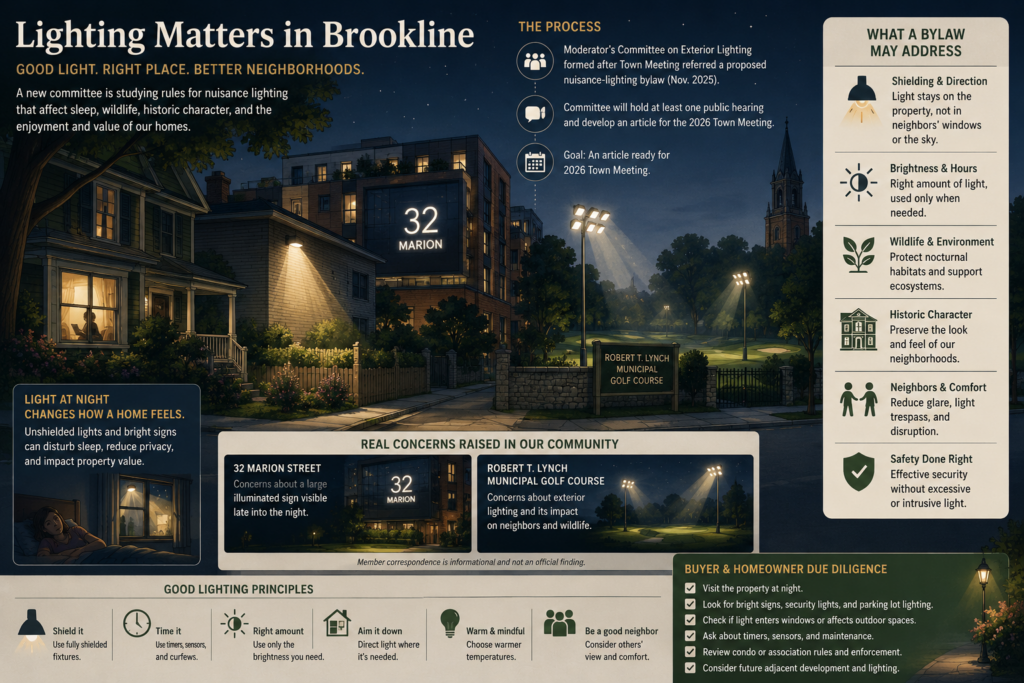
The Town created a Moderator’s Committee on Exterior Lighting after the November 2025 Town Meeting referred a proposed nuisance-lighting bylaw for further study. The committee was asked to work toward an article suitable for a 2026 Town Meeting and to hold at least one public hearing.
In June, Town Meeting member correspondence highlighted concerns about a large illuminated sign at the new 32 Marion Street development and lighting around the Robert T. Lynch Municipal Golf Course. Those messages are not official findings, but they illustrate the kinds of conflicts a future bylaw may need to address.
The issue is not whether Brookline should have lights
Good exterior lighting serves real purposes.
It helps people find entrances, navigate steps, identify addresses and move through public spaces. It can support accessibility and contribute to a sense of security.
The harder question is whether the light is designed for the task.
Useful lighting is usually:
- directed toward the area that needs illumination;
- shielded to reduce glare and spill onto neighboring properties;
- no brighter than necessary;
- on only when needed; and
- warmer in color where practical.
Poorly controlled lighting may illuminate bedrooms, wash out the night sky, create glare for pedestrians or drivers, and affect nearby habitat without improving safety.
The U.S. Fish and Wildlife Service recommends using light only where and when necessary, aiming it only at the intended area, avoiding upward light and using timers, dimmers or motion sensors. Brookline’s own historic-district guidance similarly encourages shielded, downward-directed fixtures and discourages lighting used solely to illuminate landscaping or building facades.
Why this belongs in a real estate conversation
Light exposure is property-specific.
Two units in the same building can have completely different nighttime conditions. A rear bedroom may face a quiet courtyard, while a front bedroom faces a commercial sign. A first-floor condominium may receive glare from a driveway fixture that never reaches upper floors. A house next to a park, school or institutional property may experience lighting controlled by someone else.
That makes exterior lighting relevant to both enjoyment and due diligence.
Buyers routinely ask about noise, traffic and sunlight. They should also ask what happens after dark.
A nighttime visit can reveal what daylight hides
Before buying, visit the block more than once and at different hours. Look from the sidewalk, from the primary bedrooms and from any outdoor space.
Pay attention to:
- Direct glare. Can you see a bare bulb or intensely bright fixture from a bedroom or living space?
- Light trespass. Does a neighboring fixture illuminate the interior of the home?
- Commercial signs. Are nearby signs dimmed or turned off, or do they remain bright overnight?
- Parking and driveway lights. Do fixtures activate with every passing pedestrian, animal or vehicle?
- Common-area controls. In a condominium, who controls brightness, timers and fixture replacement?
- Seasonal change. Leaf cover may block light in summer and expose it in winter.
- Future conditions. Could an adjacent redevelopment add parking, signage or facade lighting?
Photos taken from inside the unit at night can help a buyer compare conditions objectively.
What homeowners can often fix
Many lighting problems do not require removing a fixture.
A shield can block light from a neighboring window. A lower-output bulb can reduce glare. A timer or motion sensor can shorten operating hours. Re-aiming a fixture may preserve visibility while keeping the light on the owner’s property.
For a homeowner or condo association planning an upgrade, a simple lighting plan should identify:
- what each fixture is meant to illuminate;
- its brightness and color temperature;
- its direction and mounting height;
- its hours of operation; and
- whether the source is visible from neighboring homes or the public way.
The goal is not darkness at the expense of safety. It is controlled lighting that performs its job without creating a new nuisance.
The health discussion needs precision
Some June correspondence began with a media report about nighttime light and allergies. That is not the strongest basis for property advice, and a local real estate article should not turn an emerging research claim into a settled conclusion.
There is, however, well-established reason to care about bright artificial light at night. The National Heart, Lung, and Blood Institute explains that late-evening artificial light can interfere with the body’s sleep-wake process. That does not mean every outdoor fixture causes a health problem. It means bedroom exposure and nighttime comfort are reasonable conditions to evaluate.
The same care applies to wildlife. The U.S. Fish and Wildlife Service documents how unnecessary nighttime lighting can disorient migratory birds and recommends direction, timing and warmer-color strategies to reduce harm.
What a Brookline bylaw could change
The committee’s charge is to address nuisance lighting, but the final scope is not yet settled. Important implementation questions include:
- whether rules apply differently to homes, commercial properties and public facilities;
- how existing fixtures are treated;
- what measurement standard is used;
- who investigates complaints;
- what reasonable cure period owners receive; and
- how safety, accessibility, historic preservation and environmental goals are balanced.
Those details matter more than a general statement that light pollution is bad.
For property owners, clear and measurable rules can be better than uncertain conflict. A well-designed bylaw can tell owners what is expected before they spend money on fixtures and give neighbors a structured way to address serious spill or glare.
The bottom line
Brookline’s exterior-lighting debate is about how private and public properties share the night.
Homeowners do not need to wait for a bylaw to use better shielding, lower brightness and smarter controls. Buyers do not need to wait until after closing to learn what a bedroom looks like at midnight.
The practical rule is simple: evaluate lighting at the time it matters – after dark.
Related reading: 32 Marion Street: Brookline’s Affordable Housing Milestone
Also relevant: Brookline Town Meeting Zoning Debates and Your Property Value
Primary sources



 Sold
Sold