
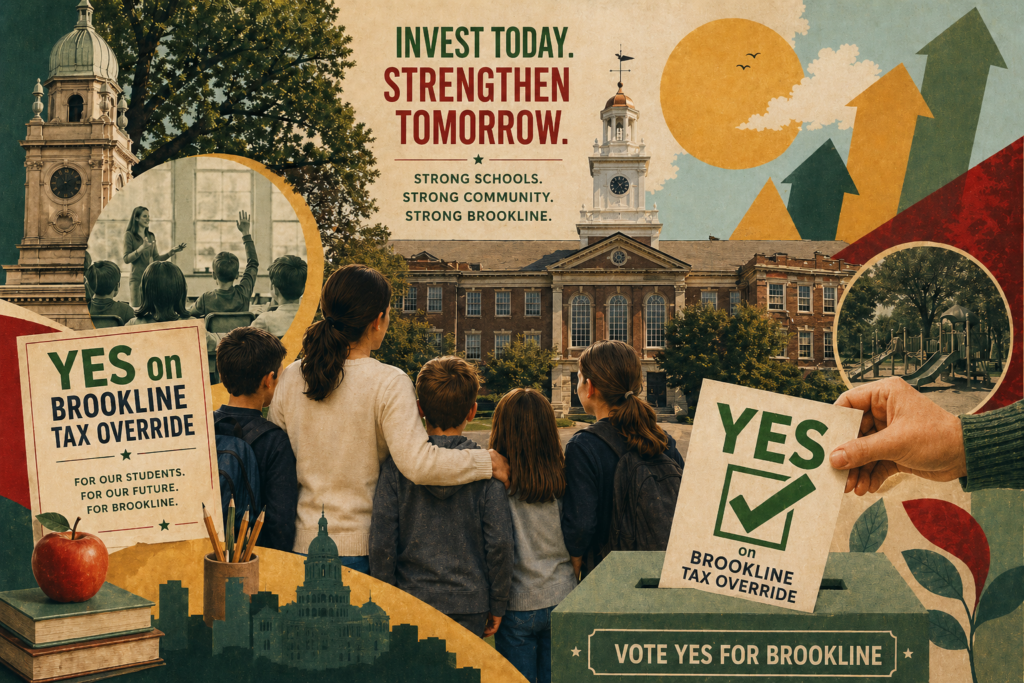
I’m voting yes on Brookline’s tax override.
I say that as a parent first, a resident second, and a real estate professional third.
Those are different perspectives, but for me they lead to the same conclusion.
As a parent
I have four kids in the Brookline public schools.
That is where this starts for me.
This vote is not theoretical. It is not just about budgets, politics, or which side has the better slogan. For families like mine, it is about the everyday reality of the schools our children walk into each morning and the kind of town we want Brookline to remain.
People do not choose Brookline by accident. Families stretch to live here for a reason. A big part of that reason is the schools. Not just the reputation of the schools, but the expectation that this town takes education seriously and is willing to support the system behind it.
That system is not automatic. It depends on good teachers, strong leadership, and enough support around the classroom to keep the whole thing functioning well. When a district starts getting squeezed, families feel it quickly: larger class sizes, fewer supports, more strain on staff, less flexibility, and a school experience that slowly becomes less strong than the one people thought they were buying into.
I do not want Brookline moving in that direction.
As a resident
As a resident, I think it is fair to ask hard questions before supporting a tax increase.
What is driving the funding need?
How would the override funds be used?
What are the likely consequences of a failed override?
Those are the right questions.
And my view is this: the answer is not simply that the town wants to spend more. The answer is that Brookline is running into the limits of a model that has become harder to sustain. Costs keep rising. Expectations remain high. And the town cannot keep relying almost entirely on residential taxpayers while also making long-term growth more difficult than it needs to be.
So yes, I’m voting yes. But this is not a blank check.
I expect better planning from the town.
I expect Brookline to be more disciplined with spending. I expect a more serious plan for commercial corridors and economic vitality. I expect more openness to smart development that creates housing, strengthens the tax base, and supports long-term fiscal health. And I expect town leadership to understand that you cannot keep narrowing your own options and then come back to residents as if higher taxes are the only possible answer.
Brookline needs to think beyond annual budget stress. It needs a stronger long-term strategy.
That includes growing commercial tax revenue. It includes supporting thoughtful development. It includes being realistic about what drives value and what undermines it. And it includes recognizing that policies which suppress investment, limit housing creation, or weaken property values do not help the town’s finances over time.
So my position is not “vote yes and move on.”
It is: vote yes now because the alternative is worse, but expect much better stewardship going forward.
As a real estate professional
From a real estate perspective, this issue is actually very simple.
Brookline’s value is not based on housing stock alone. It is based on the full package: schools, services, quality of life, civic stability, and the sense that this is a town that functions at a high level.
That is what supports demand. That is what helps people justify stretching to buy here. That is what protects Brookline’s long-term position.
Yes, taxes matter. Of course they do. Buyers care about carrying costs, and homeowners feel every increase. That is real.
But the market does not reward a town simply for keeping taxes lower in the short term. It rewards a town that remains desirable, competitive, and well run.
If Brookline allows its schools to weaken, its services to erode, or its planning to become more reactive than strategic, that has a cost too. It may not show up overnight, but it shows up. It shows up in buyer confidence. It shows up in perception. It shows up in whether people still believe Brookline offers something worth paying for.
That is the bigger point.
Brookline commands a premium because people are buying into more than a house. They are buying into a town. If the town wants to preserve that premium, it has to protect the things that created it in the first place.
My bottom line
I’m voting yes because I’m a parent and I want Brookline’s schools to stay strong.
I’m voting yes because I’m a resident and I believe the cost of saying no would be real.
And I’m voting yes because I’m a real estate professional who understands that Brookline’s long-term value depends on protecting the quality of life that makes this town special.
But I’m also voting yes with expectations.
I expect better planning.
I expect stronger fiscal discipline.
I expect a real strategy for commercial growth.
I expect more support for smart development.
And I expect town leaders to make it easier, not harder, for Brookline to remain financially strong over the long term.
So yes, I’m voting yes.
Not because everything has been handled perfectly.
Because Brookline cannot afford to get this wrong.
And because if this town wants to remain the kind of place families sacrifice to live in, it has to be willing to protect the institutions that made it that place.
Related reading: Brookline Override Vote May 2026: What Homebuyers Should Know and Brookline Veterans Tax Relief Program: What the Delay Means.