
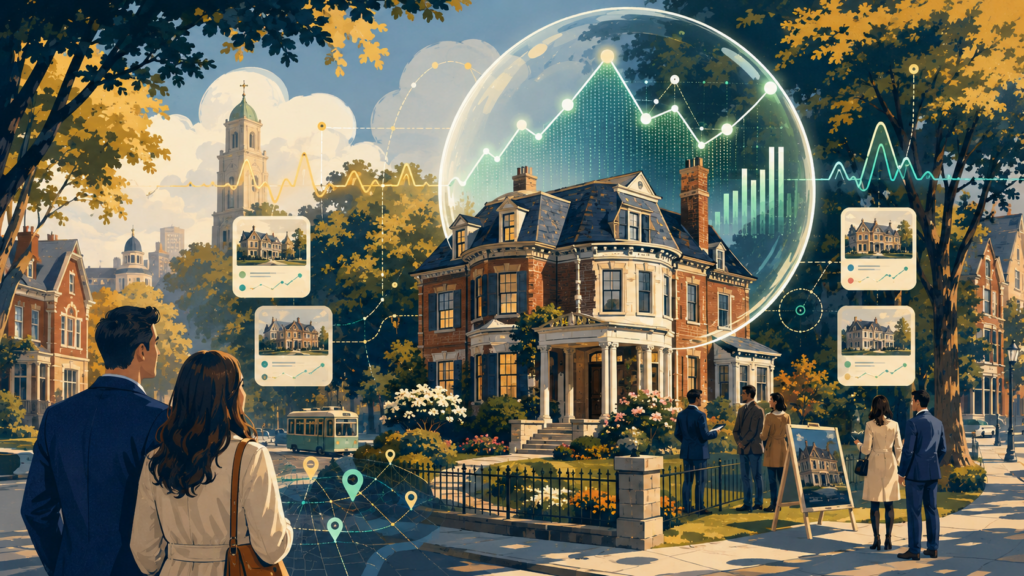
Everyone checks Zillow.
Sellers check it before they call an agent. Buyers check it before they make an offer. Neighbors check it because they are curious. Homeowners check it because watching your Zestimate move up or down can feel like watching a stock price tied to your own front door.
There is nothing wrong with that. The Zestimate has become one of the most recognizable numbers in residential real estate. It is convenient, visible, and easy to understand.
But in Brookline, that number needs context.
A Zestimate can be useful as a trend tool. It can help a homeowner see whether the algorithm thinks the market is moving up, down, or sideways. It can give buyers a general frame of reference. It can be a starting point for a conversation.
What it should not be is a pricing strategy.
That distinction matters because Brookline includes historic single-family homes, new construction, converted condominiums, two-family properties, association-dependent buildings, unusual floor plans, scarce parking, and micro-locations with different property-specific attributes.
In a market like this, the wrong comparable sale is not a rounding error. It can be the entire story.
Zillow itself is clear that the Zestimate is not an appraisal. Zillow describes the Zestimate as a computer-generated estimate of a home’s market value, using public records, MLS information, user-submitted data, home facts, location, and market trends. Zillow also says the accuracy of the Zestimate depends on the availability of data in the home’s area.
That is the key issue for Brookline.
The question is not whether Zillow is useful. It is.
The question is whether a single algorithmic estimate can replace property-specific judgment in a complex local market.
It cannot.
Zillow’s Own Accuracy Numbers Tell the Story
Source and analysis note: Zillow publishes national and regional accuracy measures, not a Brookline-specific error rate. Statements below about possible pricing or offer effects are professional interpretation, not measured causal results.
As reviewed July 22, 2026, Zillow reports nationwide median error rates of 1.83% for on-market homes and 7.01% for off-market homes. Zillow also states that a Zestimate is not an appraisal and that accuracy depends on available property and market data.
At first glance, those percentages may sound small.
In Brookline, they are not.
Those national median figures do not predict the error for a specific Brookline home. As a simple illustration, a 5% difference on a $2,000,000 property equals $100,000; that is math, not a Brookline Zestimate accuracy finding.
That is real money.
Used without other evidence, the estimate may influence a seller’s list-price decision or a buyer’s offer analysis. This article does not measure a causal effect on days on market, competition, or sale price.
This is why the Zestimate can be useful and potentially misleading at the same time.
It can be useful as a broad signal, but it should not be treated as a precise, property-specific valuation.
Percentage differences can be material at higher price points
Zillow’s published off-market figure is a national median, not a Brookline-specific error rate. It should not be used to predict the error for a particular property. As a simple illustration, a 5% difference on a $2,000,000 property equals $100,000; that is math, not a Brookline Zestimate accuracy finding.
Why Brookline Is Hard for Algorithms
Automated valuation models generally have an easier task when the available data is current, complete, and comparable.
Imagine a newer subdivision where homes are similar in age, size, lot configuration, condition, style, and location. If five nearly identical houses sold nearby in the last six months, an algorithm has a much easier job.
Brookline does not always offer that uniformity.
Brookline has:
- Victorian single-family homes with major renovation differences.
- Condos carved out of older houses.
- Professionally managed elevator buildings.
- Boutique luxury developments.
- Two-families and three-families with different rental, conversion, and owner-occupant potential.
- Homes with parking and homes without parking.
- Homes with private outdoor space and homes with none.
- Properties renovated behind the walls and properties only cosmetically improved.
- Homes that “live” better or worse than the square footage suggests.
- Neighborhood premiums that do not always show up cleanly in public data.
A database may know square footage. It may know bedroom count. It may know the last sale price. It may know the assessed value.
But does it know that one layout feels gracious and another feels chopped up? Does it know that a lower-level room technically counts as finished space but does not carry the same market value as above-grade living area? Does it know that one condo association is well run and another has deferred maintenance? Does it know that a house photographs beautifully but lives awkwardly? Does it know which open house had 50 people through it and which one was quiet?
That is where market intelligence matters.
And that is where hyperlocal expertise becomes more than a slogan.
Brookline is not a spreadsheet-perfect market.
Automated models generally have an easier task when homes are similar and comparable sales are clear. Brookline has too many property types, condition variables, and micro-location differences for one number to tell the full story.
Variables an algorithm may flatten
What local intelligence adds
Buyers Should Not Use the Zestimate as a Target Price
Buyers often look at a Zestimate and assume it tells them whether a listing is overpriced or underpriced.
Sometimes it gives a useful clue.
But in a competitive market, the Zestimate may have very little to do with the final result.
A home can sell above Zestimate because the algorithm underestimated the quality, location, renovation level, scarcity, buyer demand, or emotional appeal. A home can sell below Zestimate because the algorithm missed condition issues, layout problems, noise, lack of parking, weak association financials, or a changing market segment.
The real question for a buyer is not:
“What does Zillow say this is worth?”
The better question is:
“What will this specific home likely sell for, given the current buyer pool, recent comparable sales, property condition, competition, timing, and offer dynamics?”
That is a very different question.
A buyer who relies too heavily on the Zestimate may miss the real market. They may underbid on a property that was clearly positioned to attract multiple offers. Or they may overpay for a home where the Zestimate failed to catch a material weakness.
In Brookline, buyers need more than a number. They need interpretation.
Sellers Should Not Use the Zestimate as a List Price
For sellers, the risk may be even greater.
If a Zestimate is too low, a seller may leave money on the table or enter the market with a weak sense of the home’s true potential.
If a Zestimate is too high, a seller may anchor to an unrealistic number, overprice the home, lose early momentum, and ultimately chase the market down.
Pricing a home is not just a valuation exercise. It is a strategy decision.
A list-price recommendation should consider the property, relevant comparable sales, current competition, timing, presentation, and the seller’s goals. The strategy may emphasize accurate market positioning, property preparation, or timing; each choice should be supported by property-specific evidence.
A Zestimate cannot make those decisions.
It can give you a number.
It cannot give you a plan.
The Zestimate May Be More Useful for Trends Than Valuation
This is the fairest way to think about the Zestimate:
It is a trend tool, not a valuation tool.
If a homeowner watches the Zestimate over time, it may help identify a general direction. If the number is moving consistently, it may reflect broader market signals. If nearby values are rising or falling, the Zestimate may capture some of that movement.
But a trend is not a price.
A price is what a real buyer is willing to pay for a specific property under specific market conditions.
And in Brookline, those specifics matter.
A renovated condominium is not interchangeable with an unrenovated unit in a different association. An elevator-building condominium is not the same as a floor-through unit in a converted two-family. Similar square footage can also mask differences in condition, layout, parking, outdoor space, and building finances.
The algorithm can see some of the data.
It cannot fully see how the property lives.
Hyperlocal Expertise Is the Missing Layer
An agent’s useful contribution is not simply looking up comparable sales. Consumers and automated tools can retrieve transaction records.
The value is in knowing which comps matter.
That requires a heartbeat in the market.
It means seeing properties in person. It means understanding how they live. It means knowing which homes attracted serious buyer traffic and which ones did not. It means knowing how many offers came in, what kind of buyers showed up, what objections were raised, and why the final price landed where it did.
Two homes may look similar in a spreadsheet and behave completely differently in the market.
That is especially true in Brookline.
A spreadsheet may say two condos are both 1,500 square feet. But one may have a thoughtful layout, direct outdoor space, deeded parking, strong light, and a well-run association. The other may have awkward circulation, basement-heavy square footage, limited storage, and future building expenses.
The Zestimate may treat them as close cousins.
The market may not.
The future is not agent versus algorithm.
The advantage comes from combining local experience, live market feedback, and AI-assisted intelligence into a better pricing and negotiation strategy.
Human market presence
Seeing the homes, understanding how they live, and knowing what buyers actually reacted to.
Hyperlocal intelligence
Tracking buyer traffic, offer activity, property flaws, location differences, and true comparable sales.
AI-assisted analysis
Using technology to organize patterns, pressure-test pricing, and sharpen decision-making.
AI Will Not Replace Local Expertise – But Agents Who Use AI Well May Replace Agents Who Do Not
This is where the conversation gets more interesting.
The future is not human expertise versus AI.
The future is human expertise enhanced by AI.
A real estate agent using AI only to write listing remarks is barely scratching the surface. The real opportunity is using AI to organize market intelligence, analyze patterns, track buyer behavior, compare property attributes, identify pricing risks, and build a deeper intelligence layer around a hyperlocal market.
That is very different from asking an algorithm to guess a value from public records.
At Bushari, the goal is not to ignore technology. It is to use technology more intelligently.
AI can help process information. It can help identify patterns. It can help structure market data. It can help compare pricing scenarios. It can help track how listings perform. It can help turn raw observations into useful strategy.
But the inputs still matter.
If the intelligence layer is built only from public data, it will miss what the market actually felt like. It will miss the open house energy. It will miss buyer objections. It will miss the way a home lives. It will miss the difference between a property that looked good online and one that created urgency in person.
That is why the future belongs to agents who combine technology with true local immersion.
Not agents who reject AI.
Not agents who blindly outsource judgment to AI.
But agents who use AI to sharpen their market intelligence while staying deeply embedded in the real, human, hyperlocal market.
The Brookline Market Is Not Just Data. It Is Behavior.
Real estate values are not created by data alone. They are created by buyer behavior.
A Zestimate can analyze historical information. But pricing strategy requires understanding what buyers are likely to do next.
Will a certain home attract multiple offers?
Will buyers see the value immediately, or does it need better positioning?
Is the price range crowded or underserved?
Is the buyer pool emotional, analytical, cautious, aggressive, or thin?
Will the listing benefit from broad exposure right away, or does it need a more careful launch sequence?
Which recent sales are truly comparable, and which only look comparable on paper?
This is where local expertise becomes decisive.
Useful pricing advice goes beyond saying “the comps say X.”
It is:
“Given what I have seen in the market, here is how buyers are likely to respond.”
That is not something a Zestimate can fully replicate.
Why This Matters More in Brookline Than in Many Other Markets
Brookline includes varied housing types and many property-specific factors.
Small differences can create large price swings.
Parking, outdoor space, street position, transit access, building finances, renovation condition, room utility, and layout can all matter in a property-specific review.
And because values are high, the dollar impact of being wrong is significant.
A 5% difference equals $100,000 on a $2,000,000 property. That example illustrates why property-specific review matters; it does not claim that Brookline Zestimates have a 5% error rate.
That does not make the Zestimate useless.
It means the Zestimate should be put in its proper place.
It is one signal.
It is not the strategy.
The Better Way to Use a Zestimate
For sellers, use the Zestimate as a conversation starter.
Ask:
- Why might Zillow think my home is worth this?
- What data might Zillow be using?
- What might Zillow be missing?
- Which comparable sales are truly relevant?
- How does my home compare in condition, layout, location, and buyer appeal?
- What pricing strategy gives me the best chance of achieving my goal?
For buyers, use the Zestimate as one reference point.
Ask:
- Is the Zestimate based on strong comparable data?
- Does the property have features the algorithm may undervalue?
- Are there weaknesses the algorithm may not see?
- How competitive is this segment of the Brookline market?
- What does recent buyer behavior suggest this home will actually sell for?
The Zestimate can start the analysis.
It should not end it.
The Bottom Line
Zillow gives consumers access to information that used to be harder to find. That is a good thing.
But more information does not always mean better judgment.
In Brookline, where the housing stock is complex and the stakes are high, buyers and sellers should be careful about treating a Zestimate as a valuation. Zillow itself says the Zestimate is not an appraisal, and its own published accuracy data shows meaningful potential variance, especially for off-market homes.
The Zestimate may help you understand a trend.
It may help you start asking better questions.
But it cannot walk through the house. It cannot feel the floor plan. It cannot judge the buyer energy at an open house. It cannot know which comps mattered and which ones only looked similar. It cannot design a launch strategy. It cannot negotiate. It cannot read the room.
In Brookline, pricing is not just math. Pricing is market intelligence.
A stronger process combines data, appropriate technology, local evidence, and human judgment.
Use the Zestimate to start the conversation.
Do not use it to set the price.
How to use the Zestimate wisely
The Zestimate can be useful when it starts the conversation. It becomes risky when it replaces judgment.
✓ Useful for
- Watching broad market direction
- Starting a pricing conversation
- Comparing general neighborhood movement
- Identifying when a deeper valuation is needed
! Risky for
- Setting a list price
- Deciding what to offer
- Choosing the right comparable sales
- Replacing local strategy and negotiation
FAQ
Is the Zillow Zestimate an appraisal?
No. Zillow states that the Zestimate is not an appraisal. It is a computer-generated estimate of market value based on available data, including public records, MLS information, user-submitted facts, location, and market trends.
How accurate is the Zestimate?
As reviewed July 22, 2026, Zillow reports nationwide median error rates of 1.83% for on-market homes and 7.01% for off-market homes. Zillow also says accuracy depends on the availability and quality of data in a property’s area.
Why might a Zestimate need more context in Brookline?
Brookline has a complex housing stock: historic homes, luxury properties, converted condos, multi-family buildings, association-dependent condos, unusual layouts, and major condition differences. Automated models may struggle when the right comparable sales are not obvious.
Should buyers use the Zestimate when making an offer?
Buyers can use it as a reference point, but not as the basis for an offer. A strong offer strategy should consider recent comparable sales, property condition, competition, buyer activity, days on market, and the likely seller strategy.
Should sellers use the Zestimate to price their home?
No. Sellers can use the Zestimate as a starting point, but pricing should be based on a detailed market analysis and a strategic launch plan. A poorly supported price can affect market response and negotiating position.
Why are we not using recently sold Brookline Zestimates as proof?
A rigorous local study would require the Zestimate as it appeared before each property sold. Using the Zestimate visible today for homes that already sold would not be clean because the sale itself may influence later valuation data. Without reliable historical Zestimate snapshots, the more honest approach is to rely on Zillow’s own published accuracy data and explain what that variance can mean in Brookline dollars.
Is the Zestimate still useful?
Yes. The Zestimate can be useful as a trend tool. It can help consumers see general direction and begin asking questions. But it should not be treated as a precise valuation or pricing strategy.
Can AI replace a local real estate agent?
AI can help organize and analyze market data, but it does not replace in-person judgment, hyperlocal experience, buyer feedback, pricing strategy, negotiation, or an understanding of how a property actually lives. The future likely belongs to agents who use AI well while staying deeply immersed in their local market.