
Brookline’s fiscal health directly influences property values, and the town’s latest capital move signals both environmental ambition and budget pragmatism. With property tax bills among the highest in Massachusetts, any municipal strategy that promises long-term cost savings warrants attention from buyers, sellers, and investors evaluating the town’s financial trajectory.
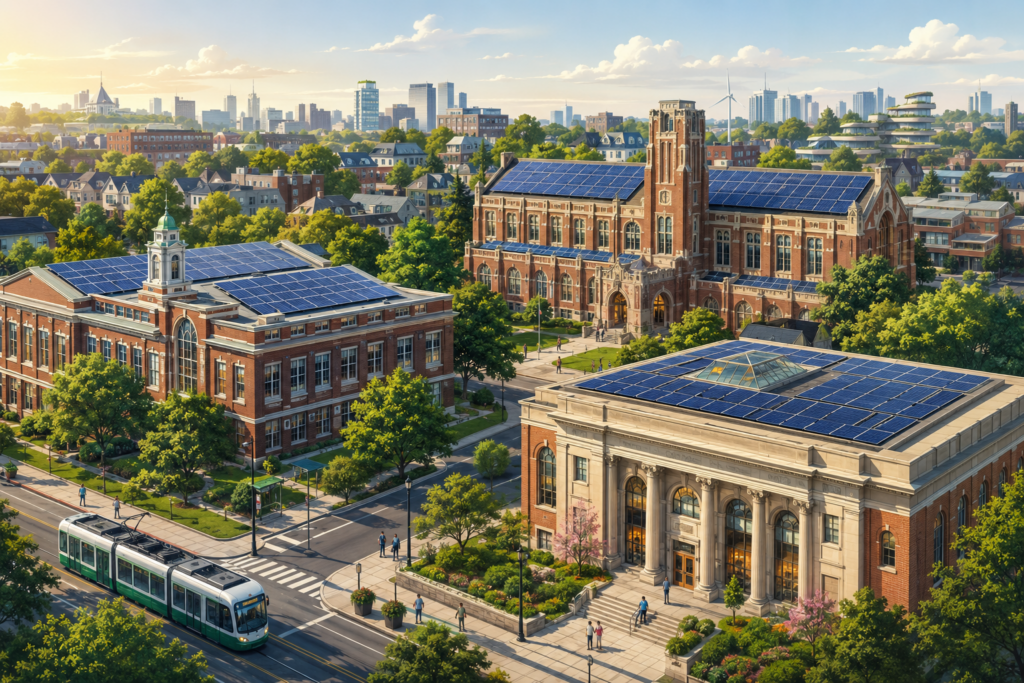
The town plans to invest $3.2 million in fiscal year 2027 for four solar energy installations at Brookline High School, the Brookline Village Library, Fire Station One, and the Hayes School. The initiative is projected to save between $12 million and $15.7 million over 25 years, with funding drawn from the Capital Improvements Plan rather than operating budgets. A working group identified 22 potential sites, designating these four as Phase 1 toward Brookline’s 2050 net-zero carbon goal.
What the Numbers Mean for Municipal Finances
The $12 million to $15.7 million in projected savings translates to roughly $480,000 to $628,000 annually once systems are operational. That’s meaningful in a town wrestling with structural deficits – where fixed costs rise faster than Proposition 2½ allows property tax revenue to grow. Brookline voters approved a $23.25 million operating override in May 2026, adding approximately 18 percent cumulatively to tax bills through fiscal 2029. Solar savings won’t reverse that increase, but they may reduce pressure on future overrides if energy costs stabilize as projected.
The initiative survived budget scrutiny only because the override passed. Town documents noted the solar program would have ended under service reduction scenarios, illustrating how capital investments compete with operational priorities during fiscal strain. Buyers evaluating Brookline homes should recognize that long-term infrastructure decisions like this one reflect municipal willingness to trade upfront capital for operational relief – a strategy that may support tax predictability over time, though results remain uncertain until systems deliver.
What Buyers and Sellers Should Watch
Climate-conscious buyers: Brookline’s progress toward its 2050 net-zero target may strengthen the town’s appeal relative to communities with abstract climate commitments. In my experience showing Brookline neighborhoods, buyers rarely ask about municipal solar during tours, but fiscal health questions come up frequently in negotiations.
Investors and landlords: Municipal fiscal health influences long-term holding costs, and energy savings that reduce operating budget pressure could theoretically moderate future tax levy growth, though the 25-year payback horizon and implementation risks mean near-term tax relief remains speculative at best.
Properties near Phase 1 sites: Proximity to Hayes School Homes or Brookline Village facilities may see modest perception benefits as visible solar installations signal municipal investment in neighborhood infrastructure. In practice, quantifying direct property value impact from nearby municipal solar remains difficult without comparable sales data.
Sellers timing the market: The solar initiative doesn’t change near-term inventory dynamics or mortgage rate sensitivity, but it contributes to Brookline’s positioning as a climate leader community within the Boston metro.
Long-term homeowners: The 25-year savings horizon aligns with typical homeownership timelines, meaning energy cost stabilization could benefit residents who plan to stay in Brookline through retirement.
Tax-sensitive buyers: While solar savings won’t offset the recent 18 percent override increase, they represent one mechanism through which the town manages operational costs without additional levy pressure.
Climate Goals Meet Capital Strategy
The town’s selection of Brookline High School, Fire Station One, and two school facilities for Phase 1 reflects prioritization based on energy consumption profiles and roof conditions. The 22-site pipeline suggests the town views this as a multi-phase, decade-long infrastructure buildout rather than a one-time project, with leftover appropriation funds earmarked for future installations.
For real estate decision-makers, the solar initiative represents one data point in evaluating Brookline’s fiscal trajectory and environmental positioning. It won’t offset the 18 percent tax increase already underway, but it signals municipal capacity to execute capital projects that align climate ambition with budget pragmatism – a combination that may support long-term value stability in a high-tax, high-price market where fiscal credibility matters.
Source: Brookline.News