Town Meeting approved a 35-unit rental project at the former Maimonides School. What landlords, renters, and adjacent homeowners should know now.
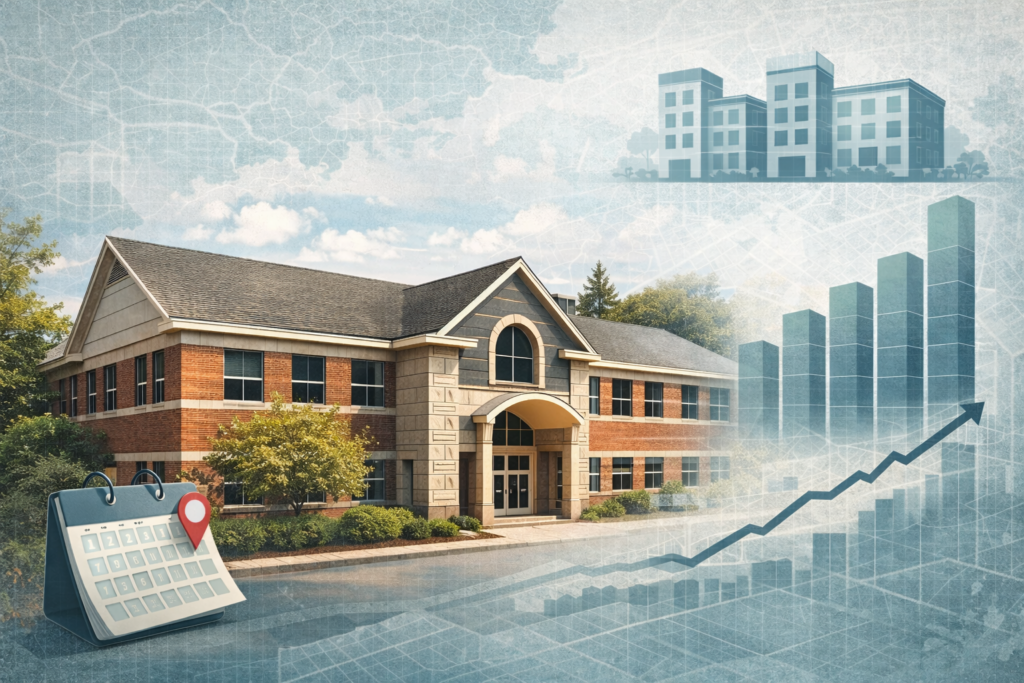
Brookline’s housing shortage just got a measured response: Town Meeting approved a zoning overlay on November 18, 2025, clearing the way for 35 rental apartments at the former Maimonides School building on 2 Clark Road. The adaptive reuse project—converting a 34,670-square-foot structure built in 1997—will deliver five permanently affordable units and 30 workforce-targeted rentals in a town where average rent now exceeds $3,650 per month. For landlords, renters, and nearby homeowners, the timeline and unit mix matter more than the headlines.
What the Overlay District Actually Permits
The Clark Road Multifamily Overlay District allows the developer to add modest rooftop bedrooms and terraces within a 67-foot height cap, creating primarily one-bedroom units averaging 700 square feet and two-bedroom units around 1,250 square feet. The site will retain approximately 35 parking spaces—roughly one per unit—and sits a five-minute walk from Brookline Hills Station on the Green Line. Developers must apply for Site Plan Review by April 19, 2027, or lose overlay protections. That deadline will likely accelerate financing and design decisions through 2026.
Landlords: Watch Rent Comps and Absorption
Landlords in nearby two- and three-family buildings: New supply targeting workforce renters may compress rents if this project and others—like the 429 Harvard Street development—deliver units faster than the market absorbs them, particularly in Coolidge Corner and Brookline Hills pockets where vacancy remains below 1% seasonally.
Renters earning 60–100% of area median income: The five affordable units will be income-restricted and deed-restricted for decades, likely oversubscribed; the remaining 30 market-rate units may lease in the $2,800–$3,600 range based on workforce pricing goals, still above affordability thresholds but below Brookline’s median—monitor the developer’s lease-up timeline and apply early if you qualify.
Adjacent homeowners within 200 feet: Rooftop additions and increased density may affect light, noise, and perceived neighborhood character; some buyers may discount proximity to multifamily, though walkability to transit and retail can offset concerns—understand zoning limits and request site plan details before listing.
Adaptive Reuse and the Affordability Gap
The project avoids demolition, preserving 50–75% of embodied carbon compared to new construction, according to AIA and National Trust research. Brookline currently faces a shortage of 2,900 units for households earning below 50% AMI and 500 units for those at 50–80% AMI. This project won’t close that gap—five affordable units represent just 14.3% of the total, slightly below the town’s 15% inclusionary threshold—but it does add modest workforce inventory in a market dominated by luxury rentals and large single-family homes.
What Buyers and Investors Should Ask
Sellers of single-family or small multifamily properties near Clark Road: The overlay may shift buyer interest toward multifamily conversion candidates or tear-down plays as investors anticipate further zoning changes—hire an appraiser familiar with overlay districts to capture any premium or discount in comps.
Institutional investors or REITs: Workforce housing in a strong rental market with 0.77–3.28% vacancy may appeal to ESG-focused funds, but deed restrictions on affordable units and modest unit sizes suggest a long hold rather than a flip—model 2–3% annual rent growth and confirm affordability caps don’t limit market-rate upside.
Source: Source
About Elad Bushari
Elad Bushari is an Executive Vice President at Compass and a leading Brookline, Massachusetts real estate agent with over $1 Billion in career sales and 22+ years of experience. He represents buyers, sellers, landlords, tenants and developers across Brookline's most sought-after neighborhoods, including Coolidge Corner, Fisher Hill, Chestnut Hill, Washington Square, and Brookline Village.
A former Inc. 5000 founder and REALTOR® Magazine "30 Under 30" honoree, Elad specializes in luxury single-family homes, condominiums, and multi-family investments throughout Greater Boston. His data-driven approach and deep local knowledge help clients navigate Brookline's competitive market with confidence.
Elad Bushari's Profile
Filed under: Construction Update