
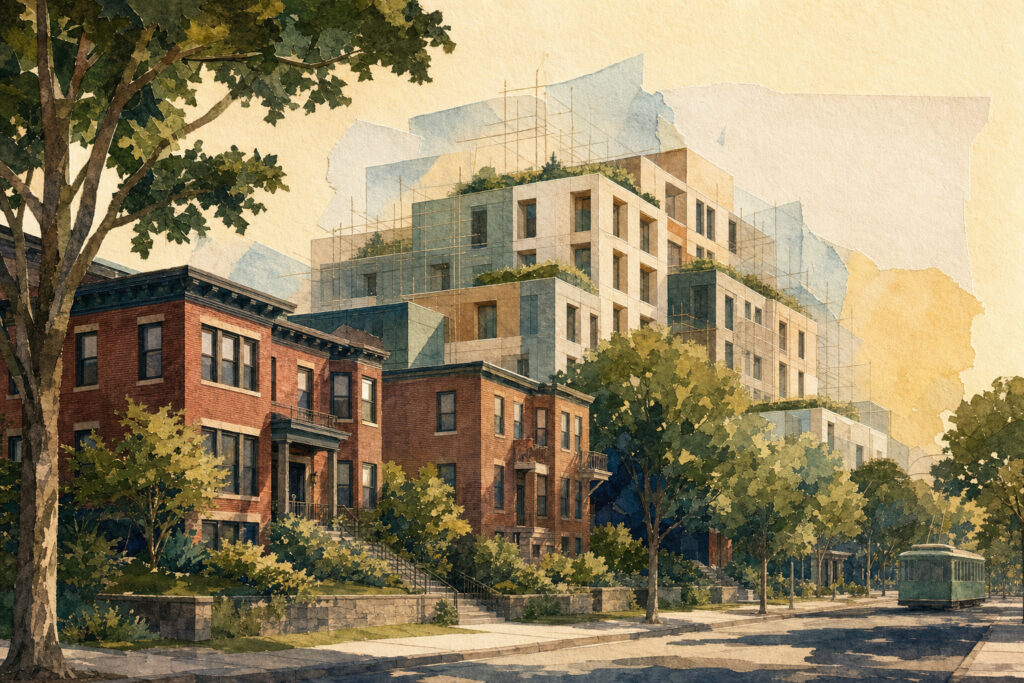
The Brookline Housing Authority is moving ahead with its Walnut Street redevelopment after securing new state and federal financing, with demolition and construction now expected to begin in 2027. The project would replace 32 aging apartments with 96 family-oriented affordable units and matters locally because it is a major affordable-housing supply addition in a high-demand location. For buyers, sellers, and renters watching Brookline neighborhoods, understanding the project’s timeline, funding structure, and unit mix offers a more realistic view of how this redevelopment may affect the surrounding market.
Walnut/High Street Project Timeline and Funding
As of August 2025, the BHA reported that Phase 1 architects were over halfway through design, though the authority was still awaiting state funding awards at that time. The Town of Brookline’s Housing Advisory Board committed up to $7.5 million from the Affordable Housing Trust Fund for the effort, part of a layered financing approach that includes tax-exempt bonds, federal low-income housing tax credits, and Community Preservation Act support. The replacement building is planned as passive house construction, a detail that signals energy efficiency and long-term operating cost control. Brookline buyers often care less about the headline unit count than about whether a project is fully funded, because financing gaps can delay construction and move-in timing.
What Brookline Buyers Should Watch
Family buyers: Households needing school access or multiple bedrooms may view the 96-unit family housing as a long-term community stabilizer that supports neighborhood continuity and reduces displacement concerns, but you should factor in surrounding Brookline homes inventory and school-zone priorities rather than relying on the project headline alone.
Buyers comparing near-transit pockets: Walnut/High Street may emerge as a future affordable-housing node, and more supply can soften some scarcity pressure in the immediate area—though not uniformly across Brookline—so track the project’s phase-by-phase schedule before assuming near-term resale effects.
High-opportunity location framing: Transit-oriented locations remain the key framing for Brookline’s larger public-housing redevelopments, which may reinforce demand for the broader submarket, so compare this project to other Brookline multifamily pockets before drawing conclusions about your own search criteria.
Implications for Sellers and Landlords
Sellers near redevelopment sites: Homes adjacent to construction often draw questions about disruption and future neighborhood change, and buyers may discount for noise, staging, or uncertainty during buildout, so prepare a concise, factual explanation of the project and its 2027 timeline to address concerns proactively.
Landlords in the rental market: The Brookline rental market tends to be sensitive to any meaningful new affordable-family supply, which may affect tenant expectations more than immediate rents, so emphasize unit quality, amenity set, and commute convenience when marketing your properties.
Renters seeking stable family housing: Households monitoring public and mixed-income pipeline projects should follow BHA notices and application timing rather than waiting for completion news, since access rules and waitlists matter as much as the new building itself.
The difference between “construction can begin” and actual occupancy is important in Brookline; those milestones can be separated by a long buildout period. The Walnut/High Street site matters because Brookline has limited large-scale redevelopment opportunities, making a project of this size unusual in the local market. Any buyer, seller, or landlord should distinguish clearly between the current phase and the broader BHA portfolio, since not all properties are on the same funding track.
Source: Source