
A new 54-unit affordable senior building in Coolidge Corner reveals what's working—and what's still missing—in Brookline's senior housing market.
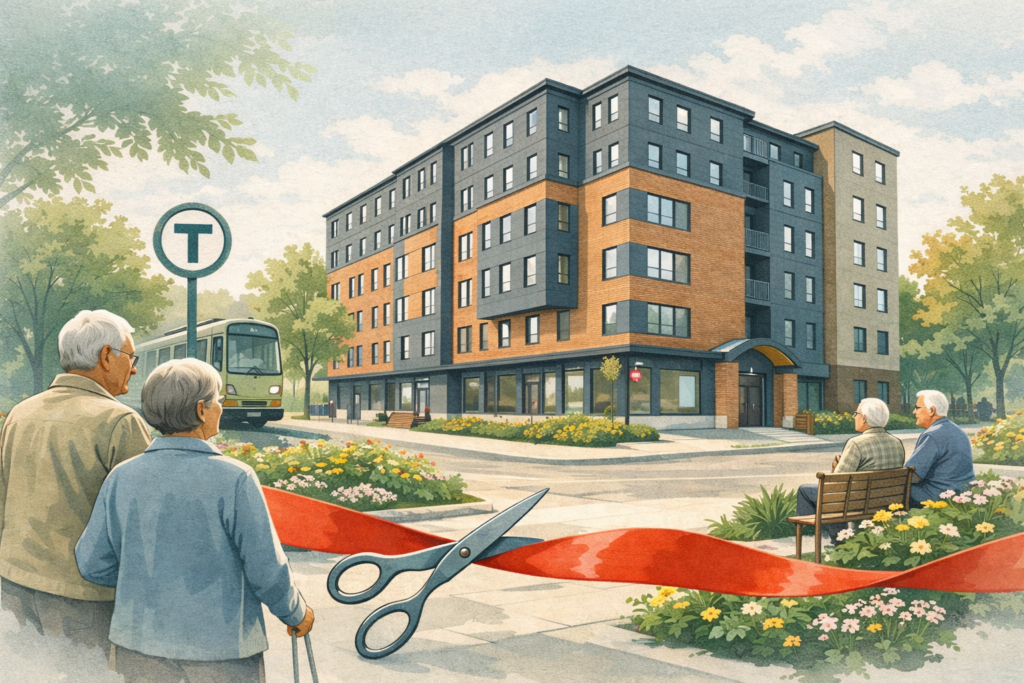
When Hebrew SeniorLife cut the ribbon on 108 Centre Street in June 2025, the 54-unit affordable senior building represented more than another development milestone—it exposed the gap between Brookline’s growing elderly population and the housing inventory that serves them. For families navigating aging-parent transitions, developers weighing feasibility, and neighbors debating density, this project offers a case study in what affordable senior housing can accomplish in Coolidge Corner—and where the town still falls short.
What Opened at 108 Centre Street
The seven-story building includes 54 one-bedroom apartments, all restricted to seniors 62 and older earning up to $69,480 for a single person or $79,440 for a couple. Sixteen units serve households at 30% of area median income; the remaining 38 target 60% AMI. Designed to Passive House standards, the project is projected to reduce energy consumption by approximately 188,680 kWh annually—nearly 63% below baseline—generating estimated annual cost savings of around $28,000.
The Affordability Math Behind the Project
This wasn’t a market-rate conversion. The Town of Brookline allocated roughly $628,637 in CDBG funds and $861,300 in HOME funds to close the financing gap, alongside state and private capital from Eastern Bank, MassHousing, MassDevelopment, and Massachusetts Housing Partnership. That layered capital stack is typical for 100% affordable projects in high-cost suburbs, where land and construction costs make achieving financial feasibility nearly impossible without subsidy.
What Brookline Buyers and Families Should Watch
Brookline’s senior population is projected to grow by 47% through 2030—an additional 3,500 seniors—while approximately 1,150 units currently serve elderly or disabled residents. With waitlists at subsidized properties stretching years, families should apply now to Hebrew SeniorLife and Brookline Housing Authority properties rather than wait for a crisis. Track the town’s Subsidized Housing Inventory, which stood at 10.76% as of November 2025, to anticipate future Chapter 40B projects and rezoning discussions that may affect home values near densification sites.
Implications for Brookline’s Housing Market
For Families and Seniors Families with aging parents in Brookline face a looming inventory crisis: with 3,500 additional seniors expected by 2030 and only 1,150 existing affordable units, waitlists are expected to stretch for years. To avoid forced decisions later, it is critical to apply to Hebrew SeniorLife and the Brookline Housing Authority immediately. Similarly, seniors themselves face a severe affordability gap; market rents for one-bedroom units hover around ,855 compared to a 60% AMI threshold of roughly ,500. Without subsidized inventory, displacement is a significant risk, making it essential to explore rental options early and apply to multiple waitlists simultaneously.
For Developers and Housing Sponsors For nonprofit developers, the capital stack used at 108 Centre Street—which blends CDBG, HOME funds, state tax credits, and private lending—offers a replicable template for making projects financially viable in transit-rich pockets. Industry professionals should study this model when evaluating future 40B senior projects in high-cost neighborhoods. Furthermore, energy-conscious developers should note that the project’s Passive House standards deliver approximately $28,000 in annual savings. As energy efficiency continues to influence building codes, evaluating Passive House certification could be key to improving the feasibility of new construction.
For Investors and Homebuyers Market-rate landlords and condo investors should anticipate that the success of 100% affordable projects may accelerate inclusionary zoning mandates, potentially requiring future affordability set-asides. It is advisable to monitor Town Select Board positions on overlay zoning and Section 8 integration requirements. Meanwhile, homebuyers near commercial corridors should recognize that the seven-story buildings in Coolidge Corner establish a density precedent. Since underutilized sites near transit may face similar rezoning debates, buyers are encouraged to research zoning history before purchasing near commercial parcels in North Brookline.
Source: Source
About Elad Bushari
Elad Bushari is an Executive Vice President at Compass and a leading Brookline, Massachusetts real estate agent with over $1 Billion in career sales and 22+ years of experience. He represents buyers, sellers, landlords, tenants and developers across Brookline's most sought-after neighborhoods, including Coolidge Corner, Fisher Hill, Chestnut Hill, Washington Square, and Brookline Village.
A former Inc. 5000 founder and REALTOR® Magazine "30 Under 30" honoree, Elad specializes in luxury single-family homes, condominiums, and multi-family investments throughout Greater Boston. His data-driven approach and deep local knowledge help clients navigate Brookline's competitive market with confidence.
Elad Bushari's Profile