Brookline’s fiscal crisis isn’t the story you’ve been told. Behind the headlines about “runaway spending” is a town trying to fund first‑class schools and services with a tax system capped in the 1980s and a tax base that refuses to grow. While homeowners shoulder some of the highest bills in the state, Brookline keeps saying…
Brookline’s Budget Crisis Isn’t About Runaway Spending – It’s About a Tax Base That Refuses to Grow
Brookline’s budget crisis has been framed as a story of mismanagement and overspending, but the math tells a different story. The town is a high‑service community whose costs are rising slightly faster than a revenue system deliberately capped by state law, even as home values and expectations for services climb. The real choice now is stark: either grow the tax base, keep voting for overrides, or accept a downgrade in the services that defined Brookline’s appeal.
The “New Math” of Brookline’s Budget
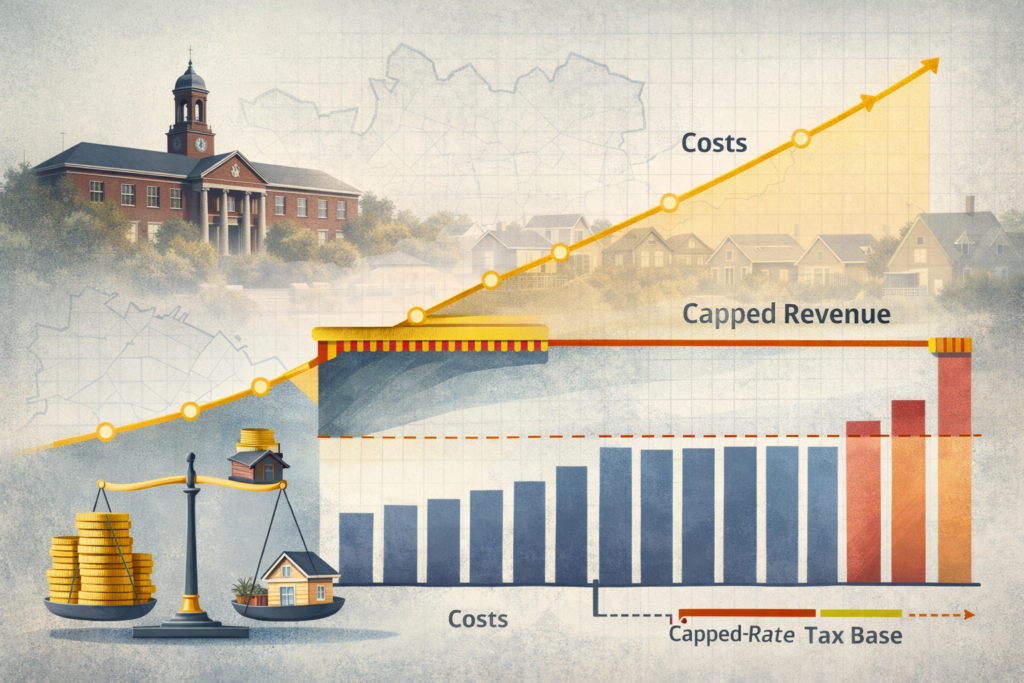
At the center of this story is Proposition 2½, the 45‑year‑old Massachusetts law that caps how fast local property tax revenue can grow. The popular shorthand: “values up 3% + 2.5% = 5.5% more money for the town”—sounds intuitive but is wrong in practice. Under Prop 2½:
- Each year, Brookline’s levy limit (the maximum the town can raise in property taxes) can grow by:
- 2.5% over the prior year’s levy limit, plus
- an additional dollar amount for new growth (new construction, major renovations, condo conversions, etc.).
- Pure market appreciation of existing homes does not increase the total levy limit by itself. It changes how the pie is divided among homeowners, but not the size of the pie.
Recent classification data show that, when you combine the 2.5% cap with realistic new growth, Brookline’s total levy has been rising at roughly 3.5–4% per year, not 5.5–6%. Meanwhile, the big‑ticket items—health insurance, salaries under collective bargaining, special education tuition and transportation, utilities—have been running hotter than that. The town itself acknowledges that fixed costs are rising faster than recurring revenues constrained by Prop 2½.
That is the structural squeeze: the cost of “level services” is climbing faster than the maximum legal growth in recurring revenue. This is not unique to Brookline; the Massachusetts Municipal Association has documented a similar structural crisis in cities and towns across the state.
When One‑Time Money Meets Structural Limits
Layered on top of the legal cap was a temporary sugar high: federal pandemic relief. During the pandemic, Brookline, like almost every district in the country, used federal aid (including American Rescue Plan funds) to hire staff and expand services. Those funds were always time‑limited, with obligations ending in 2024 and final disbursements in early 2025.
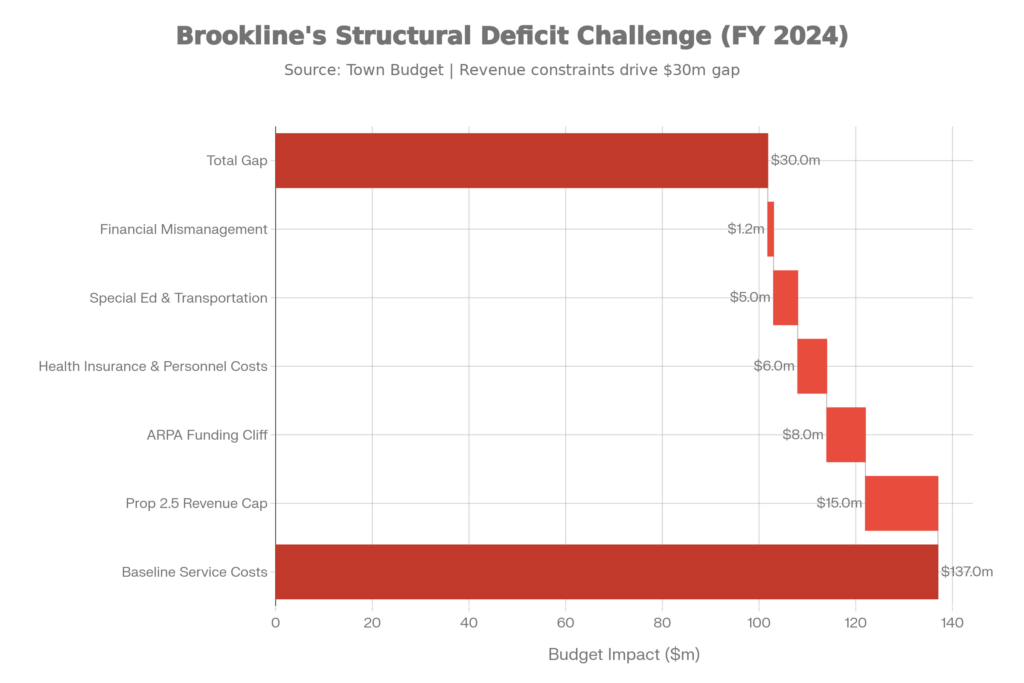
When that “ARPA cliff” hit, Brookline was left with permanent costs and disappearing one‑time money. On the school side alone, the result was an $8.2 million shortfall just to maintain services into FY26. Combined with town needs, officials have pointed to a much larger structural gap, forcing a choice between cuts, overrides, or both.
This cliff was made worse by internal missteps. An investigation uncovered that federal special education funds intended for disabled students (IDEA dollars) had been used to cover general operating costs—something federal law explicitly prohibits. A deputy superintendent responsible for special education resigned, citing “an endless stream of budget, accounting, and financial irregularities,” and a complaint was filed with the U.S. Department of Education’s Office for Civil Rights. The town ordered an independent audit, adding cost and eroding public trust.
So yes, there was mismanagement. But even with flawless administration, Brookline would still be staring at the same basic math problem: a high‑expectation, high‑service town trying to live within a 3.5–4% revenue growth path while its core cost structure grows faster.
What Residents Feel: Cuts, Not Luxuries
If this were simply a story of government excess, one would expect to see expansive new programs and gold‑plated perks. Instead, the crisis is showing up as cuts and retrenchment.
On the school side, the district has:
- Eliminated the Office of Educational Equity in a narrow 5–4 vote, saving about $337,000 but removing a central hub for equity work.
- Targeted or reduced paraprofessionals, IT support, food service roles, and administrative staff.
- Reduced or threatened course options, making it harder for students to double up in advanced subjects or access as many electives as before.
- Delayed or limited services for some of the most vulnerable students, including occupational therapy, adapted physical education, and support for visually impaired students, as special education funding was stretched and misapplied.
These are not the moves of a town luxuriating in excess. They are the signs of a system backing into austerity one line item at a time.
The Real Choice: Grow, Override, or Cut
Once the new math is laid bare, Brookline’s options simplify into three paths:
- Expand the commercial tax base.
- Win repeated tax overrides at the ballot box.
- Reduce the level of services.
Overrides have become increasingly common—effectively a recurring community decision to raise the levy limit to keep pace with costs. But residents already shoulder some of the highest average single‑family tax bills in Massachusetts, around $20,000 per year, with FY26 bills projected to rise another 6.1% for a median home. Each override, and each jump in assessed value, lands squarely on existing homeowners.
Service reductions, meanwhile, chip away at exactly what makes Brookline attractive: schools, walkability, amenities, and support systems that have historically justified high prices and high taxes.
That leaves the third path—the one the current tax structure practically begs for: grow the tax base.
Commercial Buildings as a Lifeline
Encouraging more and better commercial buildings is the cleanest structural fix available. Unlike overrides, which ask existing taxpayers to pay more, new commercial value expands the pie.
- Commercial development produces “new growth.” When new offices, labs, or mixed‑use buildings go up, they add entirely new assessed value, permanently raising the levy limit and the town’s recurring revenue capacity.
- It shifts the burden off homeowners. With a stronger commercial share of the tax base, each additional dollar of town spending is supported by more non‑residential value, easing pressure on single‑family and condo owners.
One proposal illustrates the stakes: the largely vacant Chestnut Hill Office Park. Plans to redevelop it into a dense, mixed‑use complex—including commercial space and height—were projected to add millions in annual tax revenue, on the order of $5–9 million per year once fully built. That kind of recurring money would go a long way toward stabilizing school and town budgets without another painful override.
But community resistance to height, density, and change has stalled or complicated such projects, forcing developers into contentious processes and, in some cases, state‑level appeals. Each time Brookline says “no” or “not like that” to serious commercial or mixed‑use proposals, it effectively says “yes” to:
- Higher residential tax bills.
- Deeper future school and service cuts.
- Continued dependence on overrides.
The irony is that the very lifestyle Brookline residents prize—walkable, transit‑adjacent, urban amenities—is best supported by exactly the kind of mixed‑use, transit‑oriented commercial growth they often oppose.
Lifestyle Upside: Walkability, Transit, Emissions
Well‑placed commercial and mixed‑use buildings are not just fiscal tools; they are lifestyle upgrades:
- Walk‑to‑work, walk‑to‑errands. Offices, labs, and services near Green Line stops and key bus routes mean more residents and employees can live and work in town without a car commute, cutting congestion and emissions and reinforcing the urban village feel.
- Better transit viability. More jobs and residents clustered in transit corridors support higher ridership, better service, and a more realistic car‑light lifestyle.
- Street vitality and safety. Active ground floors, evening foot traffic, and a mix of uses create safer, more vibrant streets—exactly the environment buyers are paying a premium to access.
In other words, the same buildings that keep the budget sustainable are the ones that support the kind of daily life Brookline markets to the world.
Condo Conversions: The Quiet Tax‑Base Multiplier
Beyond big commercial projects, Brookline has another powerful, underused lever: condo conversions and small‑scale multifamily intensification in already‑urban neighborhoods.
Take a typical two‑family in Coolidge Corner. As a single asset, it might sell in the mid‑$2 million range. When legally converted and sold as two separate condos, the combined value of those units often lands in the $6–7 million range. The land and building footprint haven’t changed, but the taxable value has increased by ~200%.
Under Massachusetts rules, that increase attributable to physical and legal changes counts as new growth, which:
- Raises the levy limit.
- Provides recurring revenue every year going forward.
- Does so without consuming more land or pushing development into outlying neighborhoods.
And it does something else Brookline badly needs:
- Creates more homes for more families. Two households can now own or live where effectively one did before, often in exactly the kinds of walkable, transit‑rich locations (Coolidge Corner, Washington Square, along Beacon and Harvard) that should be housing more people, not fewer.
- Aligns with lower‑carbon living. Condos near the Green Line and major bus routes encourage walking, biking, and transit instead of driving, directly supporting climate goals.
Every time policy or politics makes condo conversion harder in these core areas, the town forgoes a simple, repeatable way to increase taxable value and housing supply in the places that can handle it best.
The Growth Allergy Problem
Viewed through this lens, Brookline’s crisis looks less like a spending addiction and more like a growth allergy in a town that wants first‑class services.
The numbers are unforgiving:
- Revenue can grow only about 3.5–4% a year under Prop 2½ plus normal new growth.
- Key costs have been outrunning that, even before accounting for mismanagement and the ARPA cliff.
- Overrides are politically and financially exhausting, especially when average tax bills are already among the highest in the state.
- Cuts erode the very schools and amenities that keep property values and demand high.
That leaves one responsible path if Brookline wants to maintain its identity:
embrace more value on the same land—via commercial buildings and condo‑ and multifamily‑friendly zoning in the places that are already urban.
A Clear Path Forward
The town faces a simple but difficult decision:
- Expand the commercial tax base and welcome higher‑value, transit‑oriented mixed‑use and condo development in appropriate locations;
- Or keep asking the same homeowners for override after override;
- Or accept a slow, grinding reduction in the services—schools, supports, amenities—that made Brookline desirable in the first place.
The new math doesn’t absolve leaders of mismanagement, nor does it invalidate residents’ fears about change. But it does make the trade‑offs explicit. If Brookline wants excellent schools, strong supports, and a walkable, low‑carbon urban lifestyle, the town can no longer afford to keep its tax base frozen in an old pattern under a 2.5% growth cap.
Growing up—more commercial space, more condos, more households around transit—is not selling out. It is the only realistic way to pay for the Brookline people say they want to live in.
About Elad Bushari
Elad Bushari is an Executive Vice President at Compass and a leading Brookline, Massachusetts real estate agent with over $1 Billion in career sales and 22+ years of experience. He represents buyers, sellers, landlords, tenants and developers across Brookline's most sought-after neighborhoods, including Coolidge Corner, Fisher Hill, Chestnut Hill, Washington Square, and Brookline Village.
A former Inc. 5000 founder and REALTOR® Magazine "30 Under 30" honoree, Elad specializes in luxury single-family homes, condominiums, and multi-family investments throughout Greater Boston. His data-driven approach and deep local knowledge help clients navigate Brookline's competitive market with confidence.
Elad Bushari's Profile
Filed under: Property Taxes, Zoning