
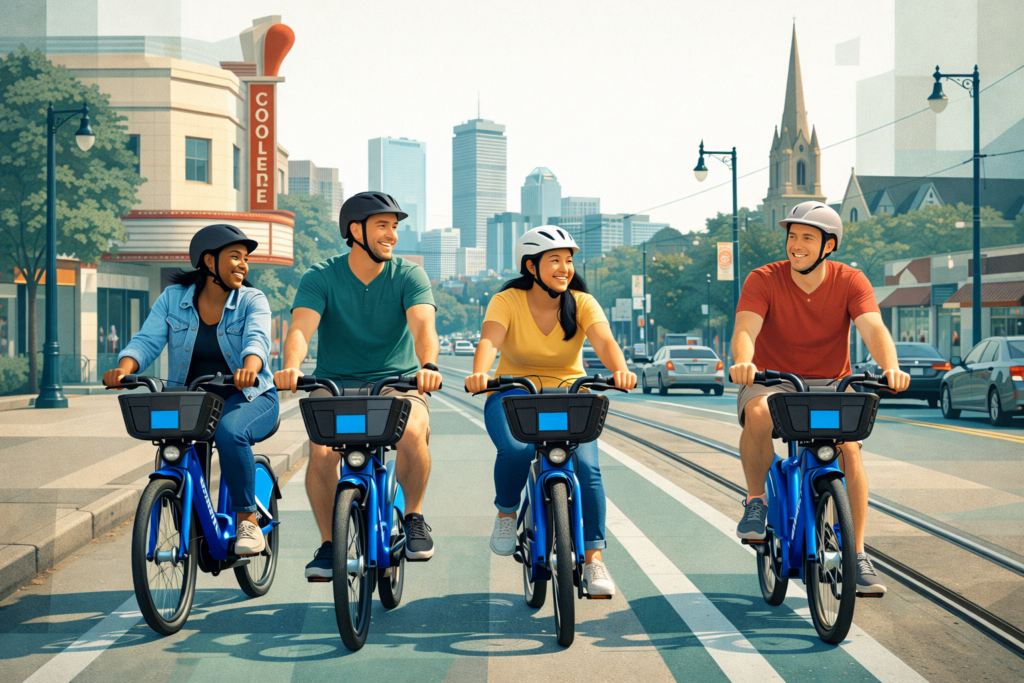
Brookline’s commitment to adding 25 new Bluebikes stations between 2026 and 2030 – growing from 14 to approximately 39 stations – represents incremental connectivity improvement that influences walkability scores and commute optionality in micro-markets near new stations. Brookline is set to enhance its transportation infrastructure with stations planned for Coolidge Corner, Chestnut Hill, and transit corridors.
Where the Stations Are Going and Why It Matters
The implementation timeline reveals strategic prioritization. In 2026, seven stations will launch including Marion Street at Park Street, Beaconsfield MBTA Station, and Longwood MBTA Station, according to the town’s Master Plan. The 2027 cohort targets seven more locations including Brandon Hall/Fairbanks MBTA Station, Dean Road MBTA Station, and Coolidge Corner Library. By 2030, the plan reaches Chestnut Hill Commercial Area and Bournewood Hospital. The clustering around Green Line stations reflects documented demand patterns—transit-adjacent stations generate substantially higher ridership than residential-only sites.
Brookline recorded over 127,000 Bluebikes trips in 2024, demonstrating year-over-year growth that outpaces system-wide expansion, per the planning documents. Electric bikes introduced in late 2023 now account for approximately 25 percent of trips despite representing a smaller fleet share, indicating strong user preference on Brookline’s hilly terrain. More than 70 percent of regional rapid transit stops have Bluebikes docking within 200 meters, enabling seamless multimodal commutes for monthly pass holders.
What Buyers and Sellers Should Watch
Condo buyers near new transit stations: Properties within a five-minute walk of planned 2026–2027 stations at Beaconsfield, Longwood, and Dean Road may see modest walkability score increases and appeal to car-light households, though in my experience, pricing impacts from such infrastructure often lag deployment by 12–18 months.
Single-family sellers in South Brookline: The Master Plan identifies 19 stations needed south of Route 9 to achieve a 10-minute walking shed, but only six are funded in this phase—meaning connectivity gaps persist in lower-density pockets where bike-share may remain less relevant to buyer decisions than parking and garage capacity.
Rental properties near new stations: Proximity to Brookline apartments with new Bluebikes access may incrementally strengthen lease-up velocity for units near Longwood Medical Area or academic institutions, particularly if combined with existing Green Line access and e-bike availability.
Investors evaluating transit-oriented parcels: The phased rollout through 2030 creates a multi-year window where early station deployments near Coolidge Corner Library and Washington Square commercial nodes may generate tenant demand shifts before pricing fully adjusts—though the effect tends to be marginal rather than transformative in already-walkable districts.
Properties near Longwood MBTA Station: The 2026 station deployment at Longwood enhances connectivity for Longwood residents, potentially increasing appeal for households prioritizing multimodal commute options to the medical district.
Walkability-focused buyers in established neighborhoods: New stations in Washington Square and near Coolidge Corner Library incrementally improve already-strong walkability profiles, reinforcing these areas’ appeal to buyers who value car-optional lifestyles.
Sellers positioning properties before station launches: Marketing homes near planned 2026–2027 stations before infrastructure is visible allows sellers to highlight future connectivity improvements while managing buyer expectations about timeline and impact magnitude.
Buyers evaluating South Brookline properties: Understanding which areas receive early-phase stations versus later deployments helps buyers assess near-term versus long-term connectivity improvements when comparing properties across different micro-markets.
Funding sources include MassDOT grants, a $21.6 million federal award announced in October 2024, and Massachusetts Fair Share Supplemental Budget allocations approved in June 2025. Approximately half of federally funded stations will include integrated e-bike charging infrastructure, addressing a key operational constraint as the system scales.
The expansion occurs against a backdrop of documented equity concerns. Research on the regional Bluebikes system found that as of 2022, only 60 percent of Black residents lived in service areas compared to 75 percent of white residents. Brookline’s Master Plan explicitly balances demand with geographic equity, targeting underserved residential areas alongside high-traffic corridors—though whether this approach materially shifts access patterns remains to be demonstrated through post-deployment ridership data.
Source: Brookline.News