
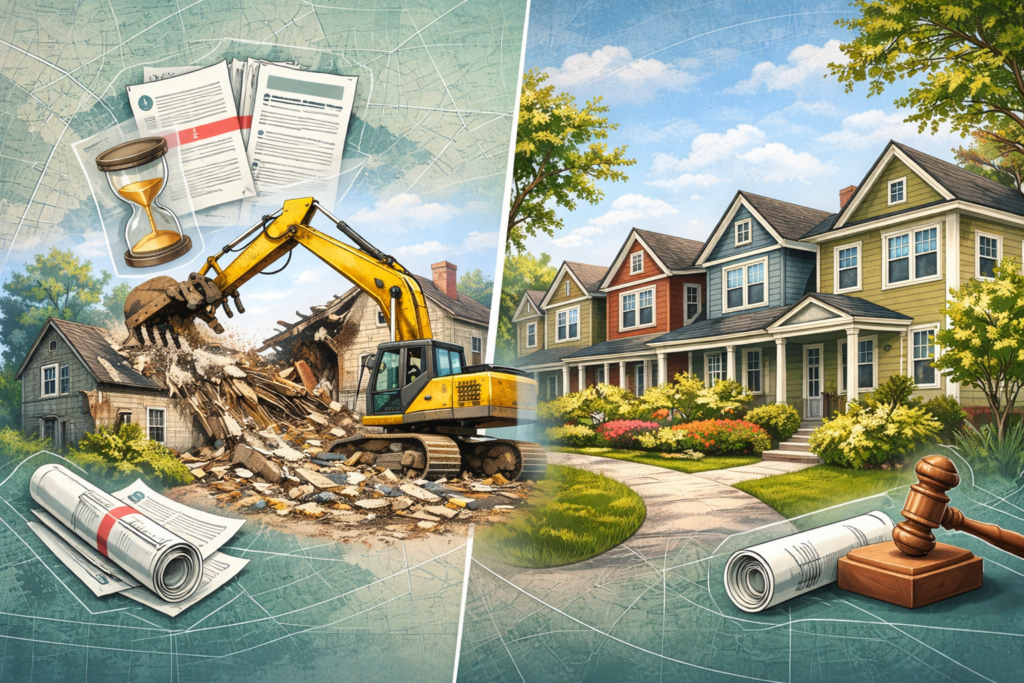
Brookline’s regulatory landscape is tilting decisively toward preservation over replacement. Recent years have seen a marked increase in applications to demolish properties deemed historically significant, prompting Town Meeting to extend demolition delays and introduce form-based zoning that rewards adaptive reuse.
Extended Demolition Delays and Preservation Review
In Fall 2022, Article 11 temporarily extended demolition delays from 12 months to a maximum of 24 months for buildings the Preservation Commission determines to be historically or architecturally significant. The extended delay was designed to be temporary, gradually reducing back to standard lengths over 12 months, but the policy reflects a broader town commitment to slowing teardowns while residents and officials explore permanent protections. Effective January 1, 2026, all full demolition cases require the applicant to post a lawn sign at the property for two weeks prior to the Preservation Commission hearing, increasing transparency and inviting neighbor input.
Properties in North Brookline and Toxteth may face extended demolition delays if deemed significant, incentivizing adaptive reuse or interior renovation over teardown and extending holding periods before conversion.
Projects that work with existing structures or follow dimensional standards under form-based zoning (T-5NH, Harvard Street corridor) may move faster than traditional special-permit routes, while demolition-based projects face longer delays and higher regulatory scrutiny.
Form-Based Zoning and Adaptive Reuse Incentives
Rather than outright demolition bans, Brookline is using zoning to make preservation economically viable. The T-5(NH) form-based zoning approved in Spring 2022 for the north Harvard Street area has encouraged expanded living area without demolitions, suggesting that allowing interior expansion, basement and attic conversion, and additional units on preserved lots can satisfy development goals without demolition. In November 2025, Town Meeting approved the Clark Road Multifamily Overlay District, creating two zones to facilitate adaptive reuse of the former Maimonides school into 35 multifamily units, including 5 affordable units, while prohibiting new construction and demolition in the CRM-I zone.
Two-family and three-family converted units—especially via ADU, third-unit, or adaptive reuse zoning—may represent emerging affordable options in Brookline neighborhoods.
New multifamily conversions may boost neighborhood density and property values in T-5NH and Harvard Street corridor zones.
What Homeowners and Investors Should Watch
Homeowners in single- and two-family zones: Entire neighborhoods (Toxteth, north Harvard, Chestnut Hill) are seeing form-based and overlay zoning amendments that may increase development pressure and neighbor activity while making it harder for adjacent properties to demolish and expand.
Landlords and investors in multifamily buildings: M-District Overlay and Harvard Street zoning as-of-right multifamily development reduces permitting friction for new projects and adaptive reuse near MBTA stations, potentially increasing competitive supply.
Preservationists and neighborhood advocates: Regulatory tools now favor preservation coalitions; extended delays and form-based standards give residents time to organize Local Historic District petitions.
Buyers evaluating teardown risk: Work with agents familiar with Preservation Commission criteria to assess whether target properties are likely to face extended delays before renovation or redevelopment.
Sellers planning major renovations: Discuss realistic timelines and preservation options with your listing agent early to understand potential delays and alternative approaches that preserve existing structures.
Source: Source