Brookline's commercial vacancy fell to 9.06% in 2024—the lowest in a decade. What residential buyers, investors, and sellers should know about this shift.
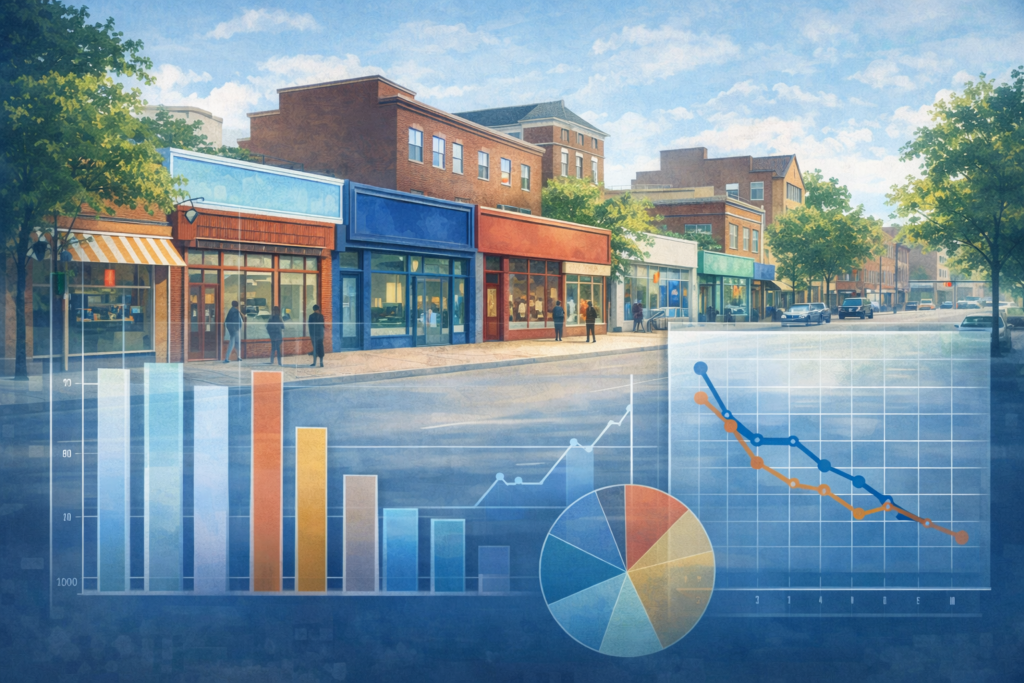
When commercial storefronts fill, residential markets take notice. Brookline’s town-wide storefront vacancy rate dropped to 9.06% in 2024, down from a pandemic peak of 12.5% in 2021 and the lowest level in approximately 10 years, according to the Town’s 2024 Commercial Area Vibrancy Report. The recovery isn’t uniform—Coolidge Corner led the rebound, while Brookline Village saw vacancies tick up. For buyers, sellers, and investors, the implications reach beyond retail: neighborhood vibrancy, property values, and investment timing are all in play.
What the Numbers Reveal About Brookline’s Commercial Mix
Brookline now counts 695 total storefronts across eight commercial areas, surveyed between June and August 2024. Service businesses—salons, medical offices, professional services—dominate at 342 locations (54%), followed by restaurants at 167 (26%) and traditional retail at just 107 (17%). That service-heavy mix matters: it tends to generate steadier foot traffic and longer lease terms than consumer retail, which remains elevated at a 4.0% vacancy rate—down slightly from 4.1% in 2023 but still triple the pre-COVID 2019 level of 1.2%. Office vacancy held at 6.2%, and triple-net retail rents stayed flat at $43.42 per square foot.
Neighborhood-Level Divergence: Where Recovery Is—and Isn’t—Happening
Coolidge Corner posted the largest decline in vacancies, with seven new occupancies and 10 storefronts removed for the Waldo-Durgin mixed-use development. Its vacancy rate now sits at 9.43% across 212 storefronts. Meanwhile, Brookline Village saw vacancy climb to 10.78%, driven by seven newly vacant spaces—four along Cypress Street alone. Chestnut Hill fared worse, with vacancy rising to 19.44% due to a single large space going dark. On the positive end, St. Mary’s Station held at 2.94% vacancy, and Putterham remained fully occupied.
What Residential Buyers and Sellers Should Watch
Buyers prioritizing walkability: Neighborhoods anchored by improving commercial clusters—Coolidge Corner, St. Mary’s Station, Washington Square—may offer more stable or appreciating values as foot traffic and amenities recover. Cross-reference vacancy trends with recent sales comps in Brookline homes near these areas before making offers.
Sellers in vibrant pockets: Homes within walking distance of active, recovering commercial districts can command premium positioning. Highlight neighborhood revitalization, new restaurant openings, and walkability in listing narratives—but verify claims against the Town’s own vibrancy data to avoid overstating recovery.
Commercial landlords and investors: The service-dominant tenant mix (54%) means lower volatility but also fewer impulse-driven retail plays. Rents remain stable at $43.42 per square foot, but Chestnut Hill and Brookline Village present selective opportunities for patient capital willing to wait for rezoning or lease-up cycles.
Restaurant operators: Outdoor dining participation dropped from 41 to 25 locations in 2024 due to increased fees, signaling margin pressure. Budget outdoor seating as a premium feature, not a given, and negotiate tenant improvement allowances while retail vacancy remains above pre-pandemic norms.
Policy Tailwinds and Development Pipeline
The Town deployed $500,000 in ARPA-funded grants to 20 small businesses in June 2024, and adopted Ground Floor Commercial Incentive Standards in July 2024 to encourage active street-level uses. The Chestnut Hill Commercial Area Study is expected to deliver rezoning recommendations by Spring 2026, which may unlock stalled projects and compress that neighborhood’s elevated vacancy. Developers should align proposals with the new Ground Floor Standards and monitor the CHCAS timeline closely.
Source: brookline.news
About Elad Bushari
Elad Bushari is an Executive Vice President at Compass and a leading Brookline, Massachusetts real estate agent with over $1 Billion in career sales and 22+ years of experience. He represents buyers, sellers, landlords, tenants and developers across Brookline's most sought-after neighborhoods, including Coolidge Corner, Fisher Hill, Chestnut Hill, Washington Square, and Brookline Village.
A former Inc. 5000 founder and REALTOR® Magazine "30 Under 30" honoree, Elad specializes in luxury single-family homes, condominiums, and multi-family investments throughout Greater Boston. His data-driven approach and deep local knowledge help clients navigate Brookline's competitive market with confidence.
Elad Bushari's Profile
Filed under: Zoning