
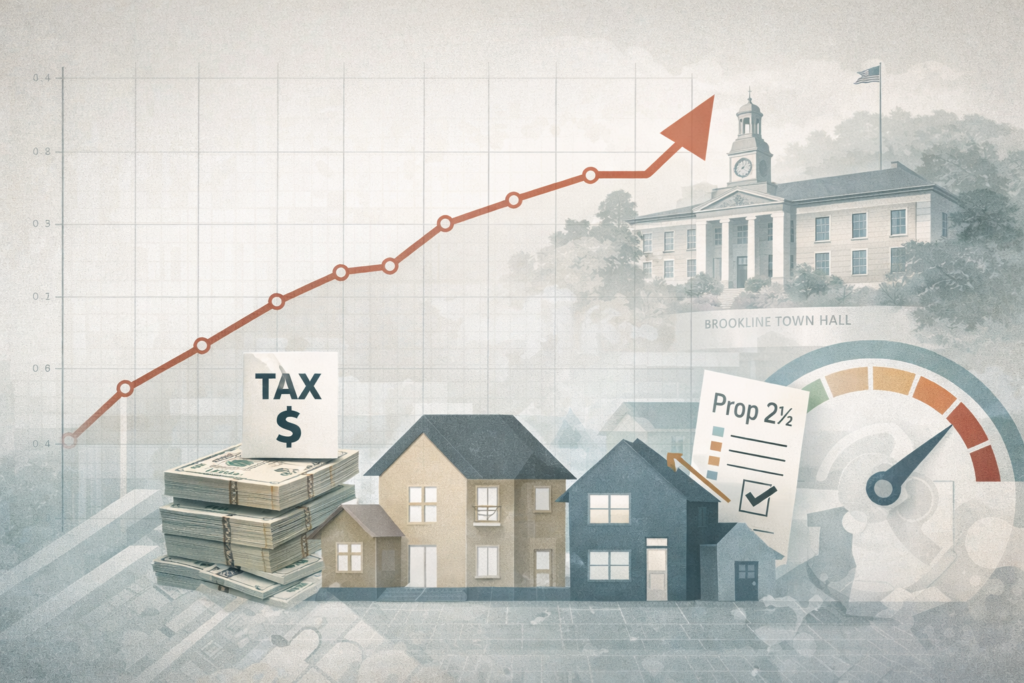
Brookline homeowners face a 6.1% increase in median single-family property tax bills for fiscal year 2026, translating to approximately $1,200 in additional annual taxes for those currently paying around $20,000. This jump reflects converging pressures: residential assessments grew 3.8% from fiscal 2024 to 2025, while Proposition 2½ constraints force the town to seek voter-approved overrides to fund schools and services. For buyers evaluating Brookline homes, understanding how tax trajectories vary by property type and neighborhood matters as much as the purchase price itself.
The article from Brookline.news outlines how the town’s structural budget deficit—driven by school costs, infrastructure needs, and employee compensation—necessitates tax increases that outpace the 2.5% annual levy growth typically allowed under state law. The FY2026 residential tax rate stands at $10.24 per $1,000 of assessed value, up from $9.87 in FY2025. But the real story lies in how this increase plays out across different property types and owner profiles.
How Tax Rates and Assessments Interact
Brookline operates under a classified tax rate system that charges residential properties $10.24 per $1,000 while commercial properties face $17.16 per $1,000 for FY2026. The residential exemption amount of $354,974 provides proportionally greater benefit to lower-valued owner-occupied homes, though the relief may feel modest when assessments themselves climb 3.8% year-over-year. Property taxes depend on both your assessed value and the levy the town needs to collect—when both rise simultaneously, homeowners experience compounding pressure.
Assessment increases follow mandatory state revaluation cycles designed to maintain equity across property classes. The town conducts complete revaluations every five years with interim adjustments, using actual arms-length sales from 12 months prior to six months following the January 1 assessment date. In Brookline’s competitive market, where the median home sale price reached $1.2 million in November 2025 (a 19.0% increase year-over-year), assessments naturally trend upward even as the methodology remains objective.
What Buyers and Owners Should Watch
Single-family buyers: The largest absolute dollar increases hit higher-valued homes in neighborhoods like Fisher Hill and Chestnut Hill, where properties often exceed $2 million and tax bills can jump $2,000+ annually—factor this into your total cost of ownership and compare effective tax rates across similar communities.
Condo buyers: Two-bedroom condos in Coolidge Corner and Brookline Village experience smaller dollar increases but meaningful percentage jumps when assessments reflect strong market demand—review recent assessment notices and calculate your projected FY2027 liability before closing.
Investment property owners: Multi-family buildings face the residential rate but higher absolute bills due to aggregate assessed values, and rising property taxes directly compress operating margins—model rent increases needed to maintain target returns and assess whether your tenant base can absorb them.
Owner-occupants considering selling: The residential exemption provides some cushion, but if you’re debating whether to sell before further tax increases, compare your current effective tax rate to what buyers will face in FY2027 when the next override cycle may materialize—tax trajectory affects buyer willingness to stretch on price.
Proposition 2½ constraints mean Brookline’s structural deficit persists beyond FY2026. The town approved a base services operating override in May 2023 that increased the levy limit by $11.98 million over three years, with FY2026 marking the final phase-in year. School budget gaps exceeding $8.2 million and rising debt service from facility renovations suggest future override requests remain likely. For prospective buyers, Brookline’s exceptional schools and services come with a tax bill that tends to outpace peer suburbs—run conservative projections assuming 4–6% annual increases rather than the statewide 2.5% baseline.
Source: brookline.news