Brookline has launched studies for Fisher Hill West and Centre Street lots. Here's how these decisions may shape neighborhoods and property values through 2026.
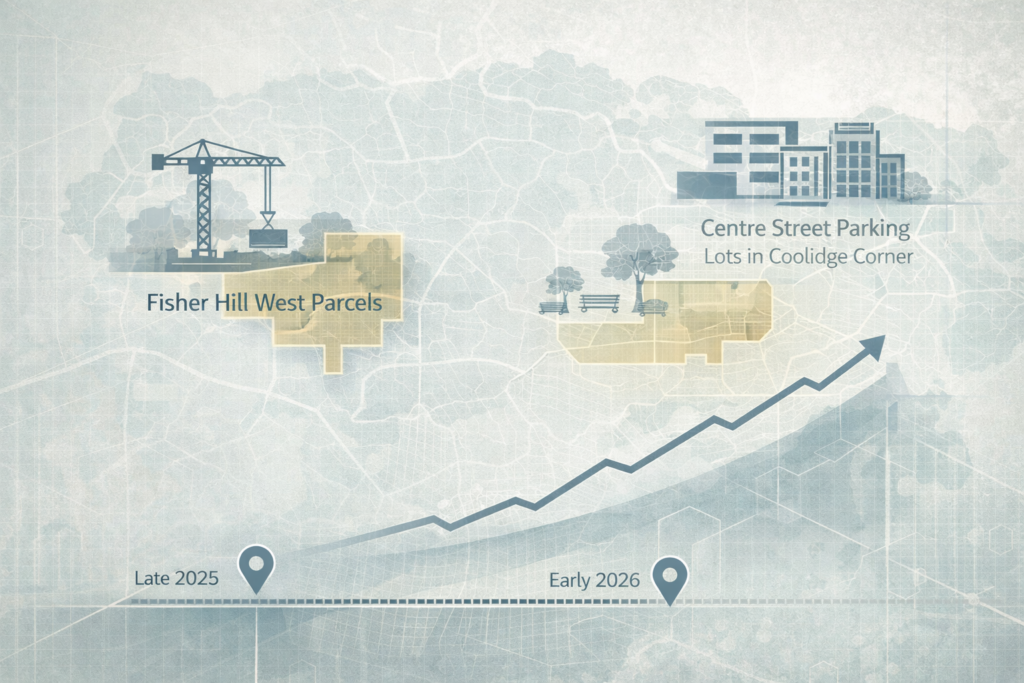
When a town controls prime real estate, the decisions it makes ripple through every neighborhood. Brookline has initiated committees to study two major municipal sites—the Fisher Hill West parcels and the Centre Street parking lots in Coolidge Corner—with recommendations expected between late 2025 and early 2026. Officials are weighing housing, recreation facilities, and municipal buildings for these locations. For buyers, sellers, and investors, these studies represent more than planning exercises: they signal where density may increase, which micro-markets may see infrastructure investment, and how the town balances tax revenue against neighborhood character.
What the Studies Cover and Why Timing Matters
The Fisher Hill West Uses Advisory Committee is examining a 25-acre town-owned parcel at 110, 124, and 150 Fisher Avenue and 146 Hyslop Road, purchased in January 2021 following negotiations with Newbury College. The site currently houses temporary municipal functions and Pierce School grades during renovation through Fall 2027. The Select Board has directed the committee to prioritize uses that minimize municipal funding, instead seeking public-private partnerships and grant funding. The Department of Planning and Community Development applied for a $150,000 state grant in June 2025 to hire consultants for community engagement and cost estimation, with grant recipients announced in November 2025.
The Centre Street Lots Exploratory Study launched in January 2025 with a 12-member committee and $225,000 in American Rescue Plan Act funding. The study examines Brookline’s most valuable municipal parking assets, which currently serve Coolidge Corner retail, theatre patrons, farmers market visitors, and residents. The consultant team, led by Brookline-based Speck Dempsey, committed to approximately one year of community engagement, with a final report due by March 31, 2026. The study methodology includes parking analysis, financial feasibility modeling, and testing three to five development concepts, with a preferred option anticipated by October 2025.
What Buyers and Sellers Should Watch
Fisher Hill buyers: If the town pursues housing or mixed-use development on the 25-acre parcel, expect increased density in a historically low-density neighborhood, which may pressure Fisher Hill home values depending on design quality and infrastructure upgrades—watch for Select Board RFP announcements through 2026.
Coolidge Corner condo owners: The Centre Street lots study explicitly tests development scenarios that could add housing supply in Brookline’s most walkable commercial district, potentially moderating condo price appreciation if substantial new inventory arrives—monitor the March 2026 final report for density and unit count projections.
Investors evaluating multi-family properties: Both studies prioritize public-private partnerships, signaling the town may seek private capital for development, which could create acquisition opportunities for Brookline investment properties near these sites if the town issues partnership RFPs.
Sellers near municipal sites: Uncertainty during planning studies tends to suppress buyer confidence in adjacent micro-markets—if you’re considering listing near Fisher Hill West or Centre Street, expect more cautious offers until the town announces preferred uses and timelines in 2026.
These studies unfold against broader planning pressures. Brookline recently fell below the state’s 10% affordable housing threshold, triggering Chapter 40B applications that bypass local zoning. The town returned above 10% as of November 18, 2025, but the temporary dip prompted as many as six 40B filings, including projects at 429 Harvard Street and 1280–1330 Boylston Street. The Fisher Hill and Centre Street decisions may influence how aggressively the town pursues affordable housing on municipal land to maintain its threshold and preserve zoning control.
Watch for committee recommendations in late 2025 and early 2026. The outcomes will clarify where Brookline adds density, how it balances tax revenue against neighborhood scale, and which micro-markets see infrastructure investment or increased housing supply.
Source: Source
About Elad Bushari
Elad Bushari is an Executive Vice President at Compass and a leading Brookline, Massachusetts real estate agent with over $1 Billion in career sales and 22+ years of experience. He represents buyers, sellers, landlords, tenants and developers across Brookline's most sought-after neighborhoods, including Coolidge Corner, Fisher Hill, Chestnut Hill, Washington Square, and Brookline Village.
A former Inc. 5000 founder and REALTOR® Magazine "30 Under 30" honoree, Elad specializes in luxury single-family homes, condominiums, and multi-family investments throughout Greater Boston. His data-driven approach and deep local knowledge help clients navigate Brookline's competitive market with confidence.
Elad Bushari's Profile