
Greenspot is shutting down 24 public EV chargers in Brookline due to low demand. What this shift means for buyers, landlords, and condo owners.
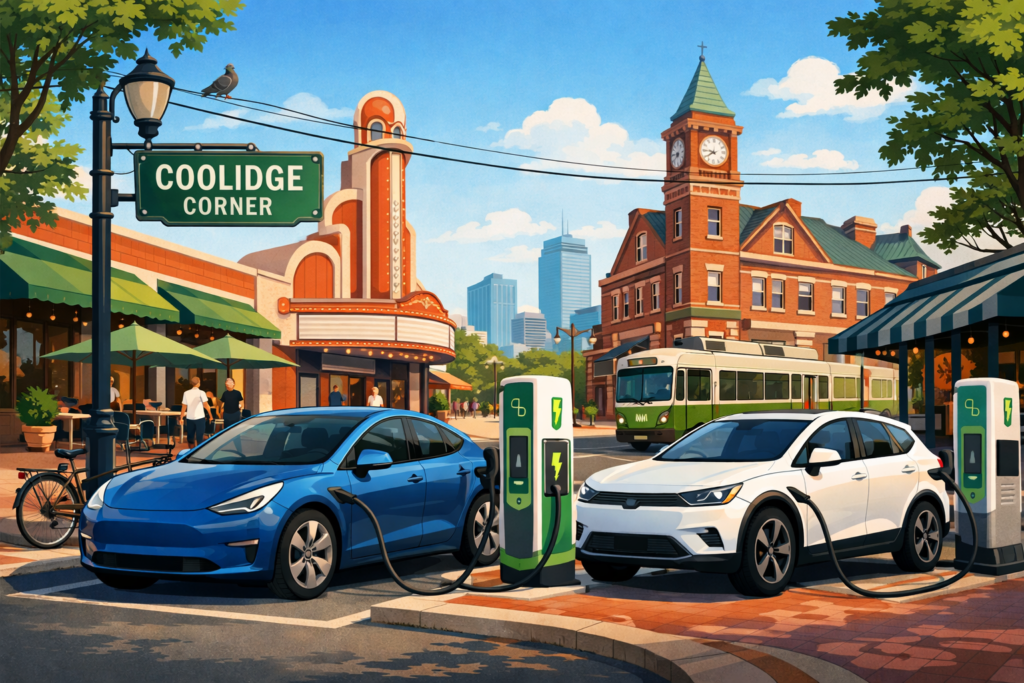
When public infrastructure fails to meet demand projections, it often signals a mismatch between planning assumptions and actual market behavior. Brookline’s decision by third-party operator Greenspot to temporarily shut down 24 of its 34 EV charging ports across two municipal parking lots reflects a sobering reality: even in a progressive, affluent suburb with strong environmental values, public EV charging demand has underperformed expectations. For real estate stakeholders, this development raises questions about the value proposition of proximity to public charging infrastructure and whether private, property-level charging will become the decisive amenity for EV owners.
Greenspot will reduce charging capacity at the Fuller Street Lot near Coolidge Corner from 20 ports to 6, and at the Kent/Webster Lot in Brookline Village from 14 ports to 4. The reduction affects 39% of Brookline’s total 62 public charging stations and stems from Greenspot’s business strategy rather than a town directive, according to Dan Murphy, Brookline’s director of engineering and transportation. The chargers were installed in late 2023 with support from Eversource. Meanwhile, the town has moved toward direct ownership of new charging infrastructure, establishing a revolving fund in May 2025 to ensure user fees cover operational costs without drawing from the general budget.
What Buyers and Condo Owners Should Watch
The pullback in public charging capacity may accelerate demand for homes with dedicated garage or driveway charging access. National data shows that Level 2 home charging remains the primary refueling method for most EV owners, with public stations serving as supplements rather than primary sources. In Brookline’s dense, parking-constrained neighborhoods, properties offering private parking with electrical capacity for charger installation may command a premium as EV adoption grows and public options contract.
Single-family buyers: Homes with garages or off-street parking in neighborhoods like Fisher Hill and Chestnut Hill may see incremental value gains if EV ownership accelerates, particularly if public charging remains unreliable or inconvenient for daily use.
Condo associations: Buildings without dedicated parking or electrical infrastructure for charger installation face a growing competitive disadvantage, especially in newer construction markets where EV readiness is increasingly standard; associations should evaluate the cost and feasibility of common-area charging before demand from unit owners intensifies.
Renters and landlords: Multifamily properties in transit-oriented locations like Coolidge Corner historically relied on nearby public charging as a selling point, but the reduction in Fuller Street capacity may shift tenant expectations toward buildings that offer on-site charging or proximity to the remaining town-owned stations priced at $0.25 to $0.35 per kilowatt-hour.
The Economics Behind the Pullback
Greenspot’s pricing structure – $0.40 to $0.45 per kilowatt-hour with dynamic adjustments for peak periods—sits at the high end of Massachusetts’ recommended range and reflects the challenging economics of public charging. McKinsey analysis shows that fast-charging stations typically require utilization rates of 15% to 20% to break even, yet national averages hovered around 7.5% in 2022. Town-owned chargers, priced lower to encourage adoption, may face similar utilization challenges unless demand increases substantially.
Investors in mixed-use properties: Buildings incorporating retail or office space near remaining public charging hubs may retain modest foot-traffic advantages, but the pullback suggests that charging infrastructure alone is unlikely to drive material tenant demand or lease premiums without broader EV adoption in the local market.
Developers and planners: The gap between installed capacity and actual usage underscores the risk of overbuilding charging infrastructure based on adoption forecasts rather than demonstrated demand; future projects should prioritize flexible, scalable installations that can adjust to actual utilization patterns rather than fixed, high-capacity deployments.
Source: Brookline.News
About Elad Bushari
Elad Bushari is an Executive Vice President at Compass and a leading Brookline, Massachusetts real estate agent with over $1 Billion in career sales and 22+ years of experience. He represents buyers, sellers, landlords, tenants and developers across Brookline's most sought-after neighborhoods, including Coolidge Corner, Fisher Hill, Chestnut Hill, Washington Square, and Brookline Village.
A former Inc. 5000 founder and REALTOR® Magazine "30 Under 30" honoree, Elad specializes in luxury single-family homes, condominiums, and multi-family investments throughout Greater Boston. His data-driven approach and deep local knowledge help clients navigate Brookline's competitive market with confidence.
Elad Bushari's Profile