
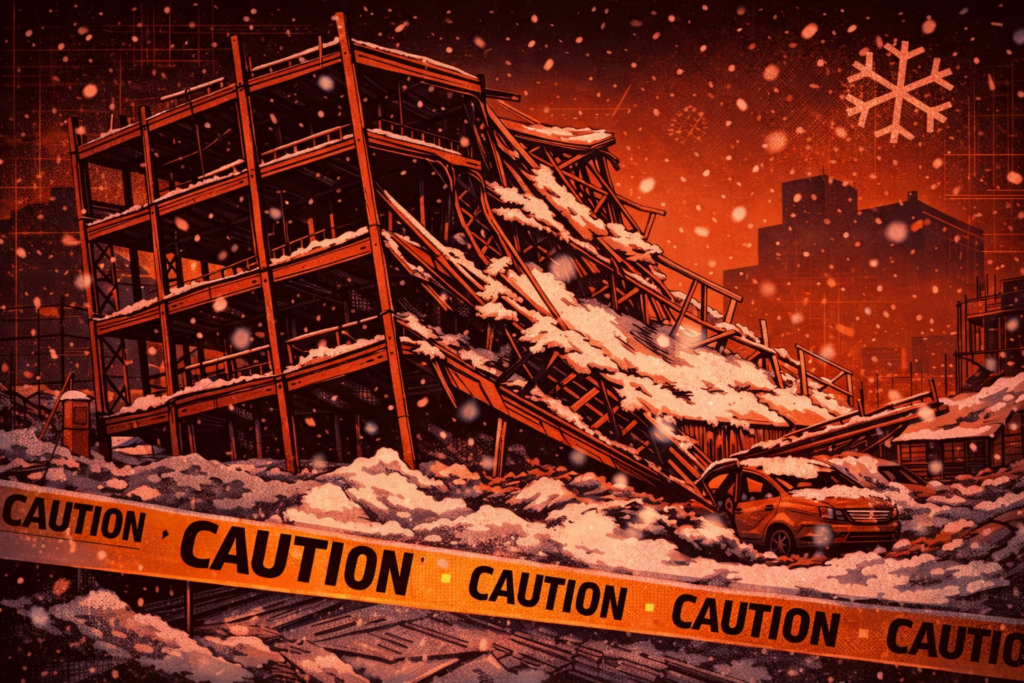
On February 16, 2025, the top two floors of a three-story apartment building under construction at 50 Vernon Street collapsed, crushing a parked vehicle. Officials attributed the failure to heavy snow accumulation during winter weather. For Brookline property owners and developers, the incident underscores a practical reality: winter weather risk during construction is not hypothetical.
What Caused the Vernon Street Collapse?
The collapse occurred around 9:30–10:00 a.m. on Sunday, February 16, 2025, when the top two floors gave way under what officials described as likely heavy snow piled on the construction site. Brookline’s design ground snow load standard is 40 psf, with a minimum flat roof snow load of 30 psf, but wet, compacted snow from late-winter storms can easily exceed design assumptions—especially on structures with compromised drainage or temporary bracing.
Implications for Developers and Contractors
Snow load management during construction must account for real-world accumulation, not just code minimums. Verify that construction management plans include documented snow removal protocols and confirm temporary roof bracing meets structural engineer sign-off.
Builder’s risk insurance should explicitly name winter weather as a covered peril. The Vernon Street incident demonstrates that standard coverage may not address interim construction phase vulnerabilities during severe weather events.
Implications for Property Owners and Landlords
Brookline’s aging residential stock often undergoes phased additions or gut rehabs. Properties near Coolidge Corner and similar corridors require licensed structural engineer sign-off on interim safety, not just final design approval.
Landlords managing multi-unit properties face heightened liability exposure in winter. The Building Department documented over 70 reports of roof collapses or potential structural damage from snow and ice in a 36-hour period, indicating systemic winter weather risk across the town.
Documented snow removal schedules and mid-winter roof inspections reduce negligence claims. Massachusetts law requires exterior stairs and fire escapes be kept clear; failure may constitute negligence under state premises liability standards.
Implications for Buyers and Neighboring Owners
Properties post-collapse or post-remediation may carry heightened inspection scrutiny. Buyers of Brookline homes should expect longer inspection periods and requests for engineer certification of structural soundness following nearby construction incidents.
Adjacent structures may face debris, access loss, and precautionary evacuation orders. Review construction management plans filed with the Town and verify loss-of-use coverage in your insurance before nearby construction begins.
Lenders should require proof of continuous builder’s risk insurance and verify construction permits remain valid. Properties in active construction may face insurance lapses, construction loan defaults, or mechanic’s liens if contractors become insolvent.
The 50 Vernon Street incident is a reminder that construction safety in Brookline winters requires vigilance beyond permitting. Winter weather risk is real and manageable with documentation, engineering oversight, and insurance clarity.
Source: Source