
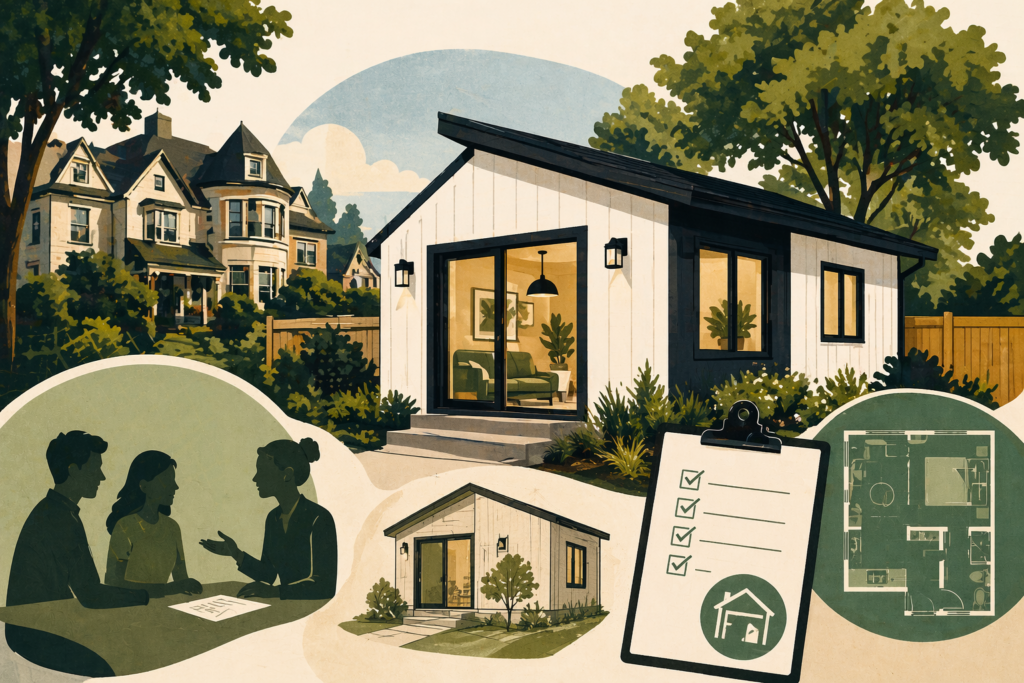
Accessory Dwelling Units, commonly called ADUs, in-law apartments, or “granny flats” – are quietly becoming one of the most important shifts in Brookline’s housing landscape.
They are small in scale. But their impact is not.
Between Massachusetts’ sweeping 2024 housing law and Brookline’s evolving zoning framework, ADUs are moving from a niche concept to a real strategy for homeowners, investors, and families navigating one of the most expensive markets in the country.
This is not just a zoning story.
It’s a supply, lifestyle, and long-term value story.
Accessory dwelling units have moved from zoning curiosity to practical reality in Massachusetts, but Brookline homeowners face a more complicated landscape than the statewide headlines suggest. While state law allows ADUs up to 900 square feet by-right as of February 2, 2025, local zoning uncertainty lingers – and that gap matters if you’re evaluating whether an ADU project pencils out on your property.
A recent analysis argues that ADUs offer a neighborhood-friendly path to increase Boston-area housing supply while creating rental income and property value upside for owners, with particular relevance in high-demand markets like Coolidge Corner, Washington Square and Chestnut Hill. The premise is sound: small-scale infill avoids the political friction of large developments and taps underutilized space in single-family zones.
What Is an ADU (and Why It Matters in Brookline)
An ADU is a self-contained residential unit located on the same property as a primary home, typically with its own kitchen, bathroom, and entrance.
In Brookline, that can take several forms:
- A finished basement apartment
- A converted garage or carriage house
- An addition attached to the main home
- In some cases, a detached backyard structure
The appeal is straightforward:
- Rental income
- Multigenerational living
- Flexible use (office, guest suite, caregiver housing)
But in a town like Brookline, where land is constrained and prices are high, the deeper value is this: ADUs allow incremental housing growth without changing neighborhood character.
The Zoning Gap Brookline Sellers and Buyers Must Navigate
Single Family Sellers: Legal ADU potential may now justify premium pricing or attract investor-profile buyers, but you should disclose ADU feasibility, basement ceiling height, lot configuration, setback compliance – in listing materials rather than leave buyers to discover constraints during due diligence. In Fall 2024, the Massachusetts Attorney General disapproved sections of Brookline’s town-adopted ADU by-law, so local zoning text may still contain conflicting language even though state law pre-empts it.
Buyers: ADU rental income could offset your mortgage, or the unit can house an aging parent or adult child, but construction timelines run six to twelve months and detached ADUs cost $250,000 to $350,000 even with MassHousing’s new loan program offering up to $250,000 at 5.25 percent. Budget for pre-development – design, permits, site surveys – before you close, and confirm your lender will count ADU income in debt-service calculations.
Landlords with two- or three-family properties in Coolidge Corner or Brookline Village: Detached ADUs now permitted by-right may unlock value on properties with rear yard space, but Brookline lots are smaller and more expensive than nearby suburbs, and required setbacks may not fit on many parcels. Consult Town planning staff for written pre-permit review rather than assume all prior restrictions are void, especially given the Attorney General’s recent disapproval.
In practice, this means buyers and sellers are operating in a hybrid system—where state law allows more than local zoning text currently reflects, creating real uncertainty in permitting.
Can I add an ADU to my Proprety?
In Brookline, ADU feasibility is highly property-specific and should be evaluated early as part of any purchase or listing strategy. The strongest candidates tend to be single-family homes or small multi-family properties with unfinished basements, existing secondary structures like garages, or sufficient lot capacity, particularly in areas like South Brookline where zoning constraints are less restrictive.
Buyers and owners should focus on whether the unit can qualify as a “by-right” or protected ADU (generally under 900 square feet or 50% of the main home), as this significantly reduces permitting risk. Key factors include the ability to create a separate entrance, adequate ceiling height and natural light for basement conversions, compliance with setback and floor area ratio limits, and the capacity to upgrade utilities such as electrical, plumbing, and HVAC systems. While additional parking is often not required, practical usability and neighborhood expectations still matter. Financially, most ADUs in Brookline cost between $150,000 and $400,000+ depending on scope, with rental potential typically supporting long-term tenancy.
For example, a typical Coolidge Corner single-family with a partially finished basement may appear to be a strong ADU candidate, but ceiling height, lack of egress, or FAR limitations often push renovation costs into the $250K+ range—changing the economics entirely.
Importantly, ADUs should be viewed less as a pure investment play and more as a flexibility and lifestyle enhancement that can improve a property’s long-term appeal and marketability, particularly for multi-generational buyers or those seeking supplemental income.
What Property Owners Should Ask Before Committing
State estimates suggest 8,000 to 10,000 ADUs could be constructed across Massachusetts over the next five years, but Brookline’s permitting cycle may stretch six to twelve months, and local design review remains stricter than in surrounding towns. Detached ADUs in Brookline may reach 22 feet in height with a maximum of 1.5 stories, an increase from the prior 15-foot limit, yet site constraints – especially in denser pockets near Washington Square – often make interior conversions (basement, attic) more feasible than detached units.
Developers and small builders: Work with local zoning counsel and obtain a pre-application meeting with Brookline Planning & Zoning before you purchase a site; expect slower approval timelines than MBTA communities, and weigh whether Boston or nearby suburbs offer faster paths if your project is timeline-sensitive. Market fundamentals remain strong, average rent in Brookline is $3,710 per month, but regulatory clarity lags demand.
ADUs may eventually add modest supply to Brookline’s constrained housing inventory, but the near-term reality for homeowners is more nuanced than statewide headlines suggest. Verify compliance with both state law and any remaining local restrictions before you commit capital, and treat ADU feasibility as a due-diligence item rather than an assumed feature of single-family ownership.
In Brookline, ADUs are not automatic upside, they are a strategic advantage for the small subset of properties where zoning, layout, and cost align. Identifying those properties early is where real value is created.
Related reading: Brookline May 2026 Election: What Homeowners Need to Know.