
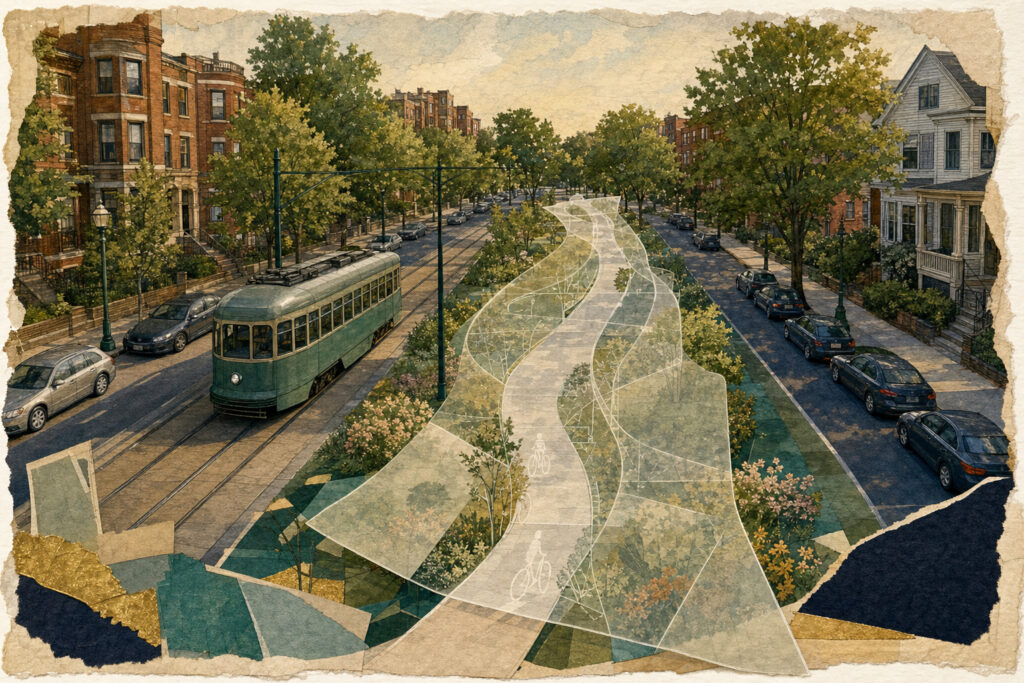
A future protected path along Beacon Street’s median could reshape how buyers, sellers, and landlords think about access, parking, and transit in one of Brookline’s most visible corridors. But the project remains in detailed design, not construction, and the timeline, final configuration, and property impacts are all prospective rather than settled.
The original reporting confirms that Brookline’s Beacon Street Bridle Path is progressing through design, with public engagement expected in 2027. Coordination with the MBTA and a change in surveying contractors have delayed the schedule. The project envisions a protected, median-based walking and bicycling route supported by federal and local funding.
What Is the Current Status of Brookline’s Beacon Street Bridle Path?
The Town of Brookline is working with Toole Design Group to restore and repurpose the historic Beacon Street median as a two-way, multi-use path for pedestrians, cyclists, and other non-motorized users. The project area runs the length of Beacon Street within Brookline, from Ayr Road to Saint Mary’s Street. Town Meeting adopted a resolution in 2018 to study feasibility.
According to Town budget documents, the project has $2 million in federal funding associated with a congressional earmark and $1 million in Town funding. The federal funding is administered through MassDOT as a reimbursable grant, and the Town’s funding is intended to bring project design to 75% completion. Construction is anticipated to be funded through the State Transportation Improvement Program.
Public-engagement meetings are expected in 2027 according to recent reporting, although specific dates had not been decided as of that publication.
How the Proposed Path Could Affect Beacon Street Properties
The planned path would be coordinated with the MBTA Green Line C Branch corridor. The project concept includes a shared-use path, landscaping, green infrastructure, access between parking and station platforms, and possible parking reconfiguration. Beacon Street conditions differ substantially between areas near Cleveland Circle, Washington Square, Coolidge Corner, and the Boston/Brookline edge.
A safer, more connected corridor may become a meaningful amenity, but the benefit remains prospective while the project is in design.
Sellers with Beacon Street listings should expect questions about future parking, construction disruption, station access, and path alignment rather than treating the proposal as a finished amenity.
The project may affect perceptions of locations near C Branch stations, although construction timing and final design remain uncertain.
Improved station and pedestrian connections could influence rental demand, while temporary construction or parking changes could create short-term objections for landlords near Beacon Street stations.
Buyers should distinguish proximity to Beacon Street from proximity to a specific station entrance, because walking routes and crossings can vary by block.
Parking is a practical Brookline negotiation issue; any future median, curb, or station-access changes may matter to condominium and multifamily buyers.
The path would provide additional transportation options for those evaluating Beacon Street access and connectivity.
Properties along the corridor may see increased interest as multimodal infrastructure develops, though timing remains uncertain.
What Buyers and Sellers Should Watch
Those comparing Beacon Street with quieter interior streets: The project may improve active-transportation convenience, but traffic, transit noise, and street activity will remain relevant tradeoffs—visit at different times and evaluate the specific block rather than relying on the project label.
Sellers whose properties depend on curbside or angled parking: Potential parking reconfiguration may affect buyer objections and showing questions—verify the current parking arrangement and avoid promising that future parking impacts are settled.
Buyers evaluating station proximity: The path alignment and station access improvements could change walking patterns and convenience, but final design details have not been released.
Those comparing Green Line-accessible locations: Beacon Street offers different tradeoffs than other Brookline neighborhoods with transit access—the path adds another variable but doesn’t change underlying corridor characteristics.
Landlords near construction zones: Phased construction could create temporary access or parking disruptions that affect tenant satisfaction and lease negotiations.
Investors evaluating long-term corridor value: Improved pedestrian and cycling infrastructure may enhance property appeal, but construction timeline and funding remain subject to state and federal processes.
Public engagement should be treated as a source of potential design changes, not as evidence that construction has been authorized or scheduled.
Source: Source