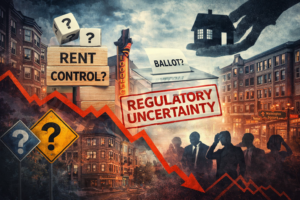
New executive orders aimed at housing affordability are getting support from the National Association of REALTORS®. But in a market like Brookline - where supply constraints are hyper-local - the real impact may be more nuanced than the headlines suggest.

A National Solution to a Local Problem
The White House’s recent executive orders targeting housing affordability are built around a familiar premise: increase supply and improve access to financing. The National Association of REALTORS® (NAR) responded with measured support, emphasizing that affordability challenges are rooted less in borrowing costs and more in a fundamental imbalance between supply and demand.
As NAR put it, the crisis is “fundamentally a supply problem”.
At a national level, that diagnosis is difficult to dispute. But Brookline is not a national market. It is a tightly controlled, hyper-local ecosystem where supply is not simply slow – it is structurally constrained.
Brookline by the Numbers: A Market Defined by Scarcity
To understand how federal policy translates locally, you have to start with the data.
Brookline remains one of the most expensive housing markets in Greater Boston:
- Median home values sit around $1.1M–$1.8M depending on methodology and segment
- Single-family homes averaged over $3.1M in 2025
- Condo averages in February were $1.14M, with wide variation by location and condition
Even more telling is what’s happening beneath the surface.
Inventory remains constrained. As of early 2026, Brookline typically has roughly 80–120 active listings at any given time, depending on seasonality . Months of supply sit well below balanced-market levels, reinforcing what agents already know: this is still a seller-influenced environment.
At the same time, the market is no longer moving at pandemic speed. Homes now take:
- Roughly 35–60 days to go pending in many segments
- Up to 80+ days in slower winter conditions or selective segments
This is not a collapsing market – it is a selective one.
Buyers are still paying high prices. They’re just taking longer to decide.
The Illusion of Federal Supply Solutions
The executive orders aim to reduce regulatory friction and encourage new construction. In theory, that should increase supply and improve affordability.
In practice, Brookline operates under a different set of rules.
The town has a long history of restrictive zoning and resistance to large-scale development. Multifamily construction has been limited for decades, and proposals frequently face delays, redesigns, or outright opposition.
That creates a structural bottleneck:
- Federal policy can encourage building
- But Brookline controls whether building happens
And historically, the answer has often been: not much.
Mortgage Access: Helpful, But Not a Game Changer
The second pillar of the executive orders focuses on mortgage lending – loosening constraints, supporting lenders, and improving access to credit.
This matters nationally. It matters less in Brookline.
In many parts of the country, affordability is constrained by access to financing. In Brookline, it is constrained by price itself.
Consider the reality:
- Median prices near or above $1.5M
- Entry-level condos often require household incomes well into six figures
- A meaningful share of buyers bring equity, cash, or high-income profiles
Lowering mortgage friction may expand the buyer pool at the margins. But it does not fundamentally change who can afford to compete here.
A Market in Transition – Not Correction
Recent data shows a market adjusting, not weakening.
Transaction volume has dropped sharply in certain months – February 2026 brookline Market Report shows a 72% year-over-year decline in sales activity – but that tells only part of the story.
At the same time:
- Price per square foot has continued to rise
- Median and average prices fluctuate based on what sells, not necessarily declining demand
- Inventory remains tight enough to sustain pricing power
This is a classic Brookline pattern:
Lower volume does not equal lower values
It reflects selective buyers in a constrained market
Where Federal Policy Could Actually Show Up
While the direct impact of these executive orders may be limited locally, their influence could emerge in more subtle ways.
First, there is the psychological effect. When affordability becomes a national priority, it shapes expectations. Buyers feel urgency when rates improve. Sellers adjust pricing strategies when demand signals shift.
Second, there is pressure – political and economic – on municipalities like Brookline. If federal efforts to increase supply continue, local governments will face increasing scrutiny over zoning, density, and development approvals.
That is where real change would happen. Not in Washington, but in town halls.
The Core Tension: Affordability vs. Exclusivity
Brookline sits at the center of a broader housing contradiction.
The goal of federal policy is to expand access to homeownership. But Brookline’s value – its schools, proximity, walkability, and character – is reinforced by limited supply.
That creates a tension:
- Increasing supply could improve affordability
- But it could also challenge the very factors that sustain long-term property values
This is not just a policy question. It is a local identity question.
What This Means for Brookline Buyers and Sellers
For buyers, the takeaway is straightforward. Federal policy is unlikely to materially reduce prices in the near term. The primary constraint remains inventory, not financing. Opportunities will continue to emerge – but selectively, and often with competition.
For sellers, the environment remains favorable. Even with longer marketing timelines, demand is intact, and pricing remains supported by structural scarcity.
Bottom Line
The federal government is attempting to solve a national housing problem with tools aimed at supply and financing.
NAR is correct: affordability is, at its core, a supply issue.
But in Brookline, supply is not dictated by federal policy. It is dictated by local decisions, local resistance, and local priorities.
Until those change, affordability will remain a national objective—and a local limitation.
FAQ
Will federal housing policy lower prices in Brookline?
Unlikely in the short term. Prices are driven by local supply constraints and high demand.
Is Brookline becoming more affordable?
Marginally at best. Slight increases in inventory and longer days on market reflect balance – not a shift toward affordability.
What would actually change affordability in Brookline?
Zoning reform, increased density, and faster permitting – not federal mortgage policy.
Is now a good time to buy?
It depends on strategy. The market is more selective, which creates opportunities – but pricing remains elevated.
Source: NAR
Related policy context: The ROAD to Housing Act: A Federal Shift That Could Quietly Reshape Brookline Real Estate and Brookline’s Rent Control Bill Is the Wrong Answer to a Real Housing Problem.
About Elad Bushari
Elad Bushari is an Executive Vice President at Compass and a leading Brookline, Massachusetts real estate agent with over $1 Billion in career sales and 22+ years of experience. He represents buyers, sellers, landlords, tenants and developers across Brookline's most sought-after neighborhoods, including Coolidge Corner, Fisher Hill, Chestnut Hill, Washington Square, and Brookline Village.
A former Inc. 5000 founder and REALTOR® Magazine "30 Under 30" honoree, Elad specializes in luxury single-family homes, condominiums, and multi-family investments throughout Greater Boston. His data-driven approach and deep local knowledge help clients navigate Brookline's competitive market with confidence.
Elad Bushari's Profile