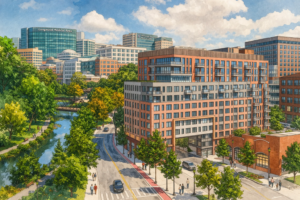
May Town Meeting will decide a 27.8-acre Route 9 overlay that could reshape Chestnut Hill's skyline—and property tax burdens across Brookline.
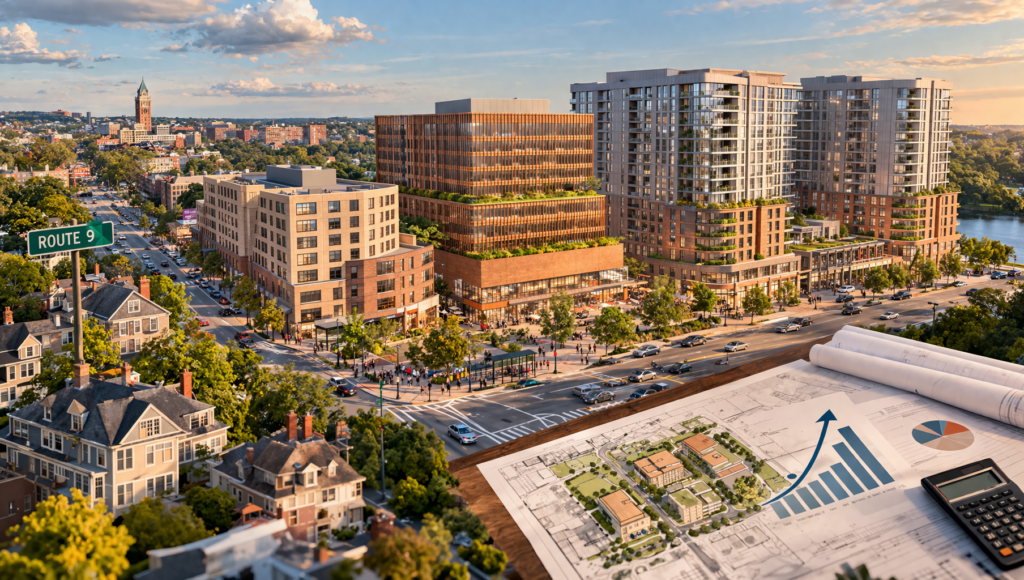
Brookline’s May Town Meeting will vote on a rezoning proposal that could fundamentally alter the Route 9 corridor – and with it, the calculus for buyers, sellers, and homeowners across town. The outcome will determine whether the town gains significant commercial tax revenue or faces a wave of Chapter 40B residential projects that bypass local design review.
The Select Board is advancing a rezoning vote for May 2026 Town Meeting following resolution of objections from an adjacent property developer. The project at 1280–1330 Boylston Street involves City Realty’s mixed-use proposal with buildings ranging from 7 to 14 stories and an estimated commercial tax benefit of $5 million annually. The proposed Chestnut Hill Commercial Overlay District covers approximately 27.8 acres over six blocks along Route 9 between Hammond Street and Hammond Pond Parkway.
The Zoning Envelope and What It Allows
The proposed overlay would permit buildings up to 150–175 feet (approximately 12–14 stories) on some parcels, with heights tapering lower toward Newton. City Realty, which acquired the 5.34-acre Chestnut Hill Office Park for $41 million in May 2024, has proposed up to 887,000 square feet of development comprising 400,000 square feet of commercial space, 270 residential units, and 204 hotel rooms. Approval requires a two-thirds majority vote of Town Meeting, and forty-two Town Meeting members from South Brookline have already registered formal opposition.
The Chapter 40B Alternative Looming Over Negotiations
If the overlay fails, City Realty has already filed applications for Chapter 40B Project Eligibility Letters proposing two residential developments with a combined 783 multifamily units—540 units in 12-story buildings on the eastern parcel and 243 units in 7-story buildings on the western parcel. This alternative would bypass design review, deliver no commercial tax revenue, and intensify residential density without the mixed-use character town planners envisioned. The threat is credible: Brookline narrowly exceeded the 10% affordable housing threshold required under Chapter 40B’s safe-harbor provision as of November 2025, leaving limited margin for error.
What Buyers and Homeowners Should Watch
Buyers near Chestnut Hill and South Brookline: Properties within a half-mile of the overlay district may experience perception shifts depending on the Town Meeting outcome; current uncertainty may suppress buyer appetite until the vote resolves, and post-vote clarity could drive either increased interest if commercial tax revenue strengthens neighborhood services or hesitancy if traffic and height concerns materialize.
Property taxpayers across Brookline: The project is estimated to generate approximately $5 million in net annual commercial tax receipts once fully operational, and this revenue matters because Brookline is considering a property tax override of approximately $24 million—potentially the largest in Massachusetts state history—so a failed rezoning vote may signal higher property tax trajectories and increased effective tax burdens on owner-occupants.
Sellers of Chestnut Hill homes: Be prepared to address neighborhood change questions with buyers who may have concerns about future density, traffic patterns, and school capacity; the May vote will provide clarity that could either validate or dispel those concerns.
Commercial developers and investors: Monitor Town Meeting voting patterns closely, because failure to pass overlay zoning in May will likely accelerate a Chapter 40B application wave within 6–12 months, reducing town planning control and shifting the corridor toward residential-only intensification.
Source: Brookline.news
About Elad Bushari
Elad Bushari is an Executive Vice President at Compass and a leading Brookline, Massachusetts real estate agent with over $1 Billion in career sales and 22+ years of experience. He represents buyers, sellers, landlords, tenants and developers across Brookline's most sought-after neighborhoods, including Coolidge Corner, Fisher Hill, Chestnut Hill, Washington Square, and Brookline Village.
A former Inc. 5000 founder and REALTOR® Magazine "30 Under 30" honoree, Elad specializes in luxury single-family homes, condominiums, and multi-family investments throughout Greater Boston. His data-driven approach and deep local knowledge help clients navigate Brookline's competitive market with confidence.
Elad Bushari's Profile