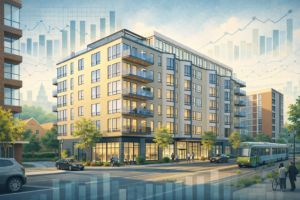
A vacant office building near the Green Line becomes four luxury condos instead of 18 apartments - an example of how Brookline’s cumbersome process can shrink housing supply and affordability.

A vacant office building at 1093 Beacon Street is being converted into four luxury condominiums instead of the previously planned 18 smaller apartments, a shift that underscores the tension between market-rate development and Brookline’s affordable housing goals. The property was sold for $6.2 million in 2024 to developer Matt Ramey of Concept Properties, and the Zoning Board of Appeals held a public hearing on December 18, 2025. Each unit will occupy a full floor with four bedrooms, four bathrooms, and private elevator access, ranging from 1,800 to 2,600 square feet. For developers, buyers, and housing advocates, the project illustrates how conversion economics in high-transit corridors often favor luxury concentration over workforce density.
Why the Shift from 18 Units to Four Matters
The original owners, Mark Blotner and Lloyd Rosenthal, who purchased the property in 2005 for $2.5 million, initially envisioned 18 apartments – primarily studios and one-bedrooms. After the sale to Concept Properties, the plan pivoted to four floor-through luxury condos. The 14,985-square-foot, four-story brownstone sits at the corner of Beacon and Hawes Streets in the Longwood neighborhood, a National Registry Historic District with strong transit access and walkability. The project preserves the building’s historic masonry and exterior details while converting 32 office units into residential use, with ground-floor commercial office space retained.
Developers considering office-to-residential conversions: Market economics in Brookline’s transit corridors increasingly favor larger, high-end units over workforce density. A four-unit luxury project generates substantially more revenue per square foot than 18 smaller apartments, but expect Planning Board scrutiny and public opposition even after Zoning Board approval – this project received a Planning Board denial letter before moving forward.
Condo buyers seeking luxury inventory near transit: New floor-through units with private elevators will compete directly with existing high-end Longwood homes and may offer an alternative to single-family maintenance for move-up buyers and empty-nesters. Monitor comparable sales in Concept Properties’ pipeline to gauge pricing expectations for this rare product type in Brookline.
Brookline’s Review Process Is Producing the Opposite of What It Wants
Brookline says it wants more housing – especially more attainable and deed-restricted housing – but too often the process functions like a grinder that rewards the safest, least productive outcome. When a project sits for months (or years) in iterative review – especially in historic contexts – carrying costs don’t pause. Interest, taxes, design fees, legal, and opportunity cost accumulate every single day. At a certain point, the math stops working, and developers don’t “adjust” their plans – they abandon them, downsize them, or design around the thresholds.
This is exactly where policy goals get undermined. The more complex and time-consuming the approvals become – whether driven by historic oversight, accessibility compliance (ADA/MAAB), or serial redesign cycles – the more incentive there is to pivot to fewer, larger units that can absorb the friction. In practice, that can mean the Town doesn’t just slow down housing production; it unintentionally deletes it. In this case, Brookline effectively traded a higher-unit plan (with meaningful affordable potential) for a lower-unit luxury plan – likely costing the community roughly three affordable units that could have existed under a larger program.
If Brookline wants different outcomes, it needs a different posture: work with serious developers early, define clear non-negotiables up front, coordinate boards so requirements don’t conflict, and compress timelines so the carrying-cost spiral doesn’t kill the project. A predictable process doesn’t “give away the store” – it produces more units, more affordability, and a better built environment. Everyone wins when the rules are clear, consistent, and fast enough that projects can actually get to the finish line.
What Sellers of Older Office Buildings Should Consider
The sale price of approximately $418 per square foot reflects strong developer appetite for adaptive reuse in high-transit locations. Properties with good light, high ceilings, and proximity to the Green Line attract investors willing to pay premiums because residential conversion unlocks more value than holding as office. Landlords with dated office buildings should evaluate highest-and-best-use scenarios early, particularly in neighborhoods like Longwood, Coolidge Corner, and Brookline Village, where zoning and transit access support residential conversion.
Renters seeking affordable units: The shift from 18 apartments to four condos eliminates 14 potential rental units in a supply-constrained market. Brookline’s Section 4.08 affordable housing bylaw requires 15% of units as affordable in conversion projects with four or more units, but a four-unit project triggers only 0.6 affordable units – typically satisfied via cash contribution rather than on-site units.
Housing advocates and town planners: This project illustrates the gap between policy intent and market outcomes. The 15% affordable requirement does not meaningfully expand supply when developers design around the four-unit threshold. Town officials may need to revisit affordability trigger thresholds, in-lieu contribution amounts, or density incentives to align developer economics with Brookline’s housing goals.
Broader Implications for Brookline’s Housing Supply
Office-to-residential conversions are likely to continue along Beacon Street and other MBTA corridors, driven by strong buyer demand for walkable, transit-oriented living. However, the economics of luxury development may limit the supply of smaller, more affordable units. Developers, landlords, and policymakers should watch whether future conversion projects follow similar patterns—and whether Brookline’s regulatory framework evolves to encourage greater unit diversity in adaptive reuse projects.
Source: Brookline.News
About Elad Bushari
Elad Bushari is an Executive Vice President at Compass and a leading Brookline, Massachusetts real estate agent with over $1 Billion in career sales and 22+ years of experience. He represents buyers, sellers, landlords, tenants and developers across Brookline's most sought-after neighborhoods, including Coolidge Corner, Fisher Hill, Chestnut Hill, Washington Square, and Brookline Village.
A former Inc. 5000 founder and REALTOR® Magazine "30 Under 30" honoree, Elad specializes in luxury single-family homes, condominiums, and multi-family investments throughout Greater Boston. His data-driven approach and deep local knowledge help clients navigate Brookline's competitive market with confidence.
Elad Bushari's Profile
Filed under: