City Realty's Chapter 40B residential fallback could reshape Chestnut Hill if commercial rezoning stalls. What it means for buyers and the market.

A 5.34-acre office park on Route 9 has become the flashpoint for a familiar Brookline tension: the town wants commercial tax revenue, but a developer holds a credible residential 40B card if rezoning talks collapse. City Realty’s dual-track strategy—pursuing a mixed-use commercial project while simultaneously filing Chapter 40B eligibility letters for 784 residential units—illustrates how state housing law continues to shape local development outcomes, even in towns that have crossed the 10% affordability threshold.
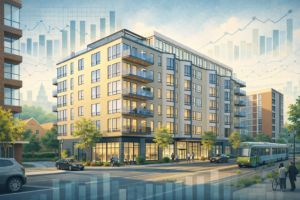
City Realty acquired the Chestnut Hill Office Park at 1280-1330 Boylston Street in May 2024 for $41 million. The developer has proposed a mixed-use vision including a 20-story hotel-and-condominium tower and medical offices that could generate $9 million in annual property tax revenue. But rezoning recommendations won’t arrive until Spring 2026 Town Meeting. Meanwhile, the 40B filing—proposing two seven-story buildings with 243 units and two 12-story buildings with 540 units, 25% affordable—offers the developer leverage and an alternative path forward if commercial approvals stall.
What Buyers and Investors Should Watch
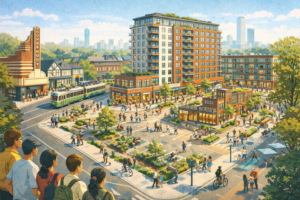
The outcome at this site will likely determine whether Chestnut Hill gains a mixed-use commercial anchor or becomes home to nearly 800 new apartments. Either scenario reshapes the neighborhood, but the implications differ sharply for buyers considering nearby properties.
Condo buyers near Route 9: A commercial outcome may bring retail amenities and walkability improvements that support values, while a residential tower adds supply and density that could pressure pricing in competing buildings—particularly older Chestnut Hill condos without recent updates.
Single-family buyers in South Brookline: Watch whether 784 new rental units shift demand patterns; renters who might have considered South Brookline apartments may find new options closer to transit, potentially easing rental competition but adding traffic and school enrollment pressure if family-sized units materialize.
Investors evaluating multifamily properties: A large-scale 40B approval would introduce institutional-grade rental supply with below-market units, likely compressing rents in older walk-up buildings within a half-mile radius and making small multifamily acquisitions in the corridor more sensitive to pro forma assumptions.
Sellers timing listings near the corridor: If rezoning advances and commercial construction begins, expect a multi-year period of disruption and uncertainty before amenities arrive; listings may benefit from moving before demolition starts or waiting until retail tenants are announced and leasing begins.
Why the 40B Threat Still Works Above 10%
Brookline crossed the 10% affordability threshold as of November 2025, reaching 10.76%, which theoretically gives the town discretion to deny 40B applications. But developers still file because municipal politics and fiscal priorities create openings. A town that wants commercial development may approve a residential 40B rather than face protracted litigation or risk losing both outcomes. The leverage comes not from overriding local zoning, but from offering the path of least resistance when rezoning timelines stretch and community opposition mounts.
City Realty’s strategy is rational: file the 40B eligibility letters now, keep the residential option alive, and let the town decide whether it can deliver rezoning approvals faster than the developer can move a comprehensive permit through MassHousing and the Zoning Board of Appeals. For buyers, the takeaway is simple—large sites in Brookline neighborhoods near transit remain vulnerable to rapid density increases, regardless of current zoning, and purchase decisions should account for that structural uncertainty.
Source: brookline.news
About Elad Bushari
Elad Bushari is an Executive Vice President at Compass and a leading Brookline, Massachusetts real estate agent with over $1 Billion in career sales and 22+ years of experience. He represents buyers, sellers, landlords, tenants and developers across Brookline's most sought-after neighborhoods, including Coolidge Corner, Fisher Hill, Chestnut Hill, Washington Square, and Brookline Village.
A former Inc. 5000 founder and REALTOR® Magazine "30 Under 30" honoree, Elad specializes in luxury single-family homes, condominiums, and multi-family investments throughout Greater Boston. His data-driven approach and deep local knowledge help clients navigate Brookline's competitive market with confidence.
Elad Bushari's Profile
Filed under: Brookline 40B Projects, Route 9 Redevelopment