

Boston’s latest foundation warning has raised an obvious local question: could Brookline face the same kind of hidden structural threat? Public records suggest the answer is more nuanced. Brookline does not appear to have Boston’s documented, large-scale wood-pile problem, but it does face its own below-grade risks tied to former wetlands, culverted streams, shallow bedrock, stormwater pressure, and localized flooding.
A recent Boston 25 News report put renewed attention on one of Greater Boston real estate’s most expensive hidden defects: historic buildings on filled land supported by untreated wood piles that must remain below groundwater to avoid rot. The report said roughly 8,000 Boston buildings may be affected, and that repairs can cost homeowners well over $200,000. The Boston Groundwater Trust describes this as a problem specific to Boston’s historic filled-land neighborhoods, where wood pilings were driven through made land and organic soils and were intended to remain permanently submerged.
That matters because Brookline’s public record points to a different geotechnical story. In the town’s environmental inventory, Brookline is described primarily through glacial geology: drumlins, glacial till, sand and gravel deposits, wetlands, and shallow bedrock. The same document says Brookline’s surface conditions reflect erosion, sedimentation, and human alteration, but it does not frame the town as a Boston-style, filled-land wood-pile district. Based on the public materials reviewed, Brookline’s official concern is less about a known, townwide wood-pile class and more about drainage, runoff, groundwater behavior, and flood-prone low areas. That is an inference from the records, not a blanket guarantee that no individual Brookline property has pile-related risk.
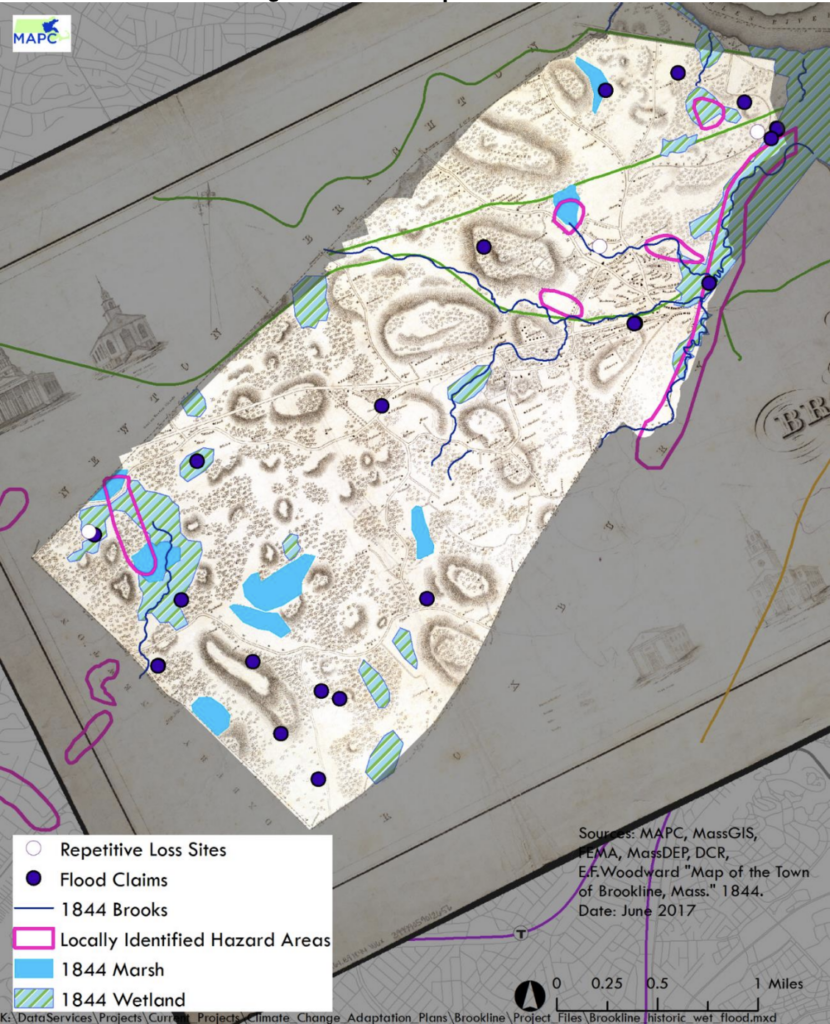
Still, Brookline is not risk-free below grade. Its climate-vulnerability assessment says many of the town’s historic wetlands and ponds were drained and filled over time, and that many former streams now run underground through drainage pipes. The report also notes that Brookline once had nine streams in addition to the Muddy River, with only fragments remaining above ground today. That is important for real estate because former water systems do not disappear simply because they have been paved over, culverted, or forgotten on the surface.
Brookline’s own environmental inventory is even more explicit about how local ground conditions can affect homes. It says that where bedrock lies close to the surface, heavy rain can create flooding because shallow soils cannot absorb enough water; runoff then migrates downslope, and “in many cases, the lowest point may be the basement of a house.” The same document says much of North Brookline consists of urban land complexes with heavy impervious coverage, meaning rainfall is quickly routed into storm drains rather than absorbed into the ground. It specifically points to highly built-up areas such as Washington Square and Coolidge Corner.
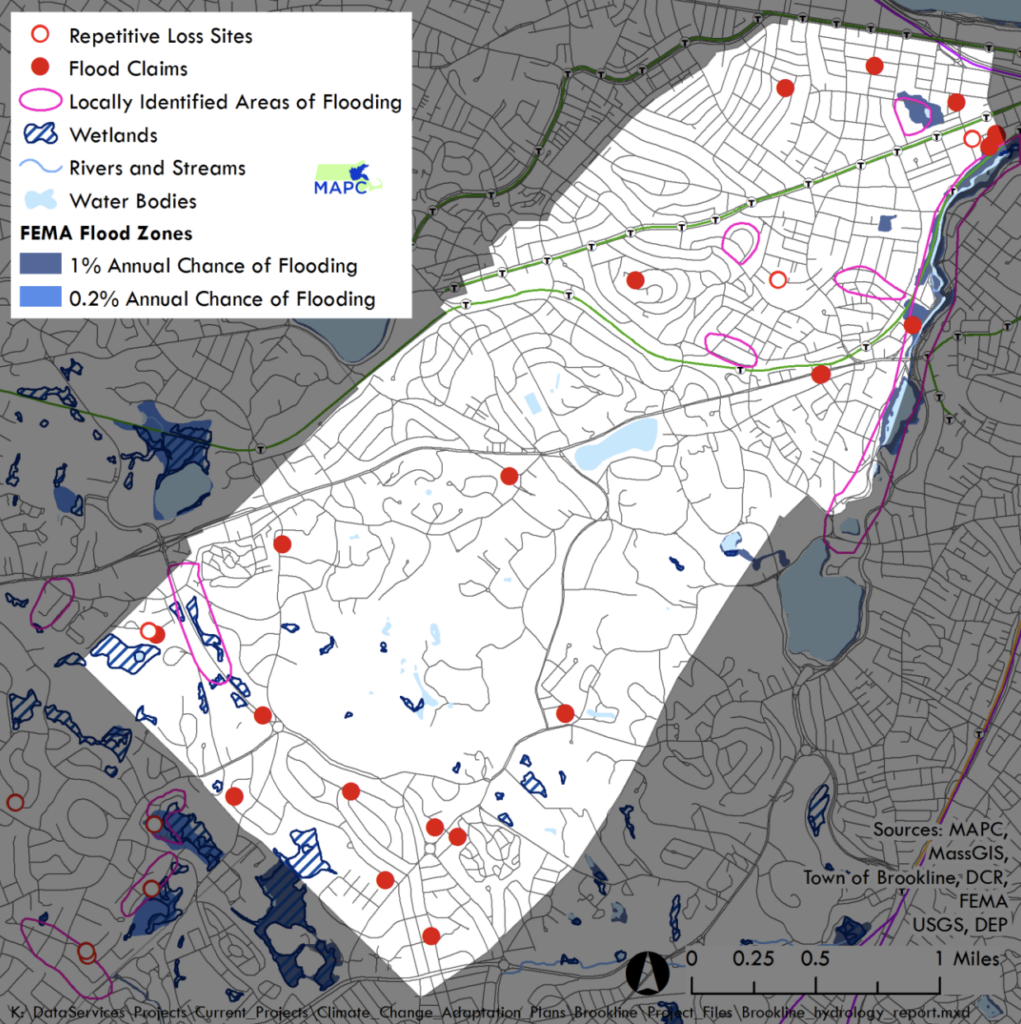
Brookline’s flood history also suggests that buyers should not rely too heavily on FEMA maps alone. The town’s climate report says less than 1% of Brookline’s land area is inside a FEMA flood zone, much of it parkland, yet the same report says damage from the 2010 storm was significantly broader than flood-insurance claims alone would suggest. It states that uninsured claims were nearly fifteen times the number of flood-insurance claims, and that many flood-damage locations were close to former wetlands and waterways even when they were not actually inside mapped FEMA flood zones.
Town government appears to recognize that this is a real infrastructure and property issue. Brookline’s current Stormwater Model and Flood Vulnerability Project is designed to identify areas at risk for flooding, determine causes, and evaluate climate impacts. The project page notes that localized flooding can result from clogged inlets or from pipes that lack sufficient capacity, and it includes Beacon Street flooding as a recent example. The town also notes that updated FEMA flood maps for the region became effective in July 2025.
For the Brookline housing market, the practical implication is not a Boston-style panic over rotting wood piles. It is a growing premium on micro-location and drainage intelligence. In market terms, homes on stronger topography or with proven water-management upgrades may become more attractive, while homes in flatter, historically altered, or repeatedly damp locations may face tougher inspection scrutiny, higher mitigation costs, and more selective buyer demand. That conclusion follows directly from the town’s documentation of former wetlands, culverted streams, shallow-bedrock runoff behavior, and active flood-vulnerability planning.
This is especially relevant for older single-families, brownstones, garden-level condos, and properties with finished basements. The right question is not simply whether a home is in a flood zone. It is whether the site has a history of seepage, water intrusion, sump-pump dependence, foundation patching, retaining-wall pressure, recurring drain backups, or runoff concentration after major rain. Brookline’s public documents strongly suggest that historic landform and buried-waterway patterns still show up in present-day damage locations.
The Boston 25 report is useful for Brookline not because it proves the same crisis exists here, but because it reminds buyers and sellers that some of the most expensive real estate risks are invisible during a sunny showing. In Boston, that hidden risk may be wood piles on filled land. In Brookline, the more credible concern appears to be whether a beautiful older home sits on ground that still behaves like the wet, low, altered landscape it once was.
FAQ
What is Boston’s wood-pile foundation problem?
In Boston’s historic filled-land neighborhoods, many older buildings were supported by untreated wood piles designed to stay below groundwater. If groundwater drops and the tops of those piles are exposed to oxygen, the wood can deteriorate and lead to settlement or structural damage.
Does Brookline have the same issue?
Brookline’s public planning and environmental records do not describe the same large-scale, townwide wood-pile problem that Boston publicly tracks through the Boston Groundwater Trust. The risks identified in Brookline’s documents are different and more localized, centering on former wetlands, culverted streams, shallow bedrock, runoff, and flood vulnerability.
Why can a Brookline home have water or foundation issues even outside a FEMA flood zone?
Brookline’s climate-vulnerability report says many local flood-damage locations were close to former wetlands and waterways even though they were outside mapped FEMA flood zones. The report also says uninsured claims after the 2010 storm far exceeded insured flood claims, suggesting that official flood maps may understate real-world property exposure in some areas.
What should Brookline buyers ask before purchasing an older home or garden-level condo?
Buyers should investigate site drainage, prior water intrusion, sump-pump systems, foundation repairs, basement seepage, recurring storm problems, and whether the property sits in a historically low or altered area. That line of due diligence is consistent with Brookline’s own findings about runoff, shallow bedrock, culverted streams, and localized flooding risk.
Source: Boston 25 News
Related Brookline due diligence: New Massachusetts home inspection law and Brookline school budget cuts guide.